How to spot Meta ad fatigue before it tanks ROAS
 By Dror Aharon
·
CEO, COREPPC
·
Updated April 17, 2026
·
11 min read
By Dror Aharon
·
CEO, COREPPC
·
Updated April 17, 2026
·
11 min read
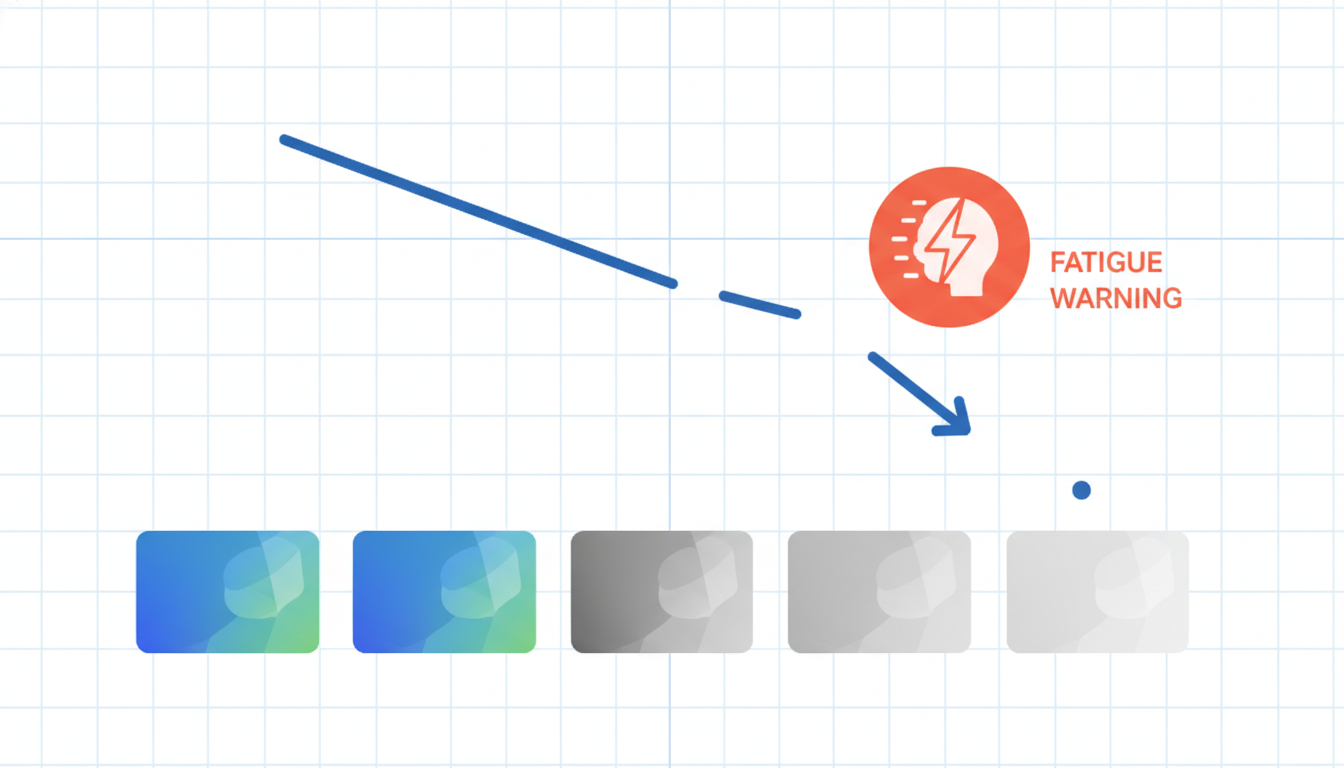
Meta creative fatigue on Shopify is the silent killer of Q3 and Q4 ROAS, and Advantage+ Shopping hides it longer than most operators realize until the floor falls out in one week. By the time CPM spikes and frequency hits 4, the algorithm has already been serving tired creative for 10 to 14 days. What changed in 2026 is that iOS 18 and Android 15 both tightened impression-capping across apps, which pushes effective frequency on any single user up by 20 to 30% vs. 2024. Creative that used to last 21 days in cold prospecting now burns out in 12 to 14. Retargeting creative burns out in 5 to 7. The 7 signals below catch it a week earlier than the dashboard does. Treat creative age distribution like inventory aging, follow the 60/30/10 rule, and swap before the rewrite, not after.
- Watch 3-day CTR decay, not 7-day, on anything over 10 days old.
- Hold 60% of spend on proven creative, 30% on 8 to 14 day old, 10% on brand new.
- Cold prospecting refresh every 14 days. Retargeting every 7. No exceptions.
- Run 3 swap tests before you greenlight a full creative rewrite.
What creative fatigue actually is on Meta in 2026
Meta creative fatigue on Shopify is what happens when a given user has seen the same ad enough times that the click-through rate collapses and the algorithm quietly raises CPM to keep delivery stable. It is not a mystery. It is a frequency curve meeting a cost curve. What changed in 2026 is the shape of that curve. Apple's iOS 18 (shipped late 2024) and Android 15 (2025) both capped impression delivery per user across Meta's app family, so the same budget now hits fewer unique users. That pushes effective frequency up and shortens the window before creative feels stale. Stores that were comfortable with a 21-day refresh cadence in 2023 are now losing ROAS around day 12. Most of them do not notice for another week, because reported ROAS looks fine until the algorithm gives up and spreads delivery across worse audiences to keep spend flowing.
The short version: ad fatigue on Meta ads is a supply-demand mismatch. Creative supply stays flat, audience demand for new stimulus grows every time a user sees the ad. The gap widens until click rates drop below the threshold the algorithm uses to justify the impression. Then CPM climbs, ROAS drops, and budget scales break. This is not the same as "the creative is bad." Good creative fatigues too. The only difference is timing. A weak ad fatigues in 4 days. A strong ad fatigues in 14. Neither is immortal.
The single biggest shift for Shopify brands running Advantage+ Shopping is that the campaign masks fatigue. More on that in section 3. First the signals.
The 7 signals your Shopify store's Meta creatives are fatigued
These are the meta ads creative fatigue signs we check first on every audit. In rough order of how early they fire, so operators who want a two-minute smoke test should work the list top to bottom and stop at the first one that flags.
- 3-day CTR drops 20%+ from the 14-day average. Not 7-day vs 30-day. That is too slow. 3-day vs 14-day is the earliest reliable signal, usually 5 to 7 days before CPM moves.
- Frequency above 3.5 on cold prospecting or above 5 on retargeting. Frequency is lagging, but above these thresholds the math is already against you regardless of creative quality.
- CPM rose 15%+ in the last 5 days with no targeting change. The algorithm is paying more to reach the same audience because click signal dropped.
- Outbound CTR stayed flat while on-platform CTR dropped. Users are still clicking the thumb-stopper, but fewer are actually leaving Meta to visit your Shopify store. Creative fatigue at the headline or offer level, not the visual.
- Comment-to-reaction ratio dropped 30%+. When fresh, good creative generates questions in comments. Tired creative generates silent scrolls or "not interested" reports.
- ROAS volatility doubled week over week while spend held flat. Daily ROAS used to swing 10%, now swings 25%. That is the algorithm spreading delivery across worse audiences to hit budget.
- Ad Library shows the same creative running 21+ days with no new upload. Your own creative velocity is a signal to both users and the algorithm. Details in section 6.
Most operators catch signal 2 or 3, by which point the damage is already a week in. Signal 1 is the leading indicator, and it is the one almost nobody tracks because it requires a custom column. Set up "CTR, Last 3 Days" vs "CTR, Last 14 Days" as a calculated column in Ads Manager and sort by the delta. That single column, checked every Monday morning, catches fatigue a full week earlier than the dashboard default.
The dashboard default view sorts by total spend, which surfaces big creatives. You want to sort by decay rate, which surfaces creatives going sideways. Different job.
Why Advantage+ Shopping masks fatigue longer than you think
Advantage+ Shopping on Shopify feels like a miracle until it is not. Most stores running ASC see 3.0 to 4.2 ROAS on paper, stable CPM, and low frequency numbers. Everything looks fine. Meanwhile the ROAS number has been coasting on a creative cohort that the algorithm rotated out of active delivery two weeks ago, and the "new" creative in the campaign is getting 5% of the delivery share because it has no social proof yet. Advantage+ keeps spending against the 95% slice, which is quietly aging, and the reported ROAS stays high because attribution is backward-looking.
This shows up in audits as a specific pattern: the campaign looks healthy at the campaign level, but if you drill to "breakdown by creative" and look at creative age, 80% of spend is going to ads 14 to 30 days old, and the top 3 ads by spend have 3-day CTRs 40% below their 14-day averages. The campaign is coasting, not growing. When the coasting creative finally fatigues out of usefulness, the campaign does not gently decline. It collapses in 5 to 7 days because Advantage+ has no fresh creative warmed up to take over.
The fix is structural, not tactical. Enforce a rule that no more than 60% of spend sits on creative older than 14 days. Below is the framework we run on every store.
Creative age distribution: the 60/30/10 rule
Treat creative like inventory. You would not run a Shopify store with 95% of stock in "Aged 60+ days." You would move it. Same rule applies to Meta creative.
- 60% of spend on proven creative (7 to 21 days old, producing inside 80% of campaign blended ROAS).
- 30% of spend on mid-age creative (3 to 7 days old, still gathering learning signal).
- 10% of spend on brand new creative (under 3 days old, must be uploaded every week minimum).
Most stores we audit run closer to 90/8/2: nearly all spend on old creative, a thin trickle of new, nothing in the middle. When the 90% fatigues, the 8% is not big enough to scale fast, and the 2% is too new to carry the campaign. That is the collapse pattern.
The 60/30/10 split gives the algorithm a staggered inventory. When the 60% slice starts to fatigue (visible in the 3-day CTR decay in signal 1), the 30% slice is already 7+ days into learning and can take over. Meanwhile the 10% slice refills the pipeline. No cliffs. No collapse. Just a smooth handoff.
Practical enforcement: check the split every Monday. If the 60% is actually 80%, cap spend on the top 3 performers to 20% each and force 30% of the daily budget to ads under 7 days old. Painful for a week, saves the campaign for the next quarter.
Refresh cadence for cold prospecting vs retargeting
Cold prospecting creative and retargeting creative fatigue at completely different speeds, and applying the same refresh schedule to both is how most stores leave money on the table. Creative refresh frequency Meta recommends generically does not split this out, which is why it underperforms.
- Cold prospecting: Upload 2 to 3 new creatives every 14 days. Retire any creative with 3-day CTR below 80% of its 14-day average. Budget: 60% to proven, 40% open for testing.
- Retargeting: Upload 2 to 3 new creatives every 7 days. Retire faster (any 3-day CTR below 70% of 14-day). Budget: 40% to proven, 60% testing. Retargeting audiences are smaller, so frequency builds faster, so fatigue hits harder.
Reason for the split: cold audiences are large (millions of users for most Shopify stores), so a given creative takes 10 to 14 days before average frequency hits 3. Retargeting audiences are small (typically 50k to 500k for a mid-size store), so the same creative hits average frequency 3 in 5 to 7 days. Same creative, totally different burn rate.
The dumbest mistake we see on this (and we see it weekly): stores using the exact same ad in a cold prospecting ad set and a retargeting ad set. The creative fatigues out of retargeting in a week, kills ROAS on that ad set, and the store pauses the entire retargeting campaign because it "stopped working." The campaign is fine, the creative was just aged out 10 days early because it had already hit frequency 4 in the smaller audience. Run separate creative pools. Flag retargeting creative with a naming convention (RET_ prefix, for example). Never reuse across the funnel without a refresh.
Using Meta Ad Library to audit your own creative velocity
Meta Ad Library is public. Your competitors use it on you. You should use it on yourself and on them weekly. The URL pattern is facebook.com/ads/library then search by page name, filter to "All ads" and your country. What you are looking for is creative age distribution, same as on your own account, but visible to you without logging into Business Manager.
Open the Ad Library for your own Shopify brand. Count creatives uploaded in the last 7 days. Count creatives running 30+ days. Divide. A healthy ratio for a scaling Shopify store is 3 to 5 new creatives per week, with 30+ day old creatives making up less than 30% of active ads. If your account shows 1 new creative in the last 14 days and 12 running for 45+ days, the meta ads creative fatigue signs are already baked in and the question is only when CPM spikes, not if.
We run this same check on every new audit client before we even look at their ad account. The Ad Library tells us within 60 seconds whether the store is producing enough creative volume to sustain spend, regardless of what the dashboard claims. See Meta's Ad Library for the tool itself.
For benchmarking, pull up the Ad Library for 3 competitors in your category. Count their creative velocity. If they are shipping 8 new creatives a week and you are shipping 2, you are not just risking fatigue, you are getting outspent on the thing that actually moves the algorithm. More on creative analytics tooling in Motion's resources if you want to go deeper on the production side.
The 3 creative swap tests we run before rewriting everything
When an account shows fatigue signs, the instinct is to call the agency, pay for a full creative refresh, and wait two weeks for new production. That usually burns another 10 days of bad ROAS while waiting. Best to run these 3 swap tests first. Each one takes under 48 hours and isolates whether the fatigue is creative, targeting, or offer.
- Copy swap: Keep the visual, rewrite the primary text and headline only. If 3-day CTR recovers to above 90% of the 14-day average, the fatigue was copy-level. Cheapest fix, usually saves 60% of a rewrite budget.
- Audience swap: Keep the full ad, move it to a fresh cold audience (lookalike refresh, or interest expansion). If CTR recovers, the fatigue was audience-level, not creative. Sometimes the creative still has life left against a different segment. Advantage+ Shopping makes this test noisier but still useful.
- Offer swap: Keep the visual and the targeting, change the offer in the ad ($50 off, free shipping, bundle, etc.). If CTR recovers, the fatigue was offer-level. Same creative, same audience, fresh incentive. Common in retargeting, rare in cold.
Run each test for 48 hours at 10% of the ad set budget. Compare 3-day CTR against the fatigued version's 14-day baseline. Whichever swap wins, that is your cheapest path forward. Only if all 3 fail does the creative actually need a rewrite. In our audit sample, roughly 55% of "fatigued" accounts turn out to be copy fatigue, 25% offer fatigue, 10% audience fatigue, and only 10% actually need a full creative overhaul. The rewrite is usually the last resort, not the first step.
This swap logic ties directly back to the audit we run on new client accounts. Before touching production, we look at the last 30 days of creative age, 3-day vs 14-day CTR delta, Ad Library velocity, and retargeting frequency. Most fatigue cases are caught and treated inside the first audit week, without any new production spend. The audit is free. The creative rewrite costs real money. Best to check the cheap thing first.
Frequently asked questions
How often should I refresh my Shopify store's Meta creatives?
What Meta frequency number triggers creative fatigue on Shopify ads?
Does Advantage+ Shopping hide creative fatigue?
What is the difference between cold prospecting and retargeting creative fatigue?
How do I use Meta Ad Library to audit my own Shopify store's creative age?
facebook.com/ads/library, search your brand page name, filter to "All ads" and your country. Count creatives uploaded in the last 7 days. Count creatives that have been running 30+ days. A healthy ratio for a scaling Shopify store is 3 to 5 new creatives per week, with 30+ day old creatives making up less than 30% of your active ad library. If you see 1 new upload in 14 days and 12 ads that have been running 45+ days, fatigue is already baked in. Run the same check on 3 competitors in your category to benchmark creative velocity. Most stores we audit are producing 3x less creative than the top competitor in their niche.Should I do a full creative rewrite when I see fatigue signs?
Meta creative fatigue on Shopify is not a creative problem, it is a systems problem. The creative itself is usually fine. What breaks is the pipeline: no staggered age distribution, no 3-day CTR column watching for decay, no separate pools for cold vs retargeting, no weekly Ad Library check on your own velocity. Fix those four things and most of what looks like fatigue stops happening, because the staggered pipeline catches it before it tanks ROAS. The stores we work with that hit consistent 4.0+ blended ROAS at $30k+ daily spend all share one habit: they treat creative like inventory, not like a campaign input. Best to audit your creative age distribution this week before the next iOS update tightens frequency caps again. If the distribution is 90/8/2 instead of 60/30/10, fix the split first. Everything else follows.
Get a full X-ray of your ad account
Paste your Meta and Google Ads. See exactly where signal is leaking. Free. 60 seconds.