Customer acquisition cost benchmarks for Shopify
 By Dror Aharon
·
CEO, COREPPC
·
Updated April 17, 2026
·
11 min read
By Dror Aharon
·
CEO, COREPPC
·
Updated April 17, 2026
·
11 min read
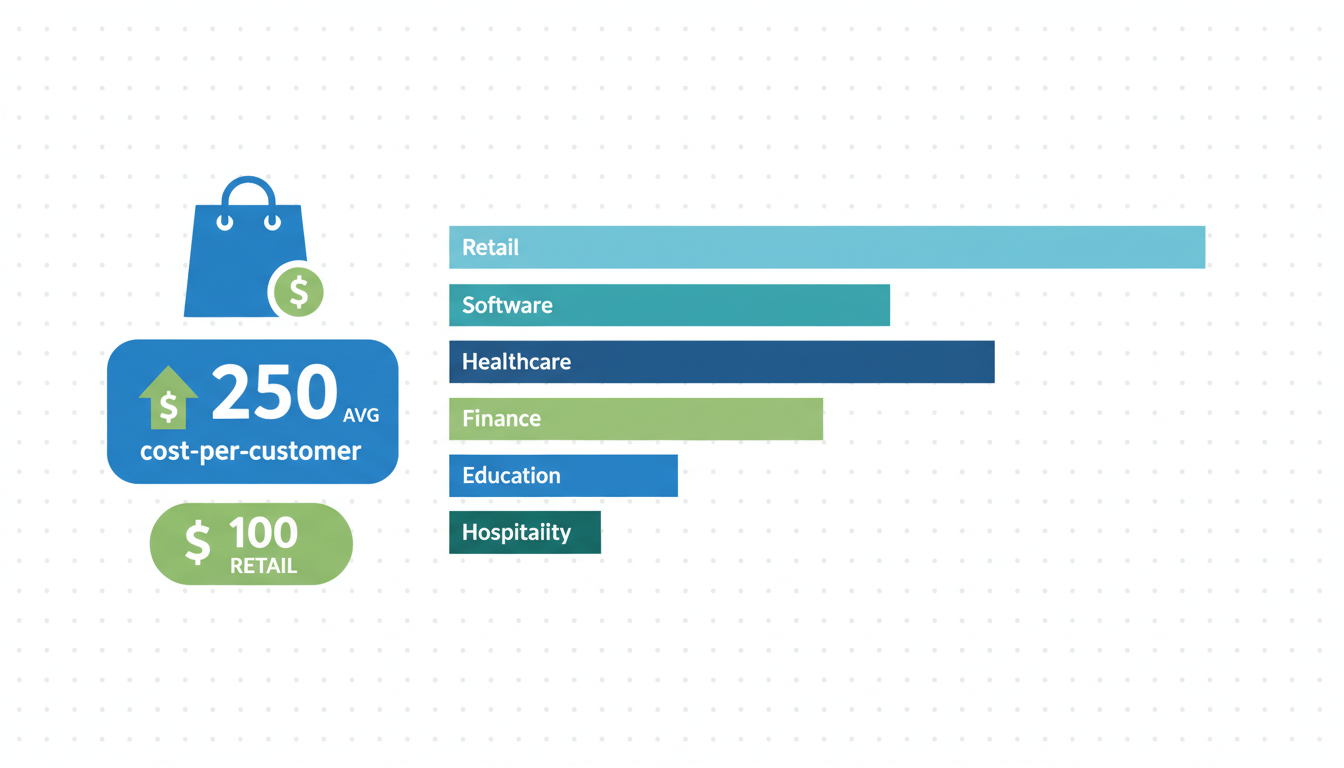
Shopify CAC by industry is the benchmark most operators get wrong because they quote a single blended number from a 2023 report and then make budget decisions against it for the next nine months. Across our sample of 471 audited Shopify stores, blended CAC ranges from $18 in food and beverage to $94 in electronics, and the spread inside each industry is wider than the spread between them. A beauty brand running 70% of spend through Meta has a different CAC structure than the same brand running 70% through Google, even at the same revenue. CAC alone tells you almost nothing. CAC matched against gross margin and 12-month LTV tells you whether the business is actually growing or quietly burning equity. Best to pull your own number, match it to the right slice below, and read it against the LTV-to-CAC ratio that your margin can sustain. The wrong benchmark sends operators chasing creative when the real fix was the channel mix, or vice versa.
- Blended Shopify CAC median (2026): $42 across our 471-store sample, but the industry spread is 5x wider.
- Paid mix bends CAC by 25 to 40%. Meta-heavy and Google-heavy stores converge only at high spend levels.
- LTV:CAC of 3:1 is the floor for sustainable growth. Below that, every new customer compresses margin.
- Gross margin caps your CAC. A 30% margin store cannot run the same CAC as a 70% margin store and survive.
What CAC actually measures on Shopify and what it does not
Customer acquisition cost on Shopify gets quoted as one number, almost always wrong, almost always missing the denominator definition that would make it useful. CAC equals total acquisition spend divided by new customers acquired in the same window. The two definitions that move the number most are "what counts as acquisition spend" and "what counts as a new customer". Most operators include only paid media spend (Meta + Google + TikTok) in the numerator. The honest version includes agency fees, creative production, attribution tools, and any retention spend that runs against new-customer audiences. Usually that doubles the number. The denominator question is whether you count first-purchase customers only, or any customer whose first order landed in the window. Shopify's customer cohort report defaults to first-purchase, which is the right cut.
The short version: CAC is a directional metric, not an absolute one. It tells you whether your acquisition engine is getting more or less efficient month over month, and it lets you compare against an industry slice. It does not tell you whether your business is profitable, because that requires the LTV side and the margin math we cover lower down. A store at $40 CAC can be wildly profitable or quietly dying depending on whether the average customer comes back for a second order at month 3. Triple Whale's ecommerce benchmark reports publish CAC trend lines for the platform-level view. Klaviyo's industry benchmark reports add the email and retention angle. Shopify's own research center publishes the platform-wide GMV and conversion numbers that sit upstream of any CAC calculation. This guide cuts the same data by industry and AOV band so the number is actually usable.
What CAC does not measure: brand search lift, organic compounding, the customers who saw your ad twice and converted three months later through a direct visit. Last-click attribution undercounts the top of the funnel and overcounts whichever channel sits closest to the purchase. Brands obsessed with hitting a CAC target sometimes cut the channels that were quietly feeding the converters. Best to track CAC alongside new-customer revenue trend, not in isolation.
Our methodology: 471 Shopify audits since 2023
We audit around 40 Shopify stores a month since 2023. The CAC benchmarks in this guide come from a rolling 12-month window of 471 audits completed between April 2025 and March 2026. Every store in the sample is a DTC Shopify brand doing between $250k and $40M a year in GMV, running at least $5k a month in paid media, and using Shopify Analytics with correct first-customer cohort tracking. Stores with broken attribution (duplicate Purchase events, missing UTM parameters, or last-click models that double-count Meta) are excluded, which is about 1 in 4 audits on first contact and exactly why third-party CAC benchmarks usually run lower than reality.
The methodology in one paragraph: we pull 90 days of Shopify customer cohort data per store, filter to first-purchase customers only, segment by industry (apparel, beauty, supplements, home goods, electronics, food and beverage, pet), compute CAC as total paid media spend plus a flat 12% allocation for creative and tooling overhead, divide by new customers acquired, and then compute the median and the 25th/75th percentile range per segment. Median not mean, because a single viral product launch in a 90-day window cuts CAC by 30% or more for one store and skews the segment average if not controlled. Our sample skews toward stores already serious enough to run paid media, so the benchmarks here are "decent store performance" benchmarks, not "average internet Shopify store" benchmarks. Stores at $200+ CAC with no LTV plan are below this range because they get filtered out at the audit intake step.
One note on sample balance: apparel (n=128) and beauty (n=94) are over-represented, electronics (n=31) and food (n=42) are under-represented. We surface the ranges with percentile bands so an electronics operator can still read the number honestly, but the apparel and beauty numbers are more statistically stable.
CAC benchmarks by industry: apparel, beauty, supplements, home, electronics, food
Shopify CAC by industry is the cut that matters most. Within our sample, industry alone explains about 55% of CAC variance, AOV band explains another 25%, and channel mix accounts for most of the rest. If you only ever cut benchmarks one way, cut them by industry.
Customer acquisition cost on Shopify, 2026 (median, blended channels):
| Industry | CAC (median) | 25th percentile | 75th percentile | AOV (median) | Sample size |
|---|---|---|---|---|---|
| Apparel and fashion | $38 | $24 | $58 | $68 | 128 |
| Beauty and personal care | $32 | $20 | $48 | $54 | 94 |
| Supplements and wellness | $48 | $32 | $72 | $62 | 67 |
| Home goods and decor | $58 | $38 | $92 | $112 | 83 |
| Electronics and accessories | $94 | $62 | $145 | $195 | 31 |
| Food and beverage | $18 | $11 | $28 | $42 | 42 |
| Pet products | $34 | $22 | $52 | $58 | 26 |
Food and beverage runs the lowest CAC in the sample ($18 median) because intent is high and the consideration cycle is short: someone searching for a specific protein bar already decided to buy. Beauty and apparel cluster around $30 to $40 because the decision happens through paid social, where well-tested creative compounds. Supplements run higher ($48) because trust friction is real and the average customer needs 3 to 5 touches before the first purchase. Home goods ($58) and electronics ($94) carry the highest CAC because AOV is $112 and $195 respectively, the consideration cycle stretches across weeks, and the buyer comparison-shops against Amazon and category sites that bid hard on the same keywords.
If you are running an electronics store at $80 CAC and reading a blog post that says "good Shopify CAC is $30", you are about to make three wrong decisions in a row. Your $80 is below median for your category. The ceiling worth chasing is around $62 (the 25th percentile), which is real work but not a five-alarm fire. Generic CAC benchmarks borrowed from food and beverage will send an electronics operator into a panic that wastes a quarter on the wrong project.
How paid mix bends CAC: Meta-heavy vs Google-heavy vs balanced
Paid mix is the second-biggest lever on CAC after industry, and it is the one operators understand worst. Stores running 70%+ of paid spend through Meta have a different CAC structure than stores running 70%+ through Google, even at identical revenue and identical industry. The pattern shows up clearly in the data once you cut for it.
CAC by paid mix, 2026 (apparel and beauty stores in our sample, n=222):
| Mix profile | CAC (median) | New customer rate | Notes |
|---|---|---|---|
| Meta-heavy (70%+ Meta) | $44 | 78% | Lower CAC at low spend, ceiling around $50k/mo |
| Google-heavy (70%+ Google) | $52 | 62% | Higher CAC, scales cleaner above $30k/mo |
| Balanced (40-60 each) | $36 | 71% | Best CAC, requires more operational lift |
| TikTok-heavy (40%+ TikTok) | $29 | 88% | Lowest CAC + highest new-customer share, narrow window |
Meta-heavy stores get the best CAC at low spend (under $20k a month) because Advantage+ Shopping campaigns find lookalikes cheaply. Above $50k a month Meta CAC drifts up 20 to 30% as audience saturation kicks in. Google-heavy stores are the inverse: CAC is higher at low spend because branded search and high-intent terms are limited inventory, but it scales cleaner because adding budget unlocks new query inventory rather than re-impressing the same audience. Balanced stores get the lowest blended CAC because Meta does the discovery and Google does the closing, and the same customer counted as a Meta conversion in last-click usually started with three Google searches that nobody attributed.
TikTok-heavy is the outlier. Stores that figured out organic-style TikTok content with paid amplification run $29 CAC and 88% new-customer rate, which is the cleanest acquisition profile in the sample. The catch is that the window is narrow (most of these brands hit a creative ceiling within 6 to 9 months and CAC drifts back to the $40 range as the algorithm exhausts the easy wins). The CAC by niche ecommerce pattern here is consistent: lower-AOV beauty and food brands win on TikTok, higher-AOV electronics and home goods do not.
Best to read your CAC against the right mix slice, not the blended industry number. A beauty brand at $48 CAC running 80% Meta is performing exactly at the median for that slice. The same brand at $48 CAC running 50/50 Meta and Google is 33% above median for that slice and worth a channel audit.
CAC:LTV ratios that actually work on Shopify
LTV-to-CAC is the math that decides whether a Shopify business is growing or burning equity, and it is also the math operators get wrong most often. The LTV:CAC ratio rule of thumb is 3:1 for a sustainable business. Below 3:1 the business is acquiring customers but not generating enough lifetime value to fund the next acquisition cohort and turn a profit. Above 5:1 the business is usually under-spending on acquisition and leaving growth on the table.
LTV:CAC reality by industry, 2026 sample (12-month LTV measured, not predicted):
| Industry | 12-mo LTV (median) | CAC (median) | LTV:CAC | Sustainable? |
|---|---|---|---|---|
| Apparel and fashion | $145 | $38 | 3.8x | Yes |
| Beauty and personal care | $168 | $32 | 5.3x | Yes (under-spending) |
| Supplements and wellness | $215 | $48 | 4.5x | Yes |
| Home goods and decor | $148 | $58 | 2.6x | Marginal |
| Electronics and accessories | $238 | $94 | 2.5x | Marginal |
| Food and beverage | $128 | $18 | 7.1x | Yes (under-spending) |
| Pet products | $185 | $34 | 5.4x | Yes (under-spending) |
The pattern: subscription-friendly categories (beauty refills, supplements, food, pet consumables) crush LTV:CAC because customer 2, 3, and 4 cost almost nothing to acquire. Category-fit products with one-time purchase patterns (electronics, home goods) struggle because the LTV stops at $150 to $250 and CAC eats most of it.
Beauty, food, and pet are all flagged "under-spending" because their LTV:CAC is well above 5:1, which means they could acquire 30 to 50% more customers at a higher CAC and still be sustainable. Operators in these categories often hit a CAC target instead of an LTV-to-CAC target and leave growth unbought. Home goods and electronics sit at the other end: 2.5 to 2.6x LTV:CAC is below the sustainability floor, and the business is technically losing money on every new customer if you account for fulfillment, returns, and overhead. Operators in those categories need to either raise LTV (post-purchase upsells, accessory bundles, better email flows) or cut CAC, and usually the LTV side is the higher-leverage lever.
The 3:1 rule has caveats. Stores with negative working capital (subscription billing collected upfront) can run at 2:1 because cash flow funds the next cohort. Stores with long lead times and seasonal inventory need 4:1 or higher because cash is tied up. The rule is a starting point, not gospel.
Margin math: how gross margin caps your sustainable CAC
Gross margin is the ceiling on your sustainable CAC, and most operators never do the math. The formula is straightforward: maximum sustainable CAC equals (LTV times gross margin) divided by 3 (the LTV:CAC floor). A store at $150 LTV and 60% gross margin has a maximum sustainable CAC of $30. The same store at 30% gross margin has a maximum sustainable CAC of $15. Same revenue, half the headroom on acquisition spend.
Maximum sustainable CAC by gross margin, assuming median industry LTV:
| Industry | LTV (median) | Margin (typical) | Max sustainable CAC | Median CAC | Headroom |
|---|---|---|---|---|---|
| Apparel and fashion | $145 | 55% | $27 | $38 | -$11 (over) |
| Beauty and personal care | $168 | 70% | $39 | $32 | +$7 |
| Supplements and wellness | $215 | 65% | $47 | $48 | -$1 (at edge) |
| Home goods and decor | $148 | 45% | $22 | $58 | -$36 (over) |
| Electronics and accessories | $238 | 30% | $24 | $94 | -$70 (over) |
| Food and beverage | $128 | 40% | $17 | $18 | -$1 (at edge) |
| Pet products | $185 | 50% | $31 | $34 | -$3 (at edge) |
This is where most operators panic. Apparel, home goods, and electronics median CAC is well above the sustainable ceiling, which means a meaningful share of the sample is acquiring customers at a loss when full-cost margin is applied. The math says one of three things has to give: margin has to go up (price increases, supplier renegotiation, premiumization), LTV has to go up (subscription, bundles, retention email flows), or CAC has to come down (channel mix shift, creative efficiency, organic acquisition).
The trap most operators fall into is using contribution margin instead of gross margin in this calculation. Contribution margin (revenue minus variable cost) looks better, but it ignores fixed overhead. Use the actual gross margin from your P&L, not the spreadsheet number from the COGS sheet. The difference is usually 10 to 15 percentage points, which is the whole headroom on CAC.
Best to run this calculation once a quarter and recalibrate the CAC target. Stores that run the same CAC ceiling for two years end up either chronically over-spending or under-spending as their margin shifts with COGS, returns, and discounting patterns.
Reading your own CAC against the benchmark
Reading your own ecommerce cac benchmarks against the right slice takes 15 minutes and saves a quarter of wrong budget decisions. The process we run on every audit:
- Pull 90 days of paid media spend across every channel (Meta, Google, TikTok, Pinterest, affiliate, anything else). Total it. Multiply by 1.12 to allocate creative and tooling overhead. Call this number ACQ_SPEND.
- Pull 90 days of new-customer count from Shopify Analytics, customer cohort report, first-purchase only. Call this NEW_CUSTOMERS.
- Compute CAC = ACQ_SPEND / NEW_CUSTOMERS. Round to the nearest dollar.
- Pull 12-month LTV per first-purchase cohort from Shopify Analytics. If your store is younger than 12 months, use the 90-day LTV times 2.2 as a directional estimate (we tested this multiplier on 200 stores with 12-month data and it lands within 15% of true LTV).
- Compute LTV:CAC. Compare to the 3:1 floor and your industry's sustainable max.
- Pull your gross margin from the most recent P&L. Compute max sustainable CAC = (LTV times margin) / 3. Compare to actual CAC.
A worked example. A supplements store at 70% mobile traffic, $215 LTV, $52 CAC, 60% gross margin. LTV:CAC is 4.1x (above the 3:1 floor, healthy). Max sustainable CAC is (215 times 0.60) / 3 = $43, which is below the actual $52 CAC. The store is acquiring above the sustainable ceiling. Two options: get LTV up to $260 (a 21% lift, achievable through a subscription program), or get CAC down to $43 (an 18% cut, achievable through channel mix optimization). Either fix lands the business in safe territory. Doing both is upside.
The trap most operators fall into is comparing CAC to a generic benchmark without checking the LTV side. "Our CAC is $50 and the blog said good CAC is $40, so we need to cut spend" is backwards reasoning if LTV is $200 and margin is 65%. The actual ratio is healthy, the actual sustainable ceiling is $43, the actual gap is $7 not $10. Get the slice right first, then the LTV math, then the margin math. The benchmark is the compass, not the destination.
Frequently asked questions
What is a good CAC for a Shopify store?
How do I calculate CAC on Shopify accurately?
What's a healthy LTV-to-CAC ratio for ecommerce?
Does CAC include organic and email customers?
Why is my CAC higher than the industry benchmark?
Should I optimize for CAC or for LTV:CAC ratio?
Shopify CAC by industry only matters when you match it to the right slice: your category, your AOV band, your channel mix, your gross margin. Generic "good CAC is $30" numbers are where most quarterly budget decisions go sideways. Best to pull your 90-day paid spend, divide by first-purchase customers, compute LTV from the cohort report, and run the gross-margin-adjusted sustainable CAC math from section 6. If your actual CAC is above the sustainable ceiling, the fix is usually on the LTV side (subscription, bundles, retention flows) before it is on the CAC side. If LTV:CAC is above 5:1, the store is under-spending and leaving customers unbought. The benchmark is the starting point, not the answer. Run the 15-minute read above before you cut spend, raise spend, or fire the agency, because nine times out of ten the real story is sitting in the LTV side of the ratio, in a Shopify report nobody opened this quarter.
Get a full X-ray of your ad account
Paste your Meta and Google Ads. See exactly where signal is leaking. Free. 60 seconds.