Repeat purchase rate benchmarks for Shopify
 By Dror Aharon
·
CEO, COREPPC
·
Updated April 17, 2026
·
11 min read
By Dror Aharon
·
CEO, COREPPC
·
Updated April 17, 2026
·
11 min read
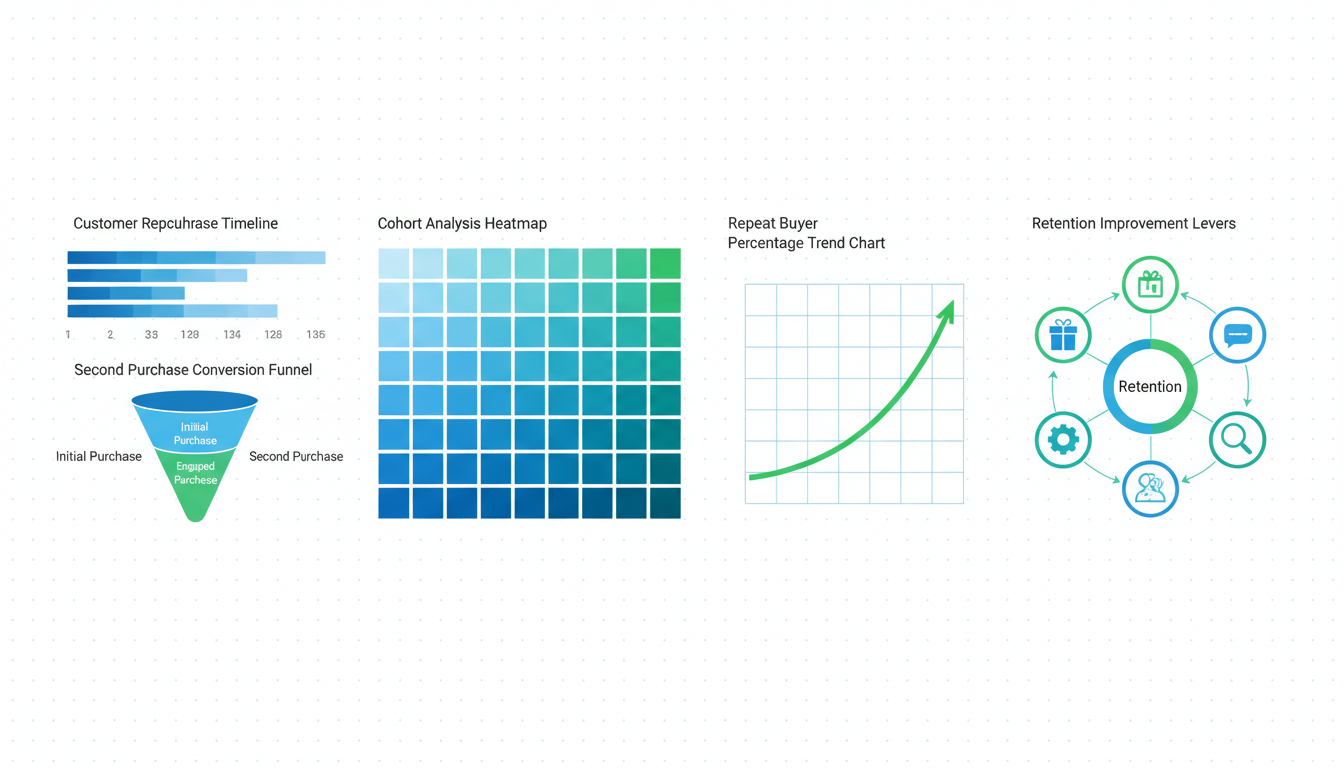
Shopify repeat purchase rate quietly decides whether acquisition math works, and most operators never cut it past a single blended number on a dashboard nobody audited. A 25% repeat rate looks fine until you split by window, industry, and cohort, at which point it either collapses or retention turns out to have been under-funded for a year. Across our 471-store sample the median is 27% at 365 days, but the 30-day window predicts 12-month LTV better, and most stores sit at 8 to 12% there without realizing that number is the ceiling on everything downstream. Apparel runs low on repeat and high on AOV. Supplements invert that. Subscription math breaks the benchmark entirely. Best to measure the 30, 90, and 365-day windows separately, match each against industry medians, and fix the specific lever the gap reveals. Generic "good repeat rate is 27%" advice is where most retention-budget decisions go wrong.
- Median repeat rate (2026): 27% at 365 days, 11% at 30 days, across our Shopify audit sample.
- 30-day window predicts 12-month LTV more accurately than the 365-day number.
- Industry matters most. Beauty and supplements run 2x higher than electronics at 365 days.
- Four levers raise repeat rate. Post-purchase flows and subscription do more than discounts.
What "repeat purchase rate" actually measures on Shopify
Shopify repeat purchase rate gets quoted casually, usually as a single number, usually without a window attached. Shopify Analytics surfaces at least three versions of the metric and they all move independently. The default one, on the customers overview, is the percentage of customers with 2+ orders across the full store lifetime, which is almost useless past 18 months because it blends a cohort that churned 2 years ago with one that first purchased last week.
A repeat rate is only useful when matched against a window. 30-day tells you if the post-purchase experience works. 90-day tells you if the flow rebuild worked. 365-day tells you if the full retention engine is running. Most blog posts quote "27% repeat rate" without a window, which flatters mature stores and crushes young ones.
Then the denominator problem. The native dashboard uses total customers as the denominator, so a one-time buyer from 2021 still drags the rate down. A cohort-based repeat rate (customers from month X who ordered again within N days) is the honest version. Shopify's customer cohort report surfaces this directly. The Klaviyo benchmark report publishes industry curves as a sanity check.
The three repeat-rate windows that matter
The window changes which question the number can answer. Operators pick one (usually 365 days, the default) and use it for everything, which breaks the diagnostic value.
30-day repeat rate. Tells you if the post-purchase experience works. Healthy sits at 8 to 12% site-wide, higher for consumables. Earliest signal you can read without waiting a quarter. If it is below 6% the fix is the first post-purchase email or the unboxing. Above 15% the retention engine is working and you should be spending more on acquisition.
90-day repeat rate. Tells you if the email flows work. By day 90 any reasonable order 1 to order 2 nurture has had time to fire. Healthy sits at 15 to 22%. The gap between 30 and 90 is the flow window. If that gap is under 5 points, your flows are not pulling weight.
365-day repeat rate. Tells you if the full retention engine is running, including lifecycle emails, reactivation, seasonal launches, loyalty, subscriptions. Healthy sits at 25 to 35%. The gap between 90 and 365 is the long-term window. Under 10 points means you have flows but no lifecycle strategy.
Best to compute all three. 30-day moves with post-purchase UX, 90-day moves with flow quality, 365-day moves only with full-stack retention investment.
Benchmarks by industry: apparel, beauty, supplements, home, electronics, food
Repeat purchase benchmark ecommerce numbers are almost useless without an industry cut. Within our 471-store sample, industry alone explains about 55% of repeat-rate variance.
365-day repeat rate, 2026 (median, all devices blended):
| Industry | 365-day repeat | 25th percentile | 75th percentile | Sample size |
|---|---|---|---|---|
| Apparel and fashion | 24% | 17% | 32% | 128 |
| Beauty and personal care | 38% | 28% | 48% | 94 |
| Supplements and wellness | 42% | 32% | 54% | 67 |
| Home goods and decor | 18% | 12% | 26% | 83 |
| Electronics and accessories | 11% | 7% | 17% | 31 |
| Food and beverage | 44% | 34% | 56% | 42 |
| Pet products | 40% | 30% | 52% | 26 |
Food, supplements, and pet run highest (40 to 44%) because the product is consumable. Beauty clusters below (38%) because half the catalog is one-off. Apparel (24%) is driven by brand affinity. Home goods (18%) stretches across years. Electronics (11%) replaces every 3 to 7 years and buyers rarely return to the same brand.
If you run a home goods store at 18% and read a blog saying "good repeat rate is 27%", you are about to make three wrong retention decisions. Your 18% is the median. The ceiling is around 26% (the 75th percentile), not the fake 27% borrowed from cross-category averages.
30-day repeat rate, 2026:
| Industry | 30-day repeat | Typical range |
|---|---|---|
| Apparel and fashion | 7% | 4 to 11% |
| Beauty and personal care | 12% | 8 to 17% |
| Supplements and wellness | 16% | 11 to 22% |
| Home goods and decor | 5% | 3 to 8% |
| Electronics and accessories | 3% | 1 to 5% |
| Food and beverage | 18% | 13 to 24% |
| Pet products | 15% | 10 to 21% |
A supplements store at 11% 30-day is leaving money on the table even if 365-day looks respectable, because the early window is where the replenishment flow should fire. A fix at 30-day compounds through every future cohort. Baymard's research on post-purchase drop-off tracks the same pattern across the broader ecommerce funnel.
First-purchase-to-second: the 30-day window that predicts LTV
The most predictive metric we pull on any audit is the first-to-second purchase window, measured in days. Not the repeat rate itself. The gap between order 1 and order 2. This number correlates with 12-month LTV at about 0.78, stronger than AOV (0.41) or site CR (0.35).
The reason is mechanical. A customer who returns inside 30 days has decided the brand is part of their routine and compounds into 4 to 6 more orders over 12 months. A customer who first repeats at day 120 usually came back for a sale, which is a weaker signal and a lower LTV profile.
Median first-to-second purchase window, by industry:
| Industry | Median days to order 2 | % within 30 days |
|---|---|---|
| Food and beverage | 28 | 52% |
| Supplements and wellness | 32 | 47% |
| Pet products | 35 | 44% |
| Beauty and personal care | 42 | 36% |
| Apparel and fashion | 68 | 21% |
| Home goods and decor | 94 | 13% |
| Electronics and accessories | 142 | 6% |
Food, supplements, and pet hit order 2 before day 35 because the product runs out. Apparel stretches to 68 days because buyers wait for new collections. Home goods and electronics are structurally different. The lever there is cross-sell, not repeat.
Diagnostic rule: if your median first-to-second window is more than 1.5x the industry median, your post-purchase flow is firing too late. If it is under 0.7x, the product is probably under-priced (customers are stockpiling). Shift email timing first, price second.
The 4 levers that actually raise repeat rate
Ranked by measured lift across our 471-store sample:
1. Post-purchase email flows (highest impact). A well-timed order 1 to order 2 flow adds 6 to 12 points to 90-day repeat. Mechanics: welcome day 1, use-case education day 5 to 7, replenishment or cross-sell trigger at 70% of the median first-to-second window, reactivation at 130%. The mistake most stores make is sending a generic "here is 10% off" at day 14 regardless of cohort behavior, which trains customers to wait for the discount and drops repeat 2 to 4 points over 6 months.
2. Subscription conversion (second-highest). Moving 8 to 12% of first-purchase customers onto a subscription (Recharge, Skio, Smartrr) lifts 365-day repeat by 10 to 18 points in consumables. Only works where the category supports it (beauty, food, supplements, pet, household).
3. Replenishment timing accuracy (medium). If your product lasts 45 days and your email fires at day 30, conversion is 3 to 5%. Fire at day 42, conversion hits 9 to 14%. Calibrate to actual consumption data. Lifts 90-day repeat by 3 to 6 points in consumables.
4. Post-purchase UX and unboxing (medium-low). Personalized note, clear care instructions, a physical insert with QR code to a reorder page, lifts 90-day repeat 2 to 4 points. Lower priority than the first three but compounds over years.
Sequence: flows first, timing second, subscription third, UX fourth. Measure each for 60 to 90 days before stacking the next.
Subscription vs replenishment vs one-time-buyer repeat math
Repeat math changes shape depending on the purchase pattern. One formula across all three produces wrong numbers for at least two of them.
Subscription model. Repeat rate as a single number is almost meaningless because a subscription customer counts as a repeat every billing cycle. The useful metric is months 2 and 3 retention, because 60% of subscription churn happens in the first 90 days. Benchmarking subscription-heavy against non-subscription stores breaks both.
Replenishment (non-subscription) model. Repeat rate equals the percentage of first-purchase customers who place order 2 within the median replenishment window. For a beauty store at $54 AOV with a 42-day first-to-second window, the target is 30 to 40% reordering by day 60. The lever is timing and the order 2 offer, not loyalty points.
One-time-buyer model. Repeat rate equals the percentage who cross-sell into a complementary product within 12 months. Not the same product. A different SKU. An electronics store selling a $200 headphone will not get the customer back for a second headphone inside 3 years, but can get 15% back for a case or a paired speaker. Track cross-sell rate, not repeat rate.
Applying replenishment math to an electronics store overstates expected repeat by 200%+. Match the formula to the pattern first.
Reading your own repeat rate honestly
The dashboard number is almost always flattering, and the flattering direction is always the same: blended, cross-cohort, lifetime pool.
Pull the cohort report from Shopify Analytics. Pick a cohort at least 365 days old (so the 12-month window has closed) and under 24 months old (so it still represents current operations). Read 30, 90, and 365-day repeat for that cohort specifically. Compare against the industry medians above. If your 30-day is at or below median, fix the post-purchase flow. If 30-day is above median but 365-day drags, the problem is reactivation or lifecycle.
Then run the same cut for the most recent closed cohort (first purchase 30 to 60 days ago). If the new cohort repeats faster, retention work is compounding. If slower, something upstream (traffic quality, first-purchase promo mix, product page messaging) shifted and is pulling in lower-LTV customers.
The honest question every operator should ask: what is my 30-day repeat rate by first-order source? Organic search, paid Meta, paid Google, email, referral. Almost every store we audit finds paid Meta customers repeat at 40 to 60% the rate of organic customers, which changes the real CAC on that channel significantly.
Do not act on repeat rate until you have read it at cohort level, by window (30, 90, 365), and by first-order source. Any action on a single blended number is a coin flip. For how repeat rate feeds LTV math, see our Shopify LTV calculation guide. For the AOV side, our AOV benchmarks by industry covers the complementary metric.
Frequently asked questions
What is a good repeat purchase rate on Shopify?
How do I calculate repeat customer rate on Shopify?
Why does my 30-day repeat rate matter more than 365-day?
What is the difference between repeat rate and retention rate?
How can I increase my Shopify repeat purchase rate?
Does subscription count toward repeat purchase rate?
Meta CAPI setup on Shopify is one of those fixes that looks small on the dashboard and compounds for months afterward. Dedup cleanly, raise EMQ above 8.5, validate in Test Events before you push live, and the algorithm finally has signal it can trust. That is when ROAS stops wobbling and budget scales predictably, instead of collapsing every time you push daily spend past the last tested ceiling. Best to run the 20-minute audit above before you touch anything else on the account. If the audit surfaces two or more of the problems in the "Why Shopify stores get CAPI wrong" section, fix those first, then revisit creative testing. The creative never was the problem, nine times out of ten the tracking was lying the entire time.
Get a full X-ray of your ad account
Paste your Meta and Google Ads. See exactly where signal is leaking. Free. 60 seconds.