Broad targeting on Meta for Shopify: when it works
 By Dror Aharon
·
CEO, COREPPC
·
Updated April 17, 2026
·
11 min read
By Dror Aharon
·
CEO, COREPPC
·
Updated April 17, 2026
·
11 min read
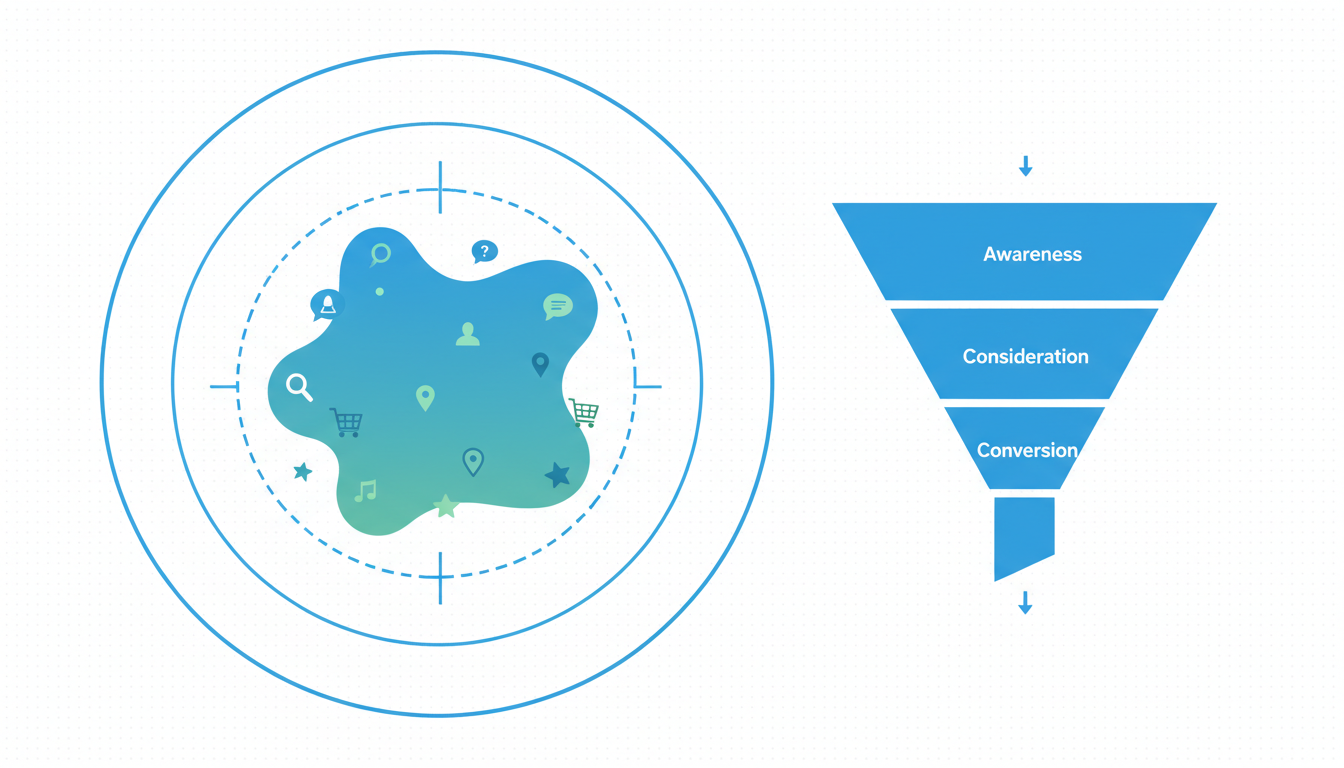
Shopify Meta broad targeting is the default setup for most stores in 2026, but it only works when three things line up: CAPI is clean (EMQ above 8), daily spend is high enough for the algorithm to exit learning, and creative rotation feeds Meta real variety every week. Stores that skip any one of those turn broad into a money pit and blame the setting. Interests still win in a few specific cases (tiny budgets, very niche products, first 14 days of a new account), but for anything scaling past $50 a day on a clean tracking stack, broad beats interest stacks on ROAS almost every time in our audit sample. The fix starts with the tracking, the budget floor, and the creative supply, not with flipping broad on in every ad set. Do the audit. Read the six debug points. Run the 30-day migration.
- Broad beats interests once CAPI is clean and EMQ sits above 8.
- Daily spend floor: $50 for Advantage+ Shopping, $30 for a standalone broad ad set.
- Creative rotation: minimum 6 active ads, 2 new creatives weekly, or broad stalls.
- Interests still win for very niche products and accounts under 14 days old.
What broad targeting actually means on Meta in 2026
Broad targeting on Meta in 2026 is not really "no targeting." It is age plus gender plus country, with the algorithm handling everything else from signal. So when someone says "I'm running Shopify meta broad targeting," what they usually mean is one of three setups: Advantage+ Shopping Campaigns with no audience input, a standard sales campaign with just geo and age, or a manual ad set with interests left blank. All three work. They work differently. That matters more than most operators realize.
Meta's algorithm reads your pixel and CAPI events, finds patterns in who converts, and builds audiences on the fly. Interest stacks used to help when browser-side signal was strong and cookies worked. After the iOS 14.5 changes in 2021, and then the cookie tightening in Safari and Firefox at the end of 2025, Meta lost roughly half the browser signal it used to rely on. So the algorithm now leans much harder on server-side events (CAPI), your product feed, and patterns across millions of other advertisers. Feeding it a narrow interest stack at that point is like telling a chef who already knows what you like which aisle to shop in. It doesn't help. It just shrinks the pool.
The short version: broad is the default because Meta's targeting got smarter and browser signal got weaker at the same time. If your tracking is a mess, broad will still flop. That is not a broad problem. That is a tracking problem. See our Meta CAPI setup guide for Shopify for the fix order.
Why broad beats interests once CAPI is clean
Here is what actually happens inside the algorithm. Meta looks at every person who converted on your pixel in the last 28 days, finds the patterns (age, buying behavior, lookalike signals, third-party data), and expands outward to people who match. Interest targeting cuts that pool down before the algorithm gets to look. On a clean pixel with CAPI running and EMQ above 8, that cut costs you more than it helps.
In our audit sample of 40 to 50 Shopify stores a month since 2023, the pattern is consistent:
- Stores with EMQ below 7: broad runs at 1.4 to 1.8 ROAS. Interest stacks hit 2.1 to 2.5. Interests win.
- Stores with EMQ 7 to 8: broad and interests roughly tie at 2.4 to 2.8 ROAS.
- Stores with EMQ above 8.5: broad hits 3.2 to 4.1 ROAS. Interests plateau around 2.6.
That last row is where most of the "broad audience Shopify meta works great" stories come from. And it is also why half the operators who tried broad in 2022 with a leaky pixel walked away thinking it was broken. It wasn't broken. The pixel was. Shopify's Facebook and Instagram app on Maximum data sharing, CAPI on, dedup clean, is roughly the threshold where broad starts to pull ahead. Below that, you are feeding Meta soup and asking for a steak.
So the decision tree is simple. Fix CAPI first. Check EMQ in Events Manager. If it is above 8, switch to broad and let the algorithm work. If it is below 7, interests are doing the job the pixel should be doing, and you will want to keep them on until tracking is fixed.
Budget and creative requirements for broad to work
Broad needs two things interests don't: enough daily budget to exit the learning phase, and enough creative variety to keep the algorithm from overfitting on one winner. This is where most of the "I tried broad and it tanked" stories come from. Not the setting. The inputs.
The daily spend floors we use on client accounts in 2026:
- Advantage+ Shopping Campaign: $50 minimum per day per campaign. Below that, Meta never exits learning, and broad basically becomes a random sampler.
- Manual sales campaign with a single broad ad set: $30 minimum per day. Narrower budget floor because one ad set collects signal faster than a campaign with multiple.
- Manual sales campaign with 3 to 5 broad ad sets (by geo or age split): $20 per ad set, $60 to $100 campaign total. Only use this if you have a reason to split, like testing US vs CA separately.
Creative is the other half. Broad reads creative performance as one of its strongest optimization signals, so a stale creative set starves the feedback loop. The rotation rule we run on every client:
- Minimum 6 active ads per ad set. Below that, the algorithm has too few variants to A/B against.
- 2 new creatives launched per week, every week. Fresh signal, not "we'll refresh next month."
- Pause creatives that have spent over $100 with ROAS below 1.5. Keep the ad set alive, swap the ad.
Stores that hit both the budget floor and the creative rotation rule see broad outperform interest stacks within 10 to 14 days. Stores that hit one but not the other, or neither, run broad at a loss for weeks and then swear it off. The setting is not the problem. The feed into it is. Meta's Advantage+ Shopping overview covers the campaign type itself if you want the official reference.
When interests still win
Broad is the default answer. It is not the only answer. A few situations still call for interest targeting in 2026, and pretending otherwise sets stores up to fail.
Very niche products with small total audiences. If you sell competition-grade archery arrows, a harp tuning tool, or something that realistically has a US audience under 200,000 people, broad wastes half its spend on people who will never convert. The algorithm needs a starting signal narrow enough to find the real buyers. Interest stacking "Archery" + "Olympic archery" + pages like "Lancaster Archery Supply" gives Meta a shape to expand from. Broad just doesn't.
Accounts under 14 days old with zero pixel history. Fresh accounts have no conversion data, so the algorithm has nothing to expand from. Broad on a cold pixel runs at 0.6 to 1.0 ROAS for the first two weeks. Interests give it a narrower starting pool that converts faster, which builds pixel history quicker. Once you have 30 to 50 conversions on the pixel, switch to broad and budgets usually climb cleanly.
Tiny total budgets, under $30 a day. Broad needs enough daily spend to exit learning. Under $30 a day you are starving the algorithm, so broad just cycles through random audiences and never stabilizes. Interest stacking at $20 a day will outperform broad at $20 a day, every time we have tested it. The issue is not that broad is worse, it is that you are not feeding it enough data. If you cannot raise budget yet, run interests. When budget climbs past $50 a day, switch.
Lead-gen or info-product funnels with no e-commerce pixel pattern. Meta's broad targeting on Shopify is tuned hard for product-purchase signal. If you are selling a course or a subscription on a Shopify checkout, the pixel still works but the feed-side signal is weaker. Interest targeting on top of lookalikes usually beats broad for those funnels. Stores selling physical products should ignore this rule. Everyone else, test both.
The broader pattern: broad is for stores with clean tracking, real daily spend, and fresh creative. Everything else, interests still carry their weight.
Broad + Advantage+ Shopping: the layered setup
The setup that quietly wins on most accounts in our audit sample is not "broad or interests." It is a layered stack. Advantage+ Shopping as the primary channel, one standard-sales broad ad set as a testing ground, and a retargeting campaign on existing visitors for recovery. Three campaigns, three jobs. See our Shopify Advantage+ campaigns deep dive for the campaign-type walkthrough.
The split that works on accounts from $10k to $200k a month Meta spend:
- Advantage+ Shopping Campaign: 70% of daily budget. No audience input, no interest stacks, just the campaign with catalog connected and creatives rotating. This is where the broad performance lives.
- Standard sales campaign, 1 broad ad set: 20% of budget. Same creatives as ASC, runs in parallel, gives you a controlled A/B against the ASC. Also your fallback if ASC starts to drift.
- Retargeting campaign (custom audience, site visitors + cart abandoners): 10% of budget. Small, steady, keeps the warm audience converting.
This split is basic signal hygiene. The algorithm needs enough data in each channel to optimize, without any one channel eating the others. The common mistake is running only ASC, which works great until a creative stalls, and then there is nothing to compare against and no way to know if the drop is creative or campaign-level. The 20% sidecar broad ad set gives you that signal almost for free.
The other mistake is stacking too many audiences inside the retargeting campaign. One custom audience (site visitors, 30-day window) converts better than ten layered audiences with overlap. Retargeting is not where you want to get clever in 2026. The iOS cookie changes made retargeting windows shorter and pools smaller, so simpler wins.
Debugging broad when it stops working
Broad stalls happen, usually in a very specific pattern. ROAS was 3.5 last week, it's 1.8 this week, spend is the same, creatives are the same, and the operator panics. Before touching the campaign, run this check list:
- Open Events Manager, pull the 7-day EMQ score. If it dropped below 8, the problem is tracking, not targeting. Somebody updated the theme, a new app was installed, or the F&I connection broke. Fix the tracking first, broad will climb back on its own.
- Check creative fatigue. Sort ads by impressions over the last 14 days. Any ad over 500k impressions with declining CTR is cooked. Pause it, add two new creatives, let the algorithm reset. See our Meta creative fatigue guide for Shopify for the full playbook.
- Look at frequency in the ad set. Above 3.5 in 7 days and your audience is saturated. Broad shouldn't hit 3.5 frequency on a clean account. If it does, either budget is too high for the current audience pool, or something is narrowing the pool unexpectedly.
- Check attribution window. If you changed from 7-day click to 1-day click recently, your reported ROAS dropped but actual revenue didn't. The "drop" is a measurement artifact, not a campaign problem.
- Audit the catalog. Advantage+ Shopping reads product feed performance as a signal. If 40% of your SKUs ran out of stock and Meta kept showing them, performance tanks even though nothing changed in the campaign. Sync the catalog, disable out-of-stock SKUs, re-run.
- Last resort: seasonal effect. Benchmark against the same week last year before assuming the campaign is broken. Sometimes the market just shifted.
Nine times out of ten, the "broad stopped working" problem is one of the first three. Tracking slipped, creative got stale, or frequency ran away. Fixing the cause is faster than rebuilding the campaign, and it keeps the algorithm's learning history intact.
The move from interests to broad: a 30-day migration
Switching from interest stacks to broad cold turkey is how accounts get burned. Meta's algorithm needs time to rebuild its signal map, and pulling the interest rug out from under a campaign mid-scale usually drops ROAS 30 to 50% for about 10 days. The safer path is a 30-day phased migration. This is the sequence we run on every client moving to Shopify meta broad targeting.
Week 1: audit and fix tracking. Run the CAPI audit. Check EMQ. If it is below 8, stop here and fix tracking before touching campaigns. This step alone takes half a day to two days depending on how messy the existing setup is. Do not skip it. Broad on a broken pixel loses money for the whole migration and you will blame the wrong thing.
Week 2: launch broad in parallel, small budget. Keep existing interest campaigns running at full budget. Add one new Advantage+ Shopping Campaign at 20% of your total Meta spend, with the same creatives as the interest campaigns. Let it run 7 days. Compare ROAS at day 7, not day 2, because broad needs exit-learning time.
Week 3: rebalance. If broad is matching or beating interests by day 7, shift budget. Move from 80/20 interests/broad to 50/50. Keep comparing. If broad lags by day 7, go back to tracking. Something is still bleeding signal.
Week 4: full switch. Once broad has matched or beaten interests for two consecutive weeks, move to 80/20 broad/interests. Keep a small interest ad set alive as a safety net, mostly so you have something to fall back to if broad has a bad week. After 60 days of steady broad performance, the interest ad set can sunset.
The 30-day timeline tracks to how long Meta's algorithm actually needs to rebuild a full conversion pattern on the new campaign type, assuming the pixel is feeding it clean data. Compressing it to 7 or 10 days almost always costs more than the time saved.
Frequently asked questions
Is broad targeting on Meta always better than interests for Shopify in 2026?
What is the minimum daily budget for broad targeting to work?
How do I know if my CAPI is clean enough to switch to broad?
Will broad targeting work for niche products or small audiences?
Why did my ROAS drop when I switched to broad?
Do I need lookalike audiences if I'm running broad?
Shopify meta broad targeting is the right default for most scaling stores in 2026, but it is not a plug-and-play setting. Broad only works when the pixel is clean, the budget clears the floor, and the creative rotation keeps feeding the algorithm real variety. Miss any one of those and broad runs at a loss while interest stacks quietly outperform, which is why half the operators who tried it in 2022 walked away thinking the setting was broken. It wasn't. The inputs were. Best to run the CAPI audit first, check EMQ, set the budget floor, and then migrate over 30 days instead of flipping the switch in one afternoon. Do that, and broad usually pulls 3.2 to 4.1 ROAS on Advantage+ Shopping within the first full creative cycle. The setting never was the problem. The feed into it almost always is.
Get a full X-ray of your ad account
Paste your Meta and Google Ads. See exactly where signal is leaking. Free. 60 seconds.