How much to spend on Facebook ads for Shopify
 By Dror Aharon
·
CEO, COREPPC
·
Updated April 17, 2026
·
11 min read
By Dror Aharon
·
CEO, COREPPC
·
Updated April 17, 2026
·
11 min read
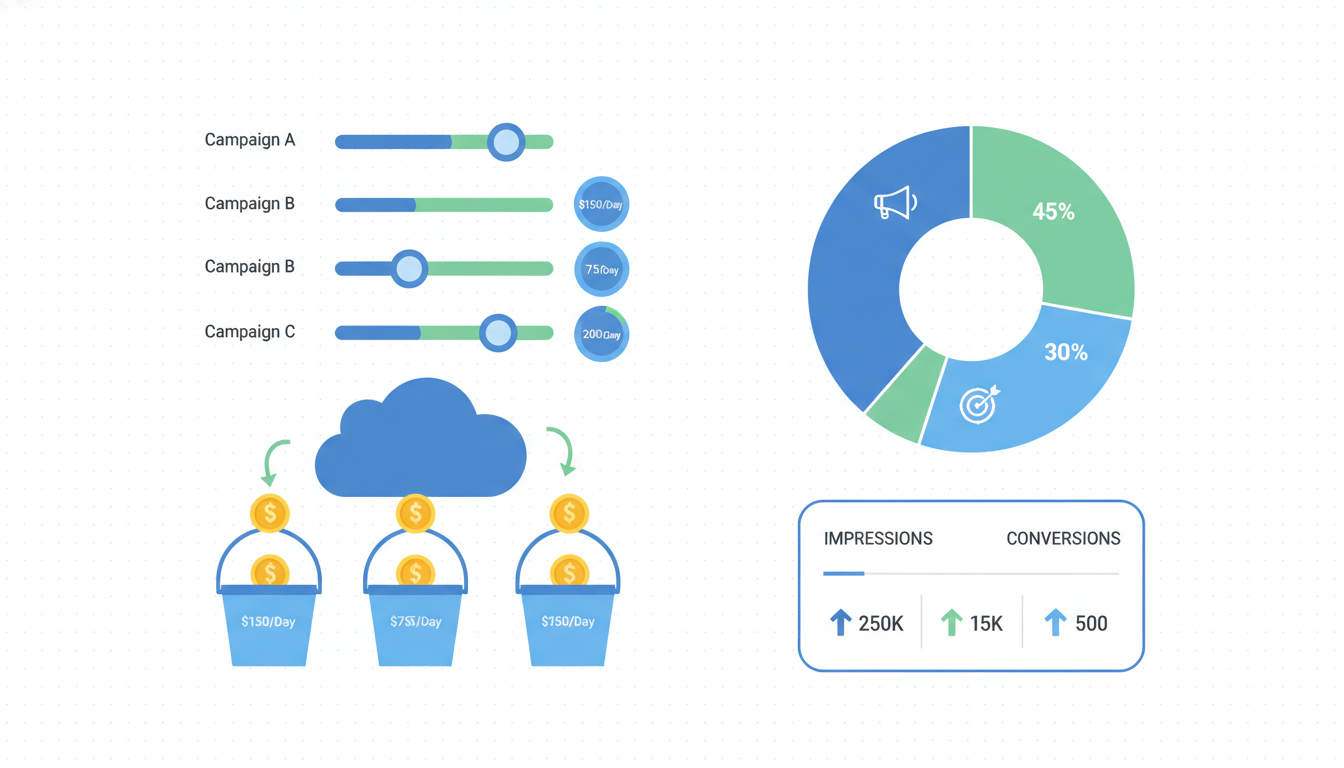
A shopify facebook ads budget set by gut or by a number a competitor mentioned at a conference is the single fastest way to torch margin in 2026, because the wrong budget at the wrong scale will either starve the algorithm of learning data or scale a losing unit economic into a much bigger losing unit economic, and you will not see which one until the credit card statement closes. The right starting point is not "what can I afford" but a three-input ceiling: gross margin per order, learning data minimums per campaign type, and blended ROAS target tied to contribution margin. Most stores get one of those three right and miss the other two. Then they raise budget on a campaign that is showing a 2.4 platform ROAS, miss that blended is actually 1.3, and wonder why the bank balance keeps shrinking even though the ad account looks healthy.
- Set a hard ceiling first: monthly Meta spend should not exceed 30 to 35% of last month's gross margin dollars.
- The learning floor for a single Advantage+ Shopping campaign is around $50 a day. Below that, the algorithm is guessing.
- Blended ROAS, not platform ROAS, is the number to defend. Platform ROAS lies by 30 to 60% on average.
- Retargeting should sit at 15 to 20% of total Meta spend. More than 25% means you are paying to convert people who would have converted anyway.
Why "how much to spend" is the wrong first question
The shopify facebook ads budget question gets asked backwards almost every time. Operators open with "how much should I spend" and mean "what is the magic number that makes Meta work." There is no magic number, and ad spend just multiplies whichever direction your unit economics are already pointing. A store that loses $4 per order at $0 in spend will lose $40 per order at $1k a day in Meta spend. Only the speed at which you go broke changes.
The right first question is "what is my gross margin per order after COGS, shipping, payment processing, and fulfillment, and what blended ROAS do I need to break even." If contribution margin per order is $24 and break-even blended ROAS is 2.1, then every dollar of Meta spend needs to drive at least $2.10 in revenue at the bank account level. The budget is whatever spend keeps you above 2.1 blended.
Stores that skip this and instead ask "should I spend $5k or $10k a month" are usually six weeks away from a panicked pause-everything moment. Best to fix the measurement layer before touching budget at all. Otherwise you are flying with a broken altimeter, and the throttle setting is irrelevant.
The 3 inputs that set your real budget ceiling
A defensible meta ads budget shopify number comes from three inputs stacked together. Get any one wrong and the budget you set will be off by 40 to 80%.
Input 1 is gross margin per order, fully loaded. Not the margin on the product alone. The margin after COGS, inbound freight, packaging, fulfillment per order, payment processing (2.9% plus 30 cents on Shop Pay), free-shipping subsidy, and any first-order discount. Most stores quote a 65% margin and the real number is 38 to 45%. Meta budget caps are a function of the real number, not the quoted one.
Input 2 is learning data minimums by campaign type. Meta's Advantage+ Shopping algorithm needs roughly 50 conversions per week per campaign to exit the learning phase. At a $40 CPA that is $2,000 a week, or about $290 a day, just to feed one campaign. Run two campaigns on $290 a day total and neither one ever exits learning. This is why undercapitalized accounts plateau no matter how good the creative is.
Input 3 is the blended ROAS target tied to break-even. If contribution margin per order is $24 and AOV is $52, break-even blended ROAS is around 2.2. Most stores aim for blended 2.5 to 3.0 to leave room for returns and discount stacking. Anything above 2.5 is profit. Anything below is subsidy.
Stack the three. $30k of gross margin last month means a hard cap around $10k of Meta spend. Inside that cap, the floor is set by learning minimums (~$1,500 a week per Advantage+ campaign). Actual spend lands wherever blended stays above 2.5. Three numbers, one ceiling, no guessing.
Budget buckets: $1k-$5k, $5k-$20k, $20k-$100k, $100k+ a month
How much spend facebook ads shopify is "right" depends on which bucket you are in. The dynamics break differently at each scale. Strategies that work at $3k a month break at $30k, and strategies that work at $200k a month would burn money at $5k. The buckets below describe the patterns we see across our 40-stores-a-month audit sample, with the math that makes each one work.
The $1k to $5k bucket. One campaign max, almost always Advantage+ Shopping with a broad audience. At $1k a month ($33 a day) the algorithm cannot exit learning at any normal CPA, so the goal is data collection. Expect blended ROAS 1.4 to 1.8 in months 1 and 2. If margin can survive that, ride it out. If it can't, the store is not ready for paid social and budget should go to organic or email.
The $5k to $20k bucket. This is where Meta starts to actually work for most stores. One Advantage+ Shopping campaign at $200 to $500 a day is the workhorse, plus one retargeting campaign at $30 to $80 a day capped at 30-day warm audiences. Blended ROAS target is 2.5 to 3.0. The most common mistake at this scale is splitting budget across 4 to 6 small campaigns to "test", which means none get enough data to learn. One well-fed campaign beats six starved ones every time.
The $20k to $100k bucket. Two to three Advantage+ Shopping campaigns segmented by goal (new customer acquisition, repeat purchase, high-LTV products), one retargeting campaign capped at 15% of total, and a creative testing campaign at $50 to $100 a day to feed winners upward. Blended ROAS target is 2.2 to 2.8 because you accept slightly lower returns in exchange for scale. Track contribution margin dollars, not ROAS percentage. A 0.3 ROAS drop on $50k spend can still be $15k more revenue, which can be more profitable than holding ROAS by cutting spend.
The $100k+ a month bucket. The constraint stops being budget and becomes audience saturation, creative fatigue, and incrementality. Frequency on retargeting hits 8 to 12 in a 30-day window, which means you are paying to convert people who would have converted from email. Run holdout tests every quarter. Most $100k+ accounts we audit have 25 to 40% of their measured Meta revenue showing as non-incremental, so real ROAS is 60 to 75% of platform-reported. Budget decisions at this scale should be driven by holdout results, not platform ROAS. Meta's documentation on budget setup covers the platform mechanics, but the strategic layer above is on you.
Learning budget minimums per campaign type
Each Meta campaign type has a learning floor below which the algorithm cannot optimize. Spend below the floor and you are not running ads, you are sampling. The floors come from Meta's 50-events-per-week threshold, which sets a daily minimum keyed to your CPA.
Advantage+ Shopping. Lowest practical floor of the bunch. At a $30 CPA the floor is $215 a day ($30 x 50 / 7). At $50 CPA, $360 a day. At $100 CPA, $715 a day. Below the floor the algorithm cycles in and out of learning every week and CPA reads random.
Sales campaign with manual audiences. Higher floor because each ad set needs its own 50 events. Three ad sets at $50 CPA each need $1,070 a day combined to keep all three out of learning. This is why splitting a $5k a month budget across three audiences usually fails.
Retargeting (warm audiences, last 30 days). Lower floor because the audience is small and high-intent, so CPA is 40 to 60% of cold. At $20 retargeting CPA the floor is $145 a day. Audience size, not the floor, is usually the constraint here.
Catalog ads (DPA). For a 50-product catalog with a 30-day visitor audience, $80 to $150 a day keeps the algorithm fed. Below $50 a day catalog ads underperform broad Advantage+ in almost every account we audit.
Practical rule: divide target CPA by 7, multiply by 50, add a 20% buffer for week-1 wobble. If the resulting daily spend is more than 30% of your total daily Meta budget, the campaign is too narrow for your scale. Widen the audience, raise the budget, or kill it and consolidate.
Blended ROAS vs platform ROAS: the number to optimize on
Platform ROAS is what Meta reports inside Ads Manager. Blended ROAS is total revenue across all channels divided by total Meta spend, measured at the bank account, usually inside Triple Whale or North Beam, or a Google Sheet that pulls Shopify revenue and Meta spend daily. The two numbers are usually 30 to 60% apart, and the gap is exactly the rate at which budget decisions made on platform ROAS will lose you money.
Why platform ROAS lies. Meta's attribution window in 2026 is 7-day click and 1-day view. Any purchase within 7 days of a click on a Meta ad gets attributed to Meta even if the customer also clicked a Google ad, opened three emails, and got a postcard. Meta double-counts revenue with Klaviyo, with Google, with organic search. A blended view automatically corrects for the overlap.
A real audit. A skincare brand running $40k a month on Meta with a 3.2 platform ROAS. Sounds great. Blended ROAS the same month was 1.7. 60% of the customers Meta claimed credit for had also been on a Klaviyo flow, were already on the email list, or clicked a Google branded search ad in the same week. The bank account showed $68k in revenue against $48k in total channel cost. That is 1.42 blended, not 3.2. The store was scaling on a number 88% inflated.
Best to set blended ROAS as the only number driving budget decisions. Platform ROAS is fine as a creative diagnostic (which ad has the highest today) but never as a budget signal. The rule: if blended holds above break-even for 14 days, raise budget 20%. If it drops below for 7 days, cut 20%. Platform ROAS does not enter the calculation.
When to raise budget and when budget raises break everything
The most common way to break a working Meta account is raising budget too fast on a campaign that just had a good week. Meta's algorithm re-enters learning when daily budget changes by more than 20% in a 24-hour window. A jump from $200 to $500 a day pushes the campaign back into learning, CPA spikes 30 to 50% for 5 to 10 days, operators panic-cut, and the campaign never recovers because now it has been through two learning resets in two weeks.
The 20% rule. Raise by no more than 20% in any 7-day window. $200 a day becomes $240 in week 1, $290 in week 2, $345 in week 3. Slower than most operators want, but the only way to scale without creating CPA spikes that look like the campaign is breaking when actually you broke it yourself.
When to raise. Three conditions. Blended ROAS above break-even for at least 14 days. Retargeting frequency below 6 in a 30-day window (audience not yet exhausted). Creative not fatigued (CTR not down more than 15% week over week for 3 weeks). All three true, raise 20%. Any one false, hold or fix the false one first.
When budget raises break things. Raising budget on a campaign with a small audience (under 1M) accelerates saturation. Frequency climbs, CTR drops, CPA spikes, you cut, the audience needs 30 days to reset. Same with catalog ads on a small catalog. Raising spend without expanding the catalog just pushes the same products at the same audience harder, with diminishing returns starting around 2x.
Raise on Friday and the algorithm spends most of the weekend learning, so Saturday and Sunday CPA looks bad and you panic-cut Monday. Raise on Tuesday and you give it five business days to find its new rhythm before a weekend.
Retargeting cap inside the total budget
Retargeting is the part of the Meta budget that feels safest and is usually the most overspent. Almost every shopify ad budget audit we run shows retargeting eating 25 to 40% of total spend, and almost every one would deliver more profit at 15 to 20%. The reason is incrementality. Retargeting converts a high percentage of the people it shows to, but most of those people would have converted anyway from your email flow, branded search, or remembering they put a thing in cart yesterday.
The 15 to 20% rule. Cap retargeting at 15 to 20% of total Meta spend. Below 10% leaves incremental conversion on the table. Above 25% you are paying to convert people who were already going to buy. Platform ROAS on retargeting always looks great (5x to 10x is normal) because Meta takes credit for conversions other channels would have delivered. Holdout tests consistently show 30 to 50% non-incremental.
Good retargeting in 2026. One campaign, two ad sets max. Ad set 1: 30-day site visitors who did not purchase, frequency cap 6 per 30 days. Ad set 2: 7-day cart abandoners, frequency cap 8. Spend split 70/30 toward the broader audience. Total around 18% of cold acquisition spend. If Advantage+ is at $400 a day, retargeting is $72 a day across both.
Overspent retargeting. Five ad sets segmented by every micro-behavior (page-view-no-add, add-no-checkout, checkout-no-purchase), each at $40 a day. Total $200, frequency on the same user often hits 12 to 18 in a 30-day window because they qualify for multiple sets. Customer experience is "this brand is following me everywhere." Consolidate to two ad sets, drop spend 60%, blended usually rises within 10 days because over-served customers convert from email instead and the freed budget moves to acquisition.
Harder question: should you run retargeting at all. For stores with strong email flows and high repeat purchase, sometimes no. Run a 4-week holdout (turn retargeting off, measure blended revenue) before assuming it helps. Half the stores we test show negative incremental retargeting, which means the spend is actively hurting blended ROAS by replacing free organic returns with paid ones.
Frequently asked questions
How much should I spend on Facebook ads as a new Shopify store?
What's a good ROAS for Shopify Facebook ads in 2026?
Should I increase my Facebook ad budget all at once or gradually?
How much of my Facebook ad budget should go to retargeting?
What's the minimum daily budget for a Facebook ad campaign on Shopify?
How do I know if I'm spending too much on Facebook ads?
A defensible shopify facebook ads budget is built from three numbers: gross margin per order fully loaded, learning minimums per campaign, and blended ROAS tied to break-even. Set the ceiling at 30 to 35% of last month's gross margin dollars, fund each campaign above its learning floor or kill it, defend blended not platform ROAS, cap retargeting at 18%, raise 20% at a time, and run a quarterly holdout to stay honest about what is actually incremental. Best to run this against your own account before raising spend on any campaign that looks like it is working. Nine times out of ten the platform-healthy campaign is leaking 30 to 50% of measured revenue into other channels, and the budget raise was funding a number that was never real. Fix the measurement layer first, then the budget question answers itself.
Get a full X-ray of your ad account
Paste your Meta and Google Ads. See exactly where signal is leaking. Free. 60 seconds.