Meta ABO vs CBO for Shopify stores in 2026
 By Dror Aharon
·
CEO, COREPPC
·
Updated April 17, 2026
·
11 min read
By Dror Aharon
·
CEO, COREPPC
·
Updated April 17, 2026
·
11 min read
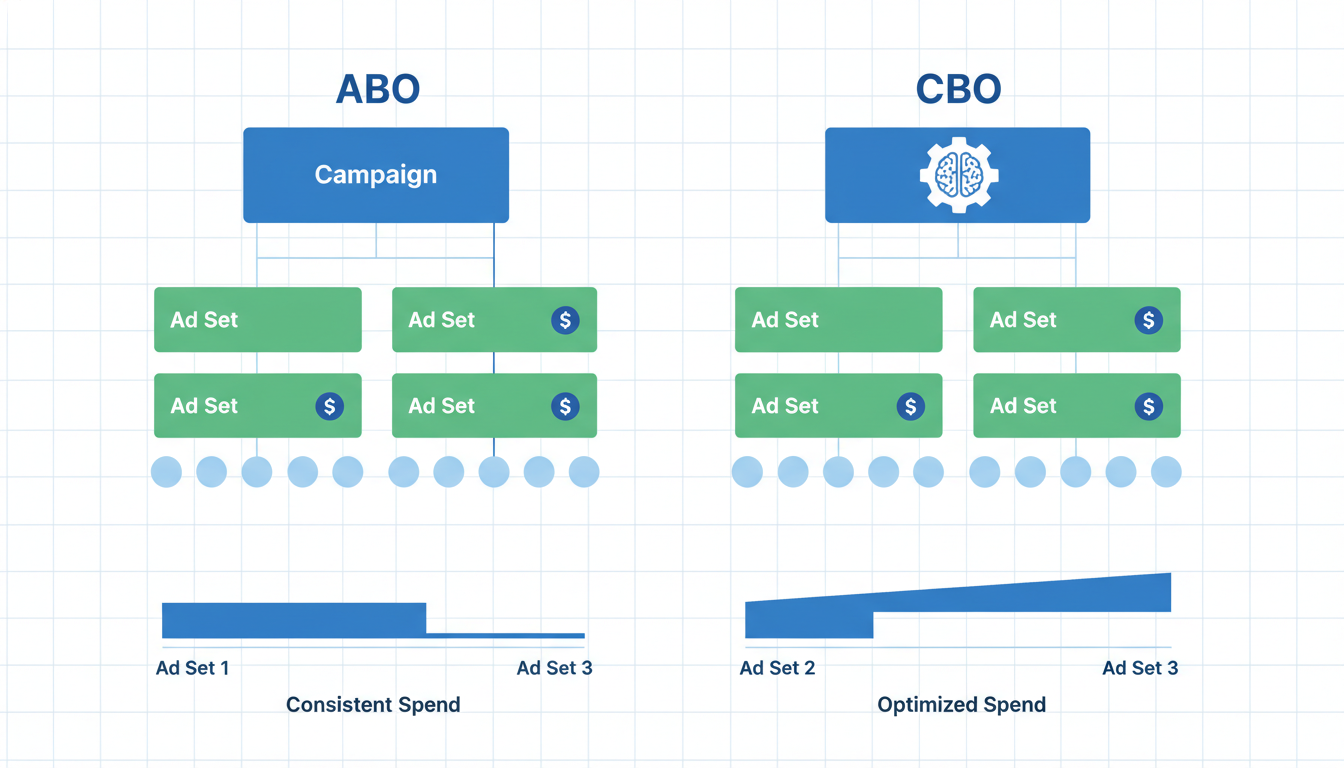
Shopify Meta ABO vs CBO is the wrong question in 2026, and most operators are still fighting it like it's 2021. ABO (ad set budget optimization) gives you per-ad-set control and clean read on audience performance. CBO (campaign budget optimization) hands Meta the allocation decision across ad sets and optimizes at the campaign level. Under $5k a month in Meta spend, ABO usually wins because you need the data cleanliness. Above $15k a month, CBO almost always wins because Meta's algorithm has enough signal to allocate better than you can. Between $5k and $15k is a coin flip, and mostly depends on how clean your tracking is. Then Advantage+ Shopping came along and changed the whole frame, because it replaces the CBO decision entirely for most Shopify stores. Read on before you migrate anything.
- Below $5k a month: run ABO for 2 to 3 weeks to learn audience performance, then decide.
- $5k to $15k a month: CBO usually wins if EMQ is above 8, ABO wins if it's below 7.
- Above $15k a month: CBO or Advantage+ Shopping. ABO is leaving money on the table.
- Advantage+ Shopping replaces CBO for most Shopify stores. Test it before you commit to CBO.
What ABO and CBO actually do differently in 2026
ABO and CBO sound like a budgeting preference. They are not. They are two completely different ways of telling Meta's algorithm what to optimize for.
ABO, or ad set budget optimization, gives each ad set its own daily budget. You pick $20 a day for the lookalike ad set, $30 a day for the interest ad set, $10 a day for the retargeting ad set. Meta spends roughly that amount in each, regardless of which one is converting. You get clean per-audience data because spend is fixed, so ROAS per ad set is directly comparable. The tradeoff is obvious, you are making the allocation decision Meta's algorithm could probably make better if it had the chance.
CBO, or campaign budget optimization, puts the budget at the campaign level and lets Meta decide how to split it across ad sets in real time. You set $60 a day at the campaign, Meta might spend $50 on the ad set that's converting and $10 on the one that isn't, and shift the ratio hourly based on performance. The tradeoff is you lose clean per-audience read, because a low-ROAS ad set might just be starved of budget that hour, not actually bad.
What changed in 2026 is that Meta's allocation algorithm got dramatically better in late 2024 when they shipped the Advantage+ audience signal merge. Before that, CBO would underspend certain ad sets for days and you would get noisy data. Now it allocates within hours of a clean signal. That shifted the break-even point on Shopify Meta ABO vs CBO meaningfully downward, from roughly $30k a month in 2023 to around $15k in 2026. See Meta's Campaign Budget Optimization documentation for the full mechanic.
When ABO wins on Shopify
ABO wins in three specific situations on Shopify stores, and most operators run it outside those situations for longer than they should.
- You are below $5k a month in Meta spend. The algorithm simply does not have enough daily conversions to allocate intelligently at the campaign level. Under 50 conversions a week across the campaign, CBO guesses. ABO at least gives you clean per-audience data you can act on yourself.
- You are testing new audiences and need a clean read. Drop 3 to 5 new ad sets in an ABO campaign at $10 to $15 a day each, run for 10 days, kill the losers. CBO would starve the slow starters before you ever got signal on them. ABO protects the test.
- Your Event Match Quality is below 7. With bad tracking, CBO's allocation decision is running on garbage signal, so it sends budget to the wrong ad sets. ABO's manual allocation at least protects you from that feedback loop. Fix EMQ first, then revisit.
The 2026 ABO playbook on Shopify looks like this. Create one campaign with clear naming ("US | Cold | ABO | April"). Drop 4 ad sets in it, each targeting a different audience hypothesis (broad, lookalike 1%, interest stack, lookalike 3%). Give each $15 to $25 a day. Run for 10 to 14 days minimum. Kill any ad set below 1.5 ROAS at day 10. Scale the winners by 25% every 3 days until they plateau. This is slow, deliberate, and boring, and it's also how you build a map of what actually works before you hand the budget to the algorithm.
When CBO wins on Shopify
CBO wins when you have scale, signal, and a stable creative pool. Take away any of those three and CBO underperforms ABO.
- You are above $15k a month in Meta spend. At this volume, Meta's algorithm is making allocation decisions across 50 plus conversions a day, which is enough signal to beat human intuition almost every time. The operators who hold on to ABO past this point are usually doing it out of habit, not math.
- Your EMQ is above 8.5 and your pixel is clean. Good signal in means good allocation out. If your Meta CAPI setup is deduped correctly and EMQ is above 8.5, CBO will route budget to the highest-LTV audience in real time, faster than you can do it manually.
- You have 4 to 8 ad sets with proven creative and you want to pressure-test them against each other at scale. CBO will double down on the winners and starve the losers inside 48 hours. That is exactly what you want at this stage. ABO would force equal spend on proven-weaker ad sets, which is waste.
The 2026 CBO playbook on Shopify. Start with a campaign budget equal to 2 to 3x your current daily Meta spend so the algorithm has room to breathe. Drop 4 to 6 ad sets in, each with its own audience hypothesis but all inside the same cold or retargeting objective. Let it run 7 days before you touch anything. Do not pause ad sets in the first week even if one is spending most of the budget. That is the algorithm doing its job. Review on day 8, prune the ad sets Meta has not spent on in 72 hours, and keep scaling the campaign budget by 20% every 3 days until ROAS drops. See Meta's ad set budget documentation for the parallel reference on when to override CBO.
The Advantage+ Shopping question (both die sometimes)
Here's the part most of the 2026 Shopify Meta ABO vs CBO guides miss, and it's the most important thing on this page. Advantage+ Shopping, which Meta shipped to general availability in 2023 and meaningfully improved in 2025, is not an audience type. It replaces the campaign structure entirely.
In Advantage+ Shopping, you do not pick ad sets. You do not pick audiences. You give Meta a budget, a set of 3 to 10 creatives, and a conversion event (usually Purchase), and Meta runs the entire allocation decision, audience decision, and creative decision on its own. It can outperform both ABO and CBO on Shopify stores above $10k a month in Meta spend, because it has access to signals the manual campaign types do not. We have seen it beat hand-tuned CBO campaigns by 20 to 40% on blended ROAS at the same spend level across around 15 store audits in Q1 2026.
So the real decision tree in 2026 is not ABO vs CBO. It is:
- Under $5k a month Meta spend? Run ABO. Learn the audiences. Full stop.
- Between $5k and $10k with clean tracking? CBO, but test Advantage+ Shopping in parallel at 30% of spend.
- Above $10k with clean tracking? Advantage+ Shopping as the primary, CBO as a backup campaign for specific retargeting flows Advantage+ cannot handle.
- Bad tracking (EMQ under 7)? Fix tracking first. Nothing else matters until the signal is clean.
Advantage+ Shopping does not handle retargeting well, which is the one area CBO still clearly beats it. Keep a CBO retargeting campaign running in parallel for your 30-day and 60-day audiences. See Meta's Advantage+ Shopping documentation for the setup specifics. If you are new to the format, run it as 30% of your total Meta budget for 2 weeks before scaling it higher, because the learning phase is real and the first 10 days can look worse than your existing setup.
Budget tier recommendations
Plain table of what we actually recommend per budget tier across the 40 ish Shopify stores we have audited in 2026 so far:
- $1k to $5k a month: ABO only. Run one campaign, 3 to 4 ad sets at $10 to $25 a day each. Do not run CBO. Do not run Advantage+ Shopping. You don't have the volume.
- $5k to $10k a month: ABO for cold audience testing (one campaign, $30 daily), CBO for scaling winners (one campaign, 50 to 70% of budget), test Advantage+ Shopping at 20% of total budget. Three campaigns, clear lanes.
- $10k to $20k a month: Advantage+ Shopping as the primary (60% of budget), CBO for retargeting (25%), ABO for new audience experiments (15%). This is the structure we run on most mid-tier Shopify clients.
- $20k to $50k a month: Advantage+ Shopping primary (70%), CBO retargeting (20%), creative testing ad set in ABO (10%). Your bottleneck at this scale is creative, not structure, so keep testing ads aggressively and let the algorithm allocate the rest.
- $50k plus a month: Advantage+ Shopping plus multiple Advantage+ variants for different customer segments (repeat buyers, first-time buyers), CBO retargeting, lean creative testing. At this scale nothing else is competitive.
The numbers above assume EMQ above 8 and a deduped pixel setup. If your tracking is broken, ignore all of this and fix tracking first. A 40% ROAS gap from bad tracking swamps any structural win you could get from picking the right campaign type.
Migration: moving from ABO to CBO without tanking learning
This is where most stores lose 4 to 6 weeks of performance, because they flip the switch on a Monday and then watch ROAS crater for two weeks and panic back into ABO before the algorithm has finished learning. The right way is boring and slow, and it works.
Best to run the migration over 3 weeks, not 3 days. Week 1: duplicate your best ABO ad sets into a new CBO campaign at 25% of current spend. Leave the ABO campaigns running untouched. You are testing, not switching. Week 2: if the CBO campaign is within 20% of ABO ROAS, scale CBO to 50% of total spend and pull ABO back to 50%. If CBO is more than 30% worse, pause it and diagnose, because that usually means either a signal problem or a creative mismatch. Week 3: if CBO held up at 50%, push it to 80%. Keep one ABO campaign running at 20% for new audience testing, permanently.
Do not, under any circumstance, migrate audiences one at a time into a CBO campaign. That breaks the algorithm's ability to learn cross-audience allocation, which is the entire reason you migrated in the first place. Move 4 to 6 audiences at once into the CBO campaign, even if some of them are weaker performers. Meta needs to see the relative quality across ad sets to allocate intelligently, and you only get that signal when all the ad sets are active at the same time.
The other migration mistake is keeping the same daily budget. Meta's CBO algorithm performs better with a higher absolute budget, because it has more daily conversions to optimize against. If you were running $100 a day in ABO across 4 ad sets, start the CBO campaign at $120 to $150 a day, not $100. You want the algorithm to have room to breathe while it learns.
The 3 tests we run before switching a client
We do not move a client from ABO to CBO until three specific things are true. Every single time we have skipped one of these, the client came back in 3 weeks asking why ROAS fell off a cliff. So now we just don't skip them.
- EMQ above 8.0 on the 7-day rolling window. If your Event Match Quality is below 8, CBO is optimizing on bad signal. It will send budget to the wrong ad sets and you will blame CBO when the real problem is the pixel. Fix CAPI setup first. We literally won't run the migration until this clears.
- At least 50 conversions per week on the campaign that is migrating. Below this, Meta doesn't have enough signal to beat a human operator's allocation. ABO will outperform until you cross the 50 per week threshold, reliably, for 2 weeks in a row. If the account is bouncing between 30 and 60 conversions week to week, hold the line on ABO until it stabilizes above 50.
- At least 4 creatives per ad set, refreshed in the last 21 days. CBO needs creative variety to allocate intelligently. If you have one hero creative per ad set and it's been running for 30 days, the algorithm can't differentiate ad sets on creative quality, only on audience, which is half the signal it actually uses. See our Meta creative fatigue guide for the refresh cadence we recommend.
Only after all three of these clear does the migration start, and even then we run the 3-week ramp from the previous section. This sounds overly cautious and it is, on purpose, because the downside of migrating too early is 4 weeks of underperformance and a shaken client relationship, and the upside of waiting 2 extra weeks is basically zero lost. Patience compounds in this business.
Frequently asked questions
Is CBO always better than ABO in 2026?
Does Advantage+ Shopping replace CBO on Shopify?
How long does CBO take to learn after I launch?
Should I test ABO and CBO at the same time?
Can I use CBO for retargeting on Shopify?
What is campaign budget optimization on Shopify actually costing me if I get it wrong?
Shopify Meta ABO vs CBO is a budget-tier question, not a best-practice question. Below $5k a month, ABO. Above $15k with clean tracking, CBO or Advantage+ Shopping. Between those two, it depends on your EMQ and your creative refresh cadence. The teams that keep fighting this as a religious debate ("CBO is always better," "ABO gives you control") are usually the ones running the wrong one for their current stage. Check your weekly conversions, check your Event Match Quality, check your creative mix, then decide. And if Advantage+ Shopping is not at least in your testing rotation, run 30% of your budget through it for 2 weeks before you do anything else, because it is the biggest shift in Meta campaign structure since CBO itself launched in 2019.
Get a full X-ray of your ad account
Paste your Meta and Google Ads. See exactly where signal is leaking. Free. 60 seconds.