Cold traffic Meta ads strategy for Shopify
 By Dror Aharon
·
CEO, COREPPC
·
Updated April 17, 2026
·
11 min read
By Dror Aharon
·
CEO, COREPPC
·
Updated April 17, 2026
·
11 min read
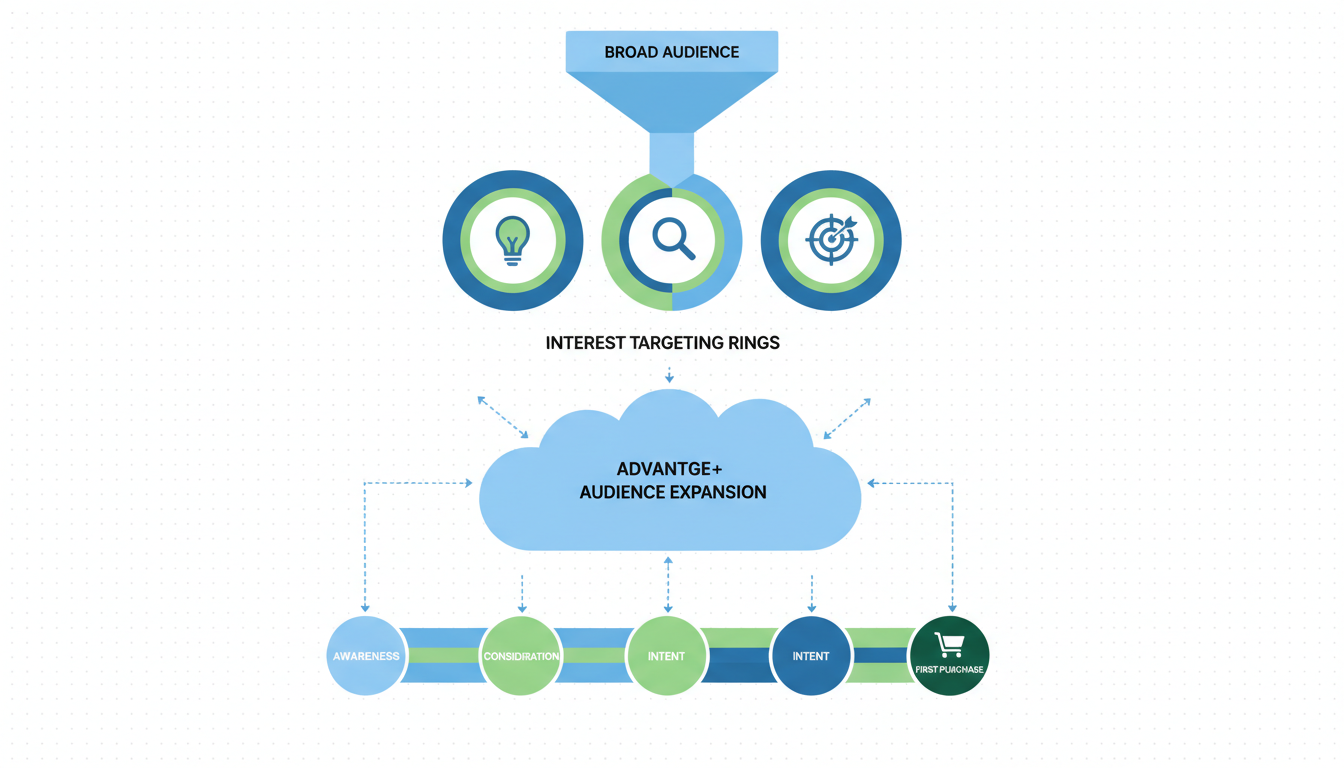
Shopify Meta cold traffic is the top of the funnel that most operators quietly starve, because retargeting ROAS looks prettier on a report and nobody wants to be the person who spent 70% of budget on people who had never heard of the brand. So they underfund prospecting, the warm pool shrinks, retargeting ROAS collapses two months later, and everyone blames the creative. The fix is a 70/20/10 split (70% cold, 20% warm, 10% retargeting), creative built for strangers not customers, broad targeting with the pixel doing the sorting, and a measurement frame that does not punish cold for having a 1.2x ROAS when it is feeding the rest of the account. Do this for 60 days and the blended number climbs. Skip it and the account slowly flatlines. The "cold cannot convert" myth is what keeps most Shopify stores stuck under $30k a month in Meta spend.
- Run a 70/20/10 budget split across cold, warm, and retargeting. Not 30/30/40.
- Build creative for strangers. Hook in the first 1.5 seconds or they are gone.
- Go broad for most Shopify stores in 2026. Interest stacks underperform since Advantage+.
- Measure cold on assisted conversions and new customer rate, not last-click ROAS.
What cold traffic actually is on Meta in 2026
Cold traffic on Meta in 2026 is anyone who has not interacted with your Shopify store in the last 180 days. No site visit, no Add to Cart, no video view past 50%, no engagement with an ad. Just a stranger scrolling through Reels on a Tuesday night. That is the pool you need to reach.
Here is the part that trips people up: "cold" does not mean "uninterested". It means "has not yet raised a hand". You are interrupting someone who was not looking for you, and you have roughly 1.5 seconds to make them not scroll past. That constraint changes everything about creative, targeting, and budget logic.
The reason this matters for Shopify specifically: most stores run a 2:1 or 3:1 ratio of existing-audience spend to cold spend, because that is what ROAS-per-campaign optimization tells them to do. Retargeting always looks better on a dashboard. But the warm pool is not infinite. If you are not feeding it from the top, it drains in 45 to 60 days and the whole account starts to wobble. That 9x retargeting ROAS in the screenshot is eating the warm pool faster than cold is refilling it, and in two months you are staring at a 1.4x blended number wondering what broke.
The 70/20/10 budget rule for cold vs warm vs retargeting
The budget split that works for 80% of the Shopify stores we audit is 70/20/10. Seventy percent of monthly Meta spend goes to cold prospecting. Twenty percent goes to warm audiences (site visitors, engagers, 50%+ video viewers from the last 90 days). Ten percent goes to true retargeting (Add to Cart, Initiate Checkout, last 30 days). Not the other way around.
The reason most operators get this backwards: retargeting always shows the highest ROAS in Ads Manager, so it looks like the obvious place to spend more. But that number is mostly last-click math on people who were going to buy anyway. You are not generating those purchases with the retargeting ad, you are harvesting demand that cold traffic already created. Scale retargeting past 20% of spend and you are paying Meta to remarket to people who would have come back through email or direct traffic anyway.
The 70/20/10 rule tests out this way in practice across the roughly 40 Shopify accounts we audit each month:
- Stores at 70/20/10: blended ROAS 2.8 to 3.4, steady month over month, predictable scale.
- Stores at 50/30/20: blended ROAS 2.1 to 2.6, scale attempts break the account because the warm pool is already stretched.
- Stores at 30/30/40 (retargeting-heavy): blended ROAS looks like 4.2 on a dashboard but actual new customer acquisition is flatlining, so the business is slowly dying while the dashboard looks fine.
Meta's own prospecting vs retargeting guidance lands in the same range. Retargeting above 20% is almost always a sign the account is underfunding the top of the funnel, not a sign that retargeting is working especially well. The dashboard is lying to you, basically.
One more thing. The 70% cold allocation is not one campaign. It is usually split across 2 to 4 cold prospecting campaigns running different creative angles and audience definitions. Single-campaign cold at 70% of spend concentrates risk on one set of creative, and when it fatigues (and it will) the whole top of the funnel goes dark for a week while you rebuild.
Cold creative is different: 4 rules
The fastest way to burn a cold prospecting budget is to run the same creative you use for retargeting. Retargeting creative can say "Come back, here is 10% off". Cold creative has to do a completely different job: introduce a brand to a stranger, make them feel something in under two seconds, and earn the second second of attention. Four rules that separate cold creative that works from cold creative that drains budget:
Rule 1: Hook in 1.5 seconds, or nothing else matters. The single biggest predictor of cold ROAS is hook rate (the percentage of people who watch past 3 seconds). Stores with hook rates above 30% run profitable cold. Stores below 20% never do, regardless of how good the rest of the ad is. The hook is a visual pattern interrupt, a question that reframes the problem, or a surprising number. "Our candles burn for 80 hours" is a hook. "Welcome to our store" is not.
Rule 2: Lead with a problem, not the product. Cold viewers do not know your brand. Showing them a product first is like handing a stranger a business card. Showing them a problem they recognize, then revealing the product as the fix, gets a 2 to 3x higher click-through. This is the mechanic behind every UGC ad that starts with "I used to have this problem and I tried everything until..." The story comes before the product, always.
Rule 3: Do not use cold creative to sell. Use it to disqualify. The point of the cold ad is not to close a sale in the first touch. It is to get the right person to click, and the wrong people to scroll past. Hype-driven creative pulls in clicks that do not convert, so cold CPA looks terrible and you kill the campaign. Specific, product-forward creative pulls in fewer clicks but higher-quality ones. Fewer clicks, higher quality, is almost always the correct trade on cold.
Rule 4: Test 4 to 6 concepts per 30 days, not 20 variations of the same concept. The failure mode we see the most is stores testing hundreds of copy variations on the same hook. That is not testing, that is noise. Real testing is four genuinely different concepts (a problem-first UGC, a product demo, a founder story, a social proof ad), each with 3 to 5 variations, running long enough to hit 50+ conversions per concept. Below that volume, winner declarations are mostly random.
Broad vs interest targeting for Shopify cold
For 90% of Shopify stores in 2026, broad targeting outperforms interest stacks on cold. This has been true since roughly Q3 2024 when Meta's algorithm improvements made interest-based targeting actively worse than broad for most e-commerce. Operators who have not retested since then are leaving money on the table.
What broad means in practice: one age range (usually 25-54 for most Shopify DTC), one country or a tight regional cluster, no interests, no lookalikes stacked on top, no behavior filters. Let the pixel and Meta's Advantage+ Shopping algorithm do the sorting. The pixel already knows who converts. Interest layers just restrict the pool and force the algorithm to optimize within a smaller set, which raises CPM and lowers match quality.
Where broad still underperforms interest:
- Very new pixels (under 50 purchases in the last 30 days). The algorithm does not have enough signal to sort broad, so interest stacks give it a head start. Stay on interest until the pixel has 50+ purchases, then retest broad.
- Geographic niches (a store selling only to Austin, Texas). Broad will waste spend across the whole country before it figures out the geo pattern. Interest in this case is usually a location filter, not a behavioral one.
- Very specific niches where the product only applies to 2% of the population (e.g., competitive powerlifting gear). The algorithm does not have enough conversion signal from broad to find that 2% quickly, and interest targeting acts as a shortcut.
For every other case (most Shopify DTC stores selling into the US or a major English-speaking market), broad is the default in 2026. Fastest way to test yourself: run two identical ad sets, one broad, one with your best-performing interest stack, same creative, same budget, for 14 days. Nine times out of ten broad wins on CPA. If interest wins, it is usually because the pixel is still learning and broad needed more time.
CBO vs ABO for cold specifically
CBO vs ABO on cold is one of those debates that looks religious from the outside but is actually simple once you separate the use cases.
CBO is the right call when you have 3+ ad sets in a campaign and you want Meta to shift spend toward whichever one is performing best in real time. This is most cold prospecting campaigns. The algorithm is usually better than you at allocating between a broad ad set, a lookalike, and a creative-specific test.
ABO is the right call when you are testing something specific and you need to prevent Meta from draining budget to the winner before you have significance. Creative testing, new audience definitions, any clean A/B. ABO forces equal spend across ad sets.
The mistake we see most often: stores put everything on CBO because "Meta recommends it", then run a creative test inside a CBO campaign and wonder why one ad ate 80% of budget in three days. CBO is not designed for testing, it is designed for scaling. Use ABO to find the winner, then move that winner into CBO to scale.
One more wrinkle. Advantage+ Shopping is a third option that sits alongside CBO and ABO, with the algorithm making almost every decision for you. For stores with a clean pixel (50+ purchases in the last 30 days, EMQ above 8), Advantage+ Shopping at 50 to 60% of cold budget is usually a better default than manual CBO in 2026. The other 40 to 50% runs on CBO with your controlled creative tests. Pure manual ABO cold is increasingly a relic, useful only for tight creative testing windows.
Measuring cold traffic performance without lying to yourself
The single most damaging measurement mistake on cold is judging it by last-click ROAS. Cold traffic almost never shows a strong last-click number, because cold is the top of the funnel. The purchase usually happens after a retargeting touch, an email, or a direct return visit. If you judge cold by last-click, you will kill the campaign that is actually driving the whole account.
The measurement frame that actually works:
- Cold ROAS target: 1.0 to 1.5x. Anything above break-even on a last-click basis is good. Cold is supposed to feed the rest of the funnel, not carry it.
- New customer rate. In Shopify analytics, the percentage of Meta-attributed purchases that are first-time buyers. Should be 60%+ for a healthy cold campaign. Below 40% and cold is just remarketing in disguise.
- Assisted conversions. In GA4 or Shopify's attribution reports, check how many purchases had a Meta ad anywhere in the path, not just as the last click. This number is usually 2 to 3x the last-click attribution.
- Blended ROAS (not campaign ROAS). Total revenue divided by total Meta spend for the month. This is the only number that tells the truth. Campaign-level ROAS is informative but misleading in isolation.
Stores that scale Meta past $30k a month run blended ROAS as the KPI and last-click as a diagnostic. Stores stuck under that number run last-click as the KPI and kill cold campaigns every time they dip under 2x. That is how you guarantee the account never scales.
When cold fatigues and what you rotate to
Cold creative fatigue is the other thing that breaks accounts silently. A creative that ran at 3x ROAS for six weeks starts drifting to 2.2x in week seven, then 1.6x in week eight, and by week ten you are losing money and do not know why. The answer is almost always frequency.
The rule of thumb: when ad frequency on cold crosses 3.0 in a rolling 7-day window, the creative is fatigued and ROAS will decline from here. Not might decline. Will decline. The audience has seen the ad too many times, the hook rate drops, the algorithm starts paying more per impression to reach new eyeballs, and the math falls apart. Fatigue is not an opinion, it is a frequency number.
The rotation pattern that works:
- Week 0: Launch 4 to 6 cold creative concepts.
- Week 2: Identify top 2 performers by CPA, kill bottom 2.
- Week 4: Launch 2 to 3 new concepts alongside the winners.
- Week 6: The original winners are hitting frequency 2.5 to 3.0. Start phasing them out.
- Week 8: Original winners are gone, new concepts are in the scale phase, another 2 to 3 are in testing.
Run this rotation continuously and the cold account never hits a fatigue wall. Skip it and every 60 days you get a panic week where blended ROAS collapses and you scramble to build new creative from scratch. The scramble always produces worse creative than a planned rotation, because good cold creative takes 1 to 2 weeks to conceive, shoot, and edit. You cannot do that in 48 hours under pressure.
Best to build the rotation into the ops calendar, not the budget calendar. Every two weeks on Tuesday morning, review frequency by creative, plan the next concepts, kick off production. It is boring and it is how accounts scale past $50k a month on Meta without ever going dark.
Frequently asked questions
Is it really true that cold cannot convert on the first touch?
Should I be running lookalikes on cold in 2026?
How much budget do I need for cold to actually work?
Why is my cold CPM so much higher than my retargeting CPM?
Does Advantage+ Shopping replace cold prospecting campaigns?
How long should I let a cold campaign run before judging it?
Cold traffic Meta ads for Shopify is the work that separates accounts that scale from accounts that plateau at $20k a month. Run the 70/20/10 split. Build creative for strangers, not for customers. Go broad and let the pixel sort. Measure on blended ROAS and new customer rate, not last-click. Rotate creative before frequency crosses 3.0. None of this is new information exactly, but the sequence matters, and most operators are skipping 2 or 3 steps. If your account is stuck, the problem is almost never the creative or the bid strategy in isolation. It is that cold is underfunded, measured wrong, and creative is fatiguing faster than it is being replaced. Fix those three things in the right order and the ceiling usually lifts inside 45 days.
Get a full X-ray of your ad account
Paste your Meta and Google Ads. See exactly where signal is leaking. Free. 60 seconds.