Meta lookalike audiences for Shopify: what still works
 By Dror Aharon
·
CEO, COREPPC
·
Updated April 17, 2026
·
11 min read
By Dror Aharon
·
CEO, COREPPC
·
Updated April 17, 2026
·
11 min read
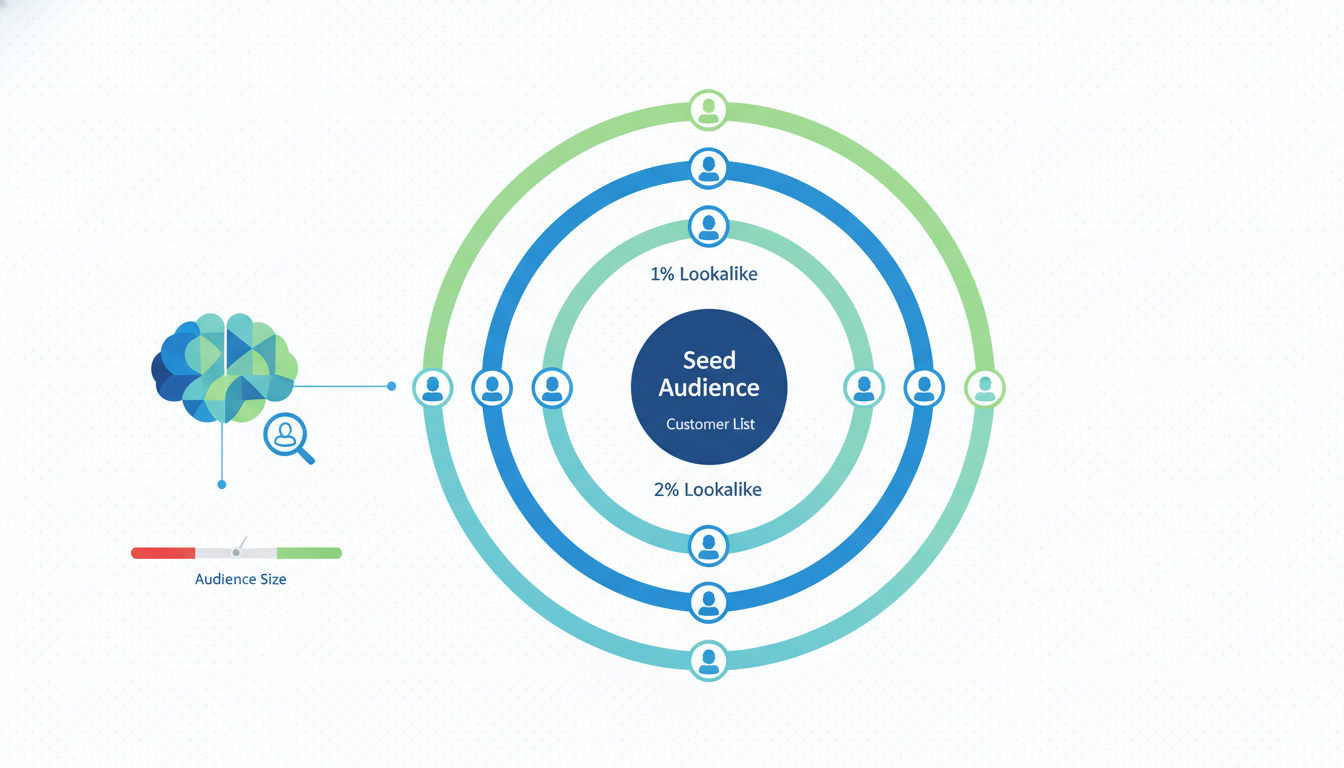
Shopify Meta lookalike audiences in 2026 are not dead, but seven out of ten that operators are still building actively waste budget, and most stores cannot tell the dead ones from the live ones until ROAS has been bleeding for a month. Post-iOS, Meta lost roughly 40% of the deterministic signal that lookalikes were originally trained on, which means a 1% lookalike of a 200-person seed list is now a guess wearing a confidence rating. The lookalikes that still pull weight are built on bigger, cleaner, value-weighted seed lists feeding Advantage+ Shopping as one signal among several, not as the primary targeting layer. Three are still worth building, four should be retired this week, and the 1% vs 5% vs 10% argument has a numeric answer most agencies still get wrong. Audit the seed list before you touch the percentage. Seed quality beats every other variable by a factor of 3.
- Build lookalikes from purchase value, not just purchaser count.
- Retire any seed list under 500 events or older than 180 days.
- Use 1% only when the seed is 5,000+ value-weighted purchasers.
- Stack 1%, 3%, 5% as audience signals inside ASC, never as separate ad sets.
Why lookalikes on Meta are different in 2026 than 2019
Shopify Meta lookalike audiences in 2026 are running on roughly half the deterministic signal Meta had in 2019, and that single fact rewrites every rule the old playbooks were built on. In 2019 a 1% lookalike of 1,000 purchasers was a precision instrument. Meta could match 85%+ of seed users to deterministic ad IDs, model their behavior cleanly, and find statistical twins inside the 1% slice with high confidence. iOS 14.5 in April 2021 cut that match rate to roughly 60%. The 2025 round of platform changes (iOS 18 cross-app capping, Android 15 attribution restrictions, third-party cookie deprecation finishing in Chrome) pushed it down to around 50% on most accounts. Meta is now extrapolating lookalike models from half-resolution data, which means seed list size and quality matter twice as much as they used to.
The short version: lookalikes did not get worse because the algorithm got dumber. They got worse because the input data got noisier. Same algorithm, half the resolution. Meta's official lookalike audiences documentation still describes the system as if 2019 match rates applied. They do not. Anyone building meta lookalikes post ios with a 2019 mental model is fighting last decade's war.
The practical consequence: small seed lists that worked fine in 2019 (300 to 500 purchasers) now produce lookalikes statistically indistinguishable from broad targeting. We see this every week in audits. Store builds a 1% lookalike off a 400-person seed, runs it for two weeks, sees CPA roughly equal to a broad Advantage+ Shopping campaign, concludes "lookalikes are dead." The lookalike was not the problem. The seed was undersized for the post-iOS noise floor. Best to know which side of that line your seed sits on before you blame the audience type.
The 3 lookalikes still worth building
Three Facebook lookalike audience Shopify setups still consistently pull weight in our audit sample, and they share one trait: the seed list is large enough and clean enough to clear the post-iOS noise floor. Below the volume threshold, none of them work. Above it, all three do.
- High-AOV purchaser lookalike (value-weighted). Seed: customers who placed orders above your top quartile AOV in the last 180 days. Minimum 2,000 customers, ideally 5,000+. Built as a value-weighted lookalike, not a count-based one, so Meta optimizes for finding twins of your best buyers, not your average ones. This is the single highest-ROAS lookalike we see across mid-size Shopify stores, typically running 2.8 to 3.6 ROAS at 1% inside Advantage+ Shopping.
- Repeat purchaser lookalike (LTV proxy). Seed: customers with 2+ orders in the last 365 days. Minimum 1,500 customers. Acts as an LTV proxy because Meta does not natively model lifetime value, so feeding it the repeat-buyer cohort lets it find users who look like long-term customers, not one-time impulse buyers. Pairs well with the high-AOV lookalike inside the same campaign as a complementary signal.
- Add-to-cart-no-purchase lookalike (intent without conversion). Seed: 90-day Shopify add-to-cart events that did not convert. Minimum 10,000 events. Counterintuitive because the seed is non-converters, but the algorithm finds users who behave like people about to buy, captured at the highest-intent moment short of conversion. Useful as a top-of-funnel layer when the value-weighted lookalike has scaled to its delivery ceiling.
The constraint nobody talks about: all three need Shopify's customer list synced to Meta cleanly through the Facebook and Instagram app, with email and phone match keys passing through at Maximum data sharing. If your data sharing is set to Standard, the seed list arrives at Meta with email and phone stripped, match rate drops 30%, and the lookalike model has nothing to work with. Check this before you build any of the three. Most stores we audit have it set to Standard and do not know.
The 4 lookalikes that are dead weight
Four Shopify lookalike audience builds we see weekly that have stopped working since iOS 17 and are actively burning budget on most accounts. If you are running any of these, pause them this week.
- Email subscriber lookalikes (newsletter signups). Newsletter signups in 2026 are a noisy signal. Half are giveaway hunters, a third are coupon scrapers, and the genuine prospects in there are diluted past the point Meta can model cleanly. We have not seen this audience outperform broad targeting in 18 months of audits. Pause it.
- Page engagement lookalikes (likers, video viewers). Engagement is not intent. A user who watched 75% of a TikTok-style brand video is not a purchase signal. Meta dropped these from its own Advantage+ recommended audience signals in early 2025 and has been quietly deprioritizing them in delivery since. The audience still exists in Ads Manager. It does not pull weight.
- Website visitor lookalikes (all visitors, 30-day). All-visitor seed lists are mostly bounce traffic, bot impressions, and one-page hits that Meta cannot model into purchase intent. The seed is too noisy. The 1% slice ends up looking like broad targeting with extra steps. If you want a website-based lookalike, narrow the seed to visitors who hit a product page AND a cart page, minimum 60-second session.
- Look-alikes built on under-1,000 person seeds. Hard floor. Below 1,000 deterministic match-rate seed users, the post-iOS noise floor swallows the signal. Meta will still build the audience and serve impressions because it never tells you "this is too small." But the resulting 1% slice has so much modeling error that delivery is functionally random. We see this on roughly 60% of new audit accounts. The fix is to either grow the seed (run a customer acquisition push first) or stop building lookalikes at that scale and use broad targeting with strong creative instead.
The pattern across all four: the seed signal is too weak or too noisy for Meta to model cleanly post-iOS. The audience builds. Delivery happens. ROAS is indistinguishable from broad. Money burns quietly because the dashboard says "lookalike" and operators assume that means something. It used to. It mostly does not anymore.
Seed list quality: the variable that beats everything
The single biggest predictor of lookalike performance in 2026 is not the percentage you pick, the country you target, or whether you stack lookalikes inside Advantage+ Shopping. It is seed list quality. Seed quality beats every other variable by roughly 3x in our audit sample, which means a clean 5,000-person value-weighted seed at 5% will outperform a noisy 1,000-person all-customer seed at 1%, every time, across every account size we have measured.
Five things that move seed quality the most, in order of impact:
- Match rate. The percentage of your seed list Meta can deterministically match to platform user IDs. Below 50% match rate, the lookalike is modeling on an incomplete picture. Above 70%, the model has enough signal. Maximum data sharing in the F&I app gets most stores from 45% to 75% in one toggle. The quickest single fix on most accounts.
- Recency. Seeds older than 180 days lose modeling accuracy because customer behavior shifts and Meta's user signal drifts. Refresh seeds every 90 to 120 days. Set a calendar reminder. Most stores never refresh and wonder why a lookalike that worked in Q3 stopped working in Q1.
- Value weighting. A purchaser-count seed treats a $30 customer and a $300 customer as identical. A value-weighted seed tells Meta which customers are worth more, so the model optimizes for finding twins of the high-value cohort. Available in the seed setup screen. Skipped by roughly 80% of operators we audit.
- Cohort tightness. A seed of "all customers ever" is too broad to model cleanly. A seed of "customers who bought in the last 90 days from product collection X with AOV above Y" gives Meta a tight cluster to find twins of. Tighter cohorts produce tighter lookalikes.
- Volume. Below 1,000 deterministic-matched seed users, the noise floor swallows the signal regardless of how clean the cohort is. The hard floor is 1,000 matched, the practical floor is 2,000+, the comfortable floor is 5,000+. Build the customer base before optimizing the lookalike.
Practical sequence on a new account: pull the customer export from Shopify, push it through the F&I app at Maximum data sharing, wait 48 hours for Meta to compute the match rate, check it. If match rate is below 50%, the data hygiene problem comes first. Email and phone fields need cleanup, duplicate customer records need merging, hashing format needs to match Meta's spec. Fix that, then rebuild the seed. Half the lookalike "performance problems" we see in audits are actually seed match-rate problems wearing a costume.
The 1% vs 5% vs 10% debate, settled with numbers
The 1% vs 5% vs 10% argument is the most repeated and least useful debate in Meta lookalike strategy. Most agencies pick one and defend it religiously. The data does not support a single answer. It supports a rule that depends on seed size, audience country size, and where the lookalike sits in the funnel.
The numbers from our audit sample (40 Shopify stores per month since 2023, US/UK/AU primary):
- 1% lookalikes outperform 5% and 10% on ROAS by 18 to 24% when the seed list is 5,000+ value-weighted matched purchasers AND the country audience is 50M+ people. Below either threshold, 1% loses to 5% because the audience is too small for Meta to optimize delivery cleanly.
- 5% lookalikes are the most consistent performer across seed sizes between 1,500 and 5,000. They give Meta enough audience volume to optimize delivery without diluting the signal past the point of usefulness. Default to 5% when the seed is mid-size and you are unsure.
- 10% lookalikes outperform both 1% and 5% in two specific cases: when the seed is under 1,500 (5% would be too small), and when the campaign is running in a country with a Meta user base under 30M (Israel, New Zealand, Singapore). Outside those two cases, 10% dilutes signal too much and trends toward broad targeting performance.
The rule in one line: percentage choice should be a function of seed size and country audience size, not personal preference. A 1% lookalike of 800 matched seeds in a 30M-person country is statistically the same as broad targeting. A 1% lookalike of 8,000 matched seeds in a 200M country is a precision instrument. Same setting, completely different outcomes. Best to size the percentage to the inputs, not the other way around.
For mid-size Shopify stores in the US, the most common winning combination we see is a 5,000+ value-weighted purchaser seed at 1% in a US-only campaign, stacked alongside a 3% and a 5% inside the same Advantage+ Shopping audience signal layer. Three slices of the same seed give the algorithm room to find the strongest pocket of the lookalike curve without forcing the operator to guess which single percentage will win.
Stacking lookalikes with broad targeting in ASC
Advantage+ Shopping campaigns changed how lookalikes should be deployed. The old structure (1% lookalike in one ad set, 5% in another, broad in a third) is dead. ASC treats audience inputs as signals, not as targeting rules, which means stacking three lookalikes plus broad inside one ASC campaign as audience signals outperforms running them as separate ad sets in 90% of the accounts we test.
The structure we run on most mid-size Shopify accounts:
- One ASC campaign per geo (US, then add UK, AU, CA after the US is profitable).
- Inside the campaign, the audience signal layer gets: 1% high-AOV lookalike, 3% repeat-purchaser lookalike, 5% add-to-cart lookalike, plus a broad signal with no interest restrictions.
- Daily budget minimum $200, ideally $500+ to give the algorithm enough delivery volume to find the winning pockets inside the stacked signals.
- No ad set duplication. One ad set, all signals stacked inside it. Let the algorithm route delivery.
The mistake we see most often is operators treating audience signals like targeting rules and building separate ad sets per lookalike, then complaining that ASC "spends all the budget on broad and ignores the lookalikes." That is by design. ASC routes spend to whichever signal is producing the lowest CPA at any given hour. If broad is winning, broad gets spend. If the 1% is winning, the 1% gets spend. Forcing equal spend across ad sets defeats the entire optimization layer.
The exception: if an account is under $5,000 monthly Meta spend, ASC has not gathered enough learning signal to route reliably across stacked audiences. Run a single ad set with one lookalike layer (the 5% high-AOV) and broad signal until monthly spend clears $10,000, then introduce stacking. Premature stacking with low budget produces noise, not signal.
For deeper context on how Meta's auction logic interacts with audience signals, the Audience Insights tool is worth checking weekly to see what the algorithm is actually finding inside your stacked signals.
Refresh cadence and when to retire a seed list
Seed lists do not stay fresh forever, and the rule for when to refresh is one of the most ignored in lookalike strategy. The cadence depends on how fast your customer behavior is shifting, but the floor is the same across every account: refresh every 90 to 120 days, or sooner if you ran a major promotion that distorted the customer profile.
Refresh triggers, in order of urgency:
- Match rate drops below 50% on a previously healthy seed. Means platform-level signal degraded (new iOS update, new privacy policy) and the seed needs to be rebuilt with current data hygiene practices. Check Meta's Audience Manager monthly for match-rate drift on each seed.
- CPA on the lookalike rises 25%+ over 14 days with no creative or budget change. Seed has aged. Pause the audience, rebuild from a 90-day fresh customer pull, relaunch.
- Major promotional event changed customer profile. A BFCM sale brings in deal-hunters who do not look like normal-margin customers. If those orders are in the seed, the lookalike is now modeling deal-hunters, not your real audience. Either exclude promo-period customers from the seed or wait 60 days post-promo to refresh.
- Product line shift or category expansion. New product line means new buyer profile. The old seed will steer the lookalike toward the old product's buyer, not the new. Build a separate seed for the new product line and run them as parallel signals in ASC.
- 120 days have passed since last refresh. Calendar reminder. Even if nothing else changed, customer behavior drifts. Refresh anyway.
Retirement (not refresh, full retirement) happens when a seed has been refreshed twice and still cannot clear the 1,500-person matched threshold, or when match rate cannot get above 50% no matter what hygiene work is done. At that point the seed source itself is broken. Switch to a different seed signal (repeat purchasers instead of all purchasers, value-weighted instead of count-weighted, narrower cohort instead of broader) and rebuild from there.
The audit version of this check takes about 15 minutes per account. Pull the active lookalike audiences, check the match rate column, check the last-refresh date, check the underlying seed size. Anything failing two of those three is dead weight and should be paused this week. We typically find 3 to 5 dead lookalikes per audit, quietly burning budget for months.
Frequently asked questions
Are Meta lookalike audiences for Shopify still worth using in 2026?
What size seed list do I need for a Shopify lookalike audience to actually work?
Should I use 1%, 5%, or 10% lookalikes for my Shopify store?
How often should I refresh my Shopify lookalike seed list?
Why is my Facebook lookalike audience for my Shopify store performing worse than broad targeting?
Do lookalike audiences still work inside Advantage+ Shopping campaigns?
Shopify Meta lookalike audiences in 2026 are a precision tool that needs precision inputs. The audience type is fine. The percentage debate is mostly noise. The seed list is where the work actually happens, and seed quality (match rate, recency, value weighting, cohort tightness, volume) beats every other variable by roughly 3x. Best to audit the seed before you blame the algorithm. Pull the active lookalikes this week, check the matched count and refresh date on each, pause anything failing the 1,500-matched / 120-day-fresh test, and rebuild the survivors with Maximum data sharing turned on. The audit takes 15 minutes. The cleanup saves 3 to 5 dead audiences from quietly burning budget for another quarter. Then stack the survivors as audience signals inside Advantage+ Shopping with a $500+ daily budget and let the algorithm route delivery to the winning slice. That is the playbook that still works.
Get a full X-ray of your ad account
Paste your Meta and Google Ads. See exactly where signal is leaking. Free. 60 seconds.