UGC ads for Shopify: how to brief and test
 By Dror Aharon
·
CEO, COREPPC
·
Updated April 17, 2026
·
11 min read
By Dror Aharon
·
CEO, COREPPC
·
Updated April 17, 2026
·
11 min read
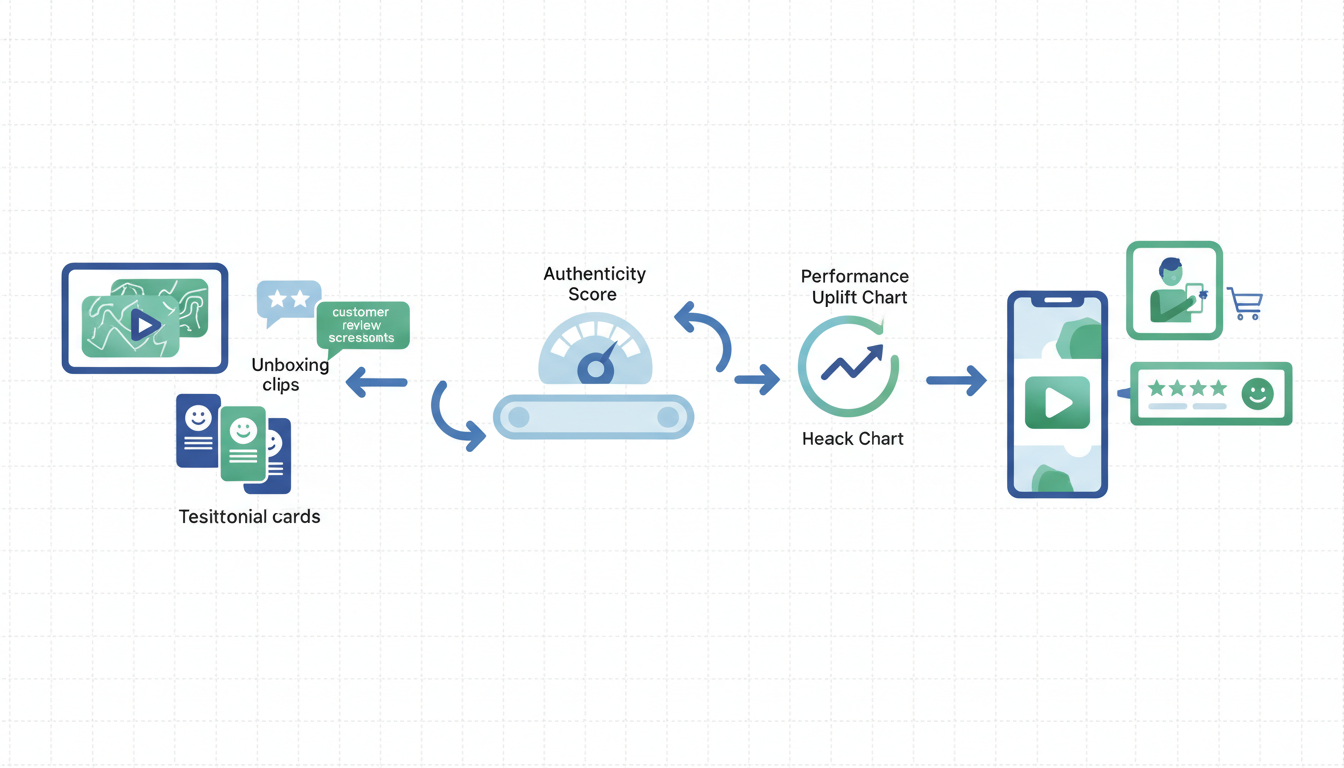
UGC became the default creative format for Shopify stores on Meta in 2024, and most operators still run it like polished brand video, which is why their UGC does not outperform their studio content. The brief is the whole job. Get it right and a $150 creator clip beats a $5,000 agency video three times out of four on cold traffic. Get it wrong and you pay creators $150 to make ads the algorithm cannot tell apart from your old stuff. This guide covers the 5-part brief template we actually send, the sourcing path that works (Insense versus Billo versus direct outreach), the budget math for a 12-ad testing grid, and the honest truth about what UGC beats and what it never will. No hero-creator fantasy. Just the briefing and testing loop that moves CPA.
- The 5-part brief template: hook, product moment, objection, call-to-action, specs.
- Creator sourcing: Insense for speed, Billo for volume, direct outreach for the winners.
- The 12-ad test grid: 3 hooks times 4 creators at $15 a day each for 7 days.
- UGC beats polished brand video on cold traffic. It does not beat a broken landing page.
Why UGC became the default creative format for Shopify Meta ads
Five years ago the default Shopify Meta ad was a studio-lit product shot on white background with a price drop headline. It worked, sort of, because every other store was running the same thing and cost per thousand was low. That era ended somewhere around 2022. By 2024 the creative that wins on Meta for Shopify is almost always a vertical phone video of a person actually using the product, talking to the camera, filmed in a kitchen or a bathroom or a car. No gimbal. Sometimes not even good lighting. The rougher it looks, the better it tends to perform.
The reason is boring and structural. Meta's feed is now 80% short-form vertical video, and the algorithm optimizes for watch time. Polished brand video pattern-matches to "ad" inside the first half-second and users thumb past. UGC pattern-matches to "friend" for another beat or two, which is enough for Meta to register a view and start serving the ad to lookalike users. The CTR gap is not huge, maybe 30 to 50%, but on a $10k a month budget that gap compounds into real dollars fast.
The other reason is that UGC scales. A studio shoot produces three or four ad variants. A creator roster produces 30 to 40 variants a month for the same budget. Meta's algorithm eats variants. More angles, more hooks, more faces, more chances for one of them to find an audience you did not know you had. So UGC became the default not because it is artistically better, but because the math works and the algorithm prefers it. The stores that are still debating this are losing ground week by week to the ones who stopped debating.
The 5-part UGC brief template that actually gets used
Most UGC briefs fail because they are written like a creative director's deck and read like one. Three pages of brand positioning, tone guidelines, target persona, mood board. The creator opens it, skims the first paragraph, and makes the video they would have made anyway. All that brief work is theater.
The brief that actually shapes the video is short, specific, and structured. Five parts, each under a paragraph. Here is the template we use.
- Hook (first 3 seconds). Write the exact opening line. Not a concept. A sentence. Example: "I bought this because my skin was wrecked from summer and nothing else was working." The creator is welcome to adjust for natural delivery. They are not welcome to invent a new hook.
- Product moment (seconds 3 to 10). Specify the one product action you want on camera. Example: "Pump three pumps into your palm, show the texture, apply to your face while talking." Not "use the product in a natural way."
- Objection handle (seconds 10 to 20). The objection your audience raises in reviews, comments, or customer service tickets. Example: "A lot of people ask if this breaks them out, and honestly it did not, and my skin is pretty reactive." The creator handles it in their voice.
- Call to action (final 3 to 5 seconds). The exact CTA. "Link in bio" or "Tap shop now" or "Use code NAME15". One CTA per ad. Do not stack.
- Specs. Vertical 9:16, shot on phone, good audio (lapel mic preferred but phone mic is fine if the room is quiet), no heavy editing, no captions burned in (we add captions ourselves for A/B testing), under 30 seconds total.
That is the whole brief. Under 400 words. The creator reads it in two minutes. Best to avoid sending anything else. Mood boards and brand guidelines actively hurt UGC because they push creators toward polished delivery, which is the exact thing you are trying to avoid.
Creator sourcing: Insense vs Billo vs direct outreach
There are three paths to get UGC made for a Shopify store on Meta, and they suit different points in the testing loop. Using the wrong one at the wrong stage is how stores burn $3,000 to get five videos that could not beat their existing creative.
Insense is the fastest on-ramp. You post a brief, creators apply, you pick four or five, product ships, videos come back in 10 to 14 days. Creator fees run $120 to $200 per video plus product cost. Quality is uneven because the creator pool skews toward beginners who are building a portfolio, but that actually works in your favor for volume testing. Best for stores that have never run UGC before and need their first 10 ads fast.
Billo is the volume path. Same model, bigger pool, slightly lower prices (around $100 to $150), shorter briefs supported, faster turnaround. Quality variance is higher still. The math makes sense when you are past the first 10 ads and running a monthly refresh cycle of 12 to 15 new creatives, because Billo will ship you that volume in two weeks without a production meeting.
Direct outreach is where the actual winners come from. Once you run the first 12-ad test grid (see next section) and one or two creators deliver ads that beat your control CPA by 20% or more, DM those creators directly and ask them to do 4 more ads at a slightly higher rate. The repeat creator is worth double what a new one is worth, because they already know your product, your hook structure, and your voice. Rate creep to $300 to $400 per video is fine for proven winners. Rate creep to $300 for untested creators is not.
The pattern: Insense or Billo for discovery, direct for scaling. Stores that try to discover winners through direct outreach end up paying premium rates to unvetted creators and usually stop running UGC inside three months.
Budget math: the 12-ad test grid
A single UGC ad does not tell you anything. Meta's algorithm needs variance to find signal, and your account needs enough spend per variant to clear learning phase. The grid we run for every new Shopify client looks like this.
- 3 hooks times 4 creators equals 12 ads. Each creator films all 3 hook variations with their own face and voice. Every ad shares the same product moment, objection, and CTA. Only the hook changes across rows, only the creator changes across columns.
- $15 a day per ad for 7 days. That is $105 per ad, $1,260 total for the grid. Meta needs roughly 50 purchase events per ad to exit learning. For a $60 product at 2% conversion rate, $105 of spend produces 8 to 12 purchases, which is not quite enough to exit learning on every ad individually but is enough on the ad set level to rank performance.
- One ad set per creator. Same audience (Advantage+ Shopping or broad interest), three ads inside the ad set, let Meta rotate them. This isolates creator effect from hook effect cleanly.
Total spend for the test: $1,260 over 7 days, plus $150 per creator times 4 creators equals $600 in production, plus $400 in product cost and shipping, for a blended $2,260 to run the full grid. Stores that try to run this for under $1,000 end up with not enough data per variant and make false calls on winners.
The output of the grid is a 3x4 matrix of CPA by hook and creator. One cell usually jumps out, sometimes two. That cell becomes your control. The next grid scales that winning combination and tests new hooks around it. This is the testing loop. It never stops. Stores that run one grid and freeze on the winner see their CPA climb 15 to 30% within six weeks as Meta's algorithm learns the creative and audience overlap saturates.
What UGC beats and what it does not
UGC is not magic. It is a creative format that fits Meta's current algorithm and user behavior, and it beats a specific set of things. It does not beat everything, and pretending it does will waste your budget.
What UGC reliably beats on Shopify Meta ads:
- Polished brand video on cold traffic, by 20 to 40% on CTR and usually 15 to 30% on CPA.
- Static product shots with price overlays, by a wider margin (40 to 60% on CTR).
- Studio lifestyle photography for beauty, apparel, food, and supplements. Less of a gap for home goods and tech.
- Generic stock-ish video ads on retargeting audiences, though not by as much because warm traffic is less hook-sensitive.
What UGC does not beat, and no amount of briefing will fix:
- A broken landing page. If your product page converts at 1%, UGC will cut your CPA maybe 10%, not 40%. Fix the landing page first.
- A weak offer. $49 shipping on a $60 product kills ads regardless of creative. Creative is downstream of offer.
- Poor product-market fit. UGC makes a good product feel familiar faster. It does not make a bad product feel good.
- Tracking problems. If your Meta CAPI setup is leaking Purchase events, UGC will look like it is not working when the real issue is Event Match Quality sitting at 5.
Most stores that "tried UGC and it did not work" were not actually beaten on creative. They had a landing page problem, an offer problem, or a tracking problem, and creative cannot fix any of those. Best to audit those three before the next creative round.
Static vs video UGC on Shopify specifically
UGC usually means video, but static UGC (phone photos of a real person using the product, not studio shots) is a distinct format with its own use case, and skipping it leaves money on the table. Static UGC is cheaper, faster, and slots into Meta's carousel and catalog ad placements where video does not fit cleanly.
The rule of thumb we use:
- Video UGC for top-of-funnel cold traffic on Advantage+ Shopping and broad interest campaigns. Video wins on watch time and pattern-break.
- Static UGC for retargeting and catalog ads, especially dynamic product ads. Static carousels run at roughly 60% of video production cost and plug into Meta's catalog placements with better reach efficiency.
- Both for mid-funnel interest testing. Running a carousel of 4 static UGC shots alongside a video UGC ad in the same ad set often surfaces a cheaper variant.
Static UGC briefs are shorter than video briefs. Three parts: the moment (creator holding or using product, specific framing), the context (kitchen counter, bathroom shelf, etc.), the vibe (cheerful, neutral, grumpy-honest). Creators charge $40 to $80 per photo set of 6 to 10 shots, which is cheap enough to run weekly refreshes without negotiating budget.
Iteration cadence and when UGC fatigues
UGC fatigues on Meta faster than static brand creative, because the pattern-break effect wears off once an audience has seen the same face twice. The numbers to watch:
- Frequency. When an ad hits 3.0 frequency on a cold audience, CTR usually drops 25 to 35% and CPA creeps up. That is the signal to rotate, not to increase budget.
- CTR decay. A healthy UGC ad holds its launch CTR for 10 to 21 days. When it drops 20% from the 7-day average and stays down for 4 days, the ad is done.
- CPA climb. CPA climbing 15% above rolling 14-day average for more than 5 days means the audience has seen enough of the creative. Rotate.
The cadence that keeps the account fresh without blowing up production budget: 12 new UGC ads per month, delivered in two drops of 6. Every drop replaces the bottom 6 performers from the prior month. At any given time the account runs 18 to 24 live creatives across all ad sets, with roughly a third of them being ads that have proven they can beat the account CPA benchmark.
This is where the roster from direct outreach pays off. Three trusted creators, each producing 4 videos a month at $250 each equals $3,000 in production for 12 ads a month, which is what a healthy $15k to $50k monthly Meta spend needs to sustain performance. Stores that try to run UGC off a single creator or a single agency hit fatigue walls in six to eight weeks and cannot figure out why their ROAS is sliding.
For the stack around the creative, Meta's own creative best practices documentation covers the technical specs (aspect ratios, file sizes, captions) and is worth a scan once a quarter as placement rules change.
Frequently asked questions
How much does a UGC ad cost to produce for a Shopify store in 2026?
Do I need creator licensing rights for Meta ads?
How do I A/B test UGC hooks without making four full videos?
What hook structures tend to win on Shopify Meta ads?
How does UGC interact with Meta's Advantage+ Shopping campaigns?
Do I need to disclose that content is sponsored if a creator made it for my ads?
Meta CAPI setup on Shopify is one of those fixes that looks small on the dashboard and compounds for months afterward. Dedup cleanly, raise EMQ above 8.5, validate in Test Events before you push live, and the algorithm finally has signal it can trust. That is when ROAS stops wobbling and budget scales predictably, instead of collapsing every time you push daily spend past the last tested ceiling. Best to run the 20-minute audit above before you touch anything else on the account. If the audit surfaces two or more of the problems in the "Why Shopify stores get CAPI wrong" section, fix those first, then revisit creative testing. The creative never was the problem, nine times out of ten the tracking was lying the entire time.
Get a full X-ray of your ad account
Paste your Meta and Google Ads. See exactly where signal is leaking. Free. 60 seconds.