Klaviyo vs Shopify Email: when to upgrade
 By Dror Aharon
·
CEO, COREPPC
·
Updated April 17, 2026
·
11 min read
By Dror Aharon
·
CEO, COREPPC
·
Updated April 17, 2026
·
11 min read
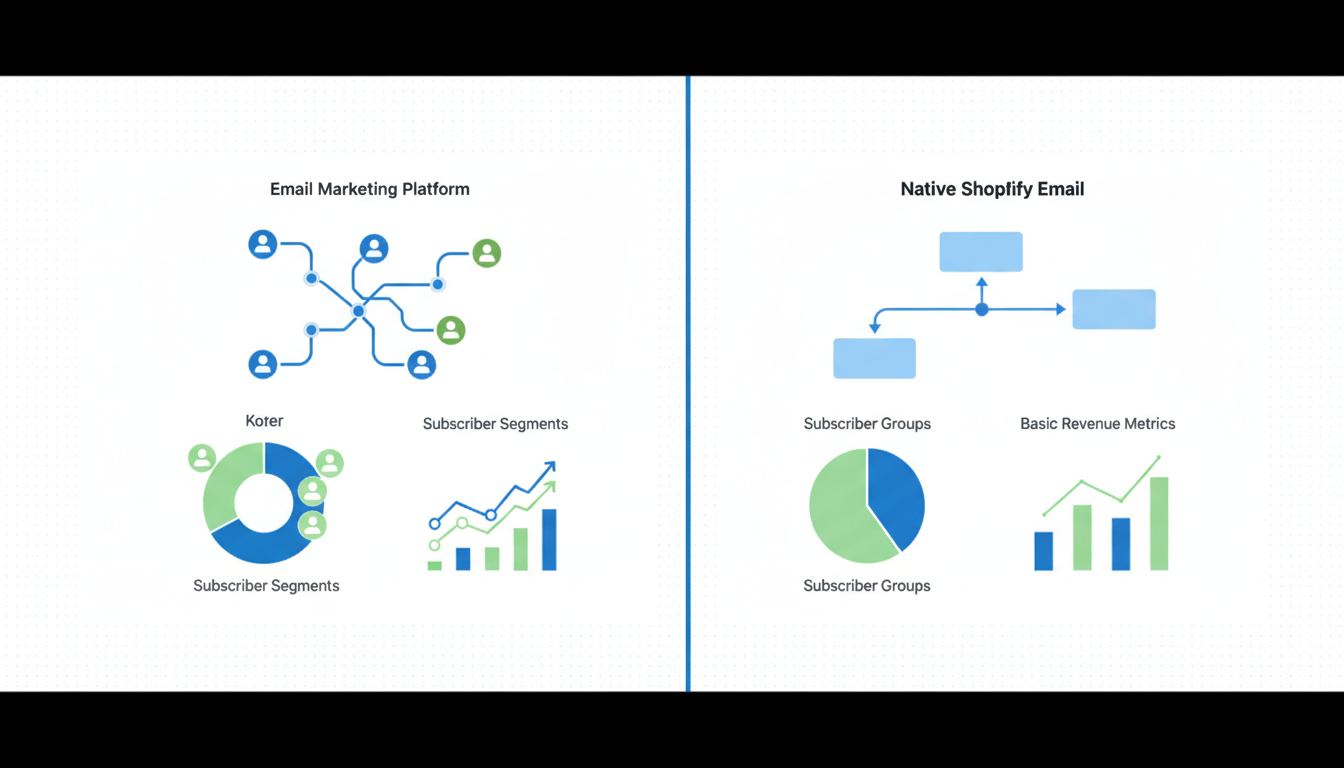
Klaviyo vs Shopify Email is the comparison most operators put off too long, usually because Shopify Email is free up to 10k sends a month and inertia is cheap. The honest answer in 2026 is that Shopify Email is genuinely enough for stores under roughly $40k a month with a list under 5k subscribers, two flows, and no segmentation beyond "bought once" or "did not buy". Above that, every month you stay on it costs real revenue, because email should drive 20 to 30% of total store revenue at maturity and Shopify Email caps out around 8 to 12%. We have run the audit on 60+ Shopify stores in 2025 and 2026. The pattern is clean: stores stuck on Shopify Email past the threshold leave $8k to $40k a month on the table, and the migration to Klaviyo pays back in 6 to 10 weeks. Best to test against the 25% rule before you decide.
- Shopify Email is genuinely enough below $40k/month revenue and 5k subscribers.
- The upgrade signal is email driving under 15% of total store revenue at scale.
- Klaviyo migration costs $3k to $8k and pays back in 6 to 10 weeks above the threshold.
- The 25% rule: if email is under 20% of revenue, the platform is the constraint.
When Shopify Email is genuinely enough
Shopify Email gets dunked on a lot in agency blogs, mostly by agencies that sell Klaviyo migrations, so it is worth saying clearly: the tool is fine for the store it was built for. The store doing $20k to $40k a month, with a list under 5k subscribers, sending one or two newsletters a month plus a basic abandoned cart flow, is the exact profile Shopify designed it for. At that scale, paying $20 to $100 a month for Klaviyo to do the same job is just rent for capabilities you will not use.
The honest pricing math: Shopify Email is free for the first 10,000 emails per month, then $1 per 1,000 emails after that. A store with 4k subscribers sending 4 campaigns a month (16k emails) plus an abandoned cart flow (maybe 2k emails) pays around $8 a month. Klaviyo at the same list size starts at $60 to $80 a month on the email-only plan. That is $700+ a year in savings, real money for a small store.
The integration is also genuinely tight in a way third-party apps cannot be. Shopify Email pulls product data, customer data, and order events from the same database the rest of the store runs on, with no webhook lag, no sync errors, no "the app needs to reconnect" notifications at 2am. Templates pull live product images, prices, and inventory automatically. For a small store running tight on operator hours, that reliability has real value.
What Shopify Email handles well, in plain terms: scheduled newsletters with product blocks that update automatically; one or two simple flows (welcome series, abandoned cart); basic segmentation on purchase history and signup source; and standard reporting on opens, clicks, and revenue per campaign. If your email needs do not extend past that list, you do not have a tool problem. You have a "your business is small and that is fine" situation, and any agency telling you otherwise is selling you something.
The line in the sand: under $40k a month in store revenue, under 5k subscribers, under 4 active flows, no segmentation beyond bought/did not buy. If three of those four are true, stay on Shopify Email and spend the $700 a year on something with higher impact, like better photography or paid ad creative testing.
The signals you have outgrown Shopify Email
The shopify email or klaviyo decision starts mattering when you cross specific thresholds, and most operators cross them without noticing. The five signals below come up in roughly the same order in every audit we run on stores stuck on Shopify Email past their useful threshold.
Signal 1: email revenue is stuck under 15% of total store revenue. For a store doing $80k a month, that means email is generating less than $12k. Klaviyo benchmarks for stores in the $50k to $200k monthly band typically run 22 to 28% of revenue from email. If you are at 12% and your competitors are at 25%, the platform is leaving roughly 13 percentage points on the table, which at $80k revenue is $10k a month in missing flow and campaign revenue.
Signal 2: you tried to build a flow and gave up halfway. Shopify Email's flow builder handles welcome and abandoned cart cleanly. Past that, the logic gates get thin fast. If you have ever wanted a post-purchase sequence that branches based on product purchased, or a win-back flow that fires only for customers above a certain LTV, and you opened the flow builder and closed it again, that is the signal. The capability gap is real.
Signal 3: you cannot segment on the dimension that matters. Shopify Email lets you segment on purchase history (bought X product, spent over Y, last ordered before Z date) and basic profile data. It does not segment on email engagement (opened in last 14 days, clicked specific campaign), browse behavior (viewed product page in last 7 days), or predicted attributes (LTV percentile, churn risk). When your "VIP" segment is just "spent over $200" with no engagement layer, half that segment is dormant and the campaigns to them tank engagement metrics.
Signal 4: list size is climbing past 5k and growing. Shopify Email scales technically (sending volume is fine well past 10k subscribers) but the segmentation and flow ceiling stays the same. A 15k list with three segments and two flows is about 20% as productive as the same list on Klaviyo with the same hours of operator time invested.
Signal 5: you are running paid acquisition and email signups are accelerating. Paid traffic that converts at 2 to 3% means 97% of the traffic leaves without buying. Email capture on that traffic is where most of the LTV math hides. If your store is spending $5k+ a month on Meta or Google and your email signups are growing 10%+ month over month, the platform that captures and nurtures those signups is doing real revenue work, and the gap between Shopify Email and Klaviyo on that work is large.
If three of these five signals are true, you have outgrown Shopify Email. The rest of this guide is the math on what the upgrade actually costs and pays back.
Pricing reality at 1k, 5k, 25k subscribers
Pricing is where the shopify native email vs klaviyo comparison gets foggy fast, because both platforms publish complicated tier structures and most blog posts quote stale numbers. Below are the real costs as of April 2026, pulled from Shopify Email's pricing page and Klaviyo's pricing page.
| Subscribers | Sends/month | Shopify Email | Klaviyo (Email) | Monthly delta |
|---|---|---|---|---|
| 1,000 | 4,000 | $0 (under 10k) | $20 | +$20 |
| 5,000 | 20,000 | $10 | $100 | +$90 |
| 10,000 | 40,000 | $30 | $150 | +$120 |
| 25,000 | 100,000 | $90 | $400 | +$310 |
| 50,000 | 200,000 | $190 | $720 | +$530 |
| 100,000 | 400,000 | $390 | $1,380 | +$990 |
The price gap looks brutal in isolation. $310 a month at 25k subscribers, $990 a month at 100k subscribers. That is real money. The math only works one direction: the revenue lift Klaviyo drives has to clear that delta plus a margin to make the upgrade rational.
Here is the rough revenue math at each tier. At 5k subscribers with a typical store doing $50k a month, email at 12% (Shopify Email benchmark) generates $6k. At 25% (Klaviyo benchmark), it generates $12.5k. Difference: $6.5k a month in email revenue. The $90 platform delta is rounding error against that lift. At 25k subscribers with a store doing $200k a month, the same percentage gap is $26k a month in revenue difference against a $310 platform delta. The economics get more obvious at scale, not less.
The trap at the small end: stores with 1k to 3k subscribers often try to "future-proof" by switching to Klaviyo early, paying $20 to $60 a month for capabilities the list is too small to need. At that scale, the segmentation depth does not matter because the segments themselves are too small to send to (a "VIP customer" segment of 40 people is not a meaningful campaign target). Below 5k subscribers, save the money and stay on Shopify Email until the signals in the previous section show up.
The trap at the large end: stores past 50k subscribers sometimes stay on Shopify Email because "the migration is a lot of work." It is. It is also a $530+ a month platform delta on top of $20k+ a month in lost email revenue. The migration pays back in roughly 4 to 6 weeks at that scale. Staying put is the expensive option.
Segmentation depth: where Shopify Email hits a wall
Segmentation is where the shopify email app comparison stops being about features and starts being about money. The depth of segmentation directly drives engagement, which drives deliverability, which drives every single campaign you send afterward. A store that segments well lands in the inbox. A store that blasts the full list every campaign lands in promotions, and over time, in spam.
Shopify Email's segmentation works on these dimensions: purchase behavior (product bought, total spent, order count, last order date), basic profile data (location, signup source, accepts marketing), and product affinity (tagged products in past purchases). The segments are flat AND/OR conditions, no nested logic. You can build "customers who bought running shoes AND spent over $150" but not "(customers who bought running shoes OR sneakers) AND (engaged in last 30 days) AND (predicted LTV in top 25%)".
Klaviyo's segmentation works on those dimensions plus: email engagement (opened/clicked specific campaigns or any campaign in a date range), browse behavior (viewed product page, viewed category, abandoned cart), predictive metrics (predicted LTV, predicted next order date, churn risk score), site activity (active on site in last X days, viewed X pages), and any custom event you fire from your store or apps. The logic supports nested AND/OR with multiple levels.
The practical impact of the gap, in real campaign math: a store with a 20k list runs a Black Friday campaign. On Shopify Email, the cleanest segment is "engaged in last 90 days based on purchase activity" which captures roughly 40% of the list, or 8k subscribers. On Klaviyo, the same store can build "opened email in last 30 days OR purchased in last 90 days OR viewed product in last 14 days" which captures 55% of the list at higher actual engagement, or 11k subscribers with stronger inbox placement.
That gap (8k vs 11k engaged sends, with the Klaviyo cohort engaging at higher rates) typically produces 40 to 60% more revenue from the same campaign idea. At a $50k Black Friday campaign on Klaviyo, the Shopify Email equivalent is $30k to $35k. The difference is not the email content. It is the platform's ability to find the right people to send it to.
The deliverability compound is the second-order effect that matters more over time. Engagement-based segmentation means dormant subscribers get pruned automatically from campaign lists, which keeps engagement rates high, which keeps domain reputation strong, which keeps every future campaign landing in the inbox. Stores stuck on Shopify Email's flatter segmentation often see open rates drift from 28% to 18% over 12 months as dormant subscribers drag down the average, and by the time they notice, deliverability has already degraded.
Flows and automation: where Klaviyo earns its price
Flows are the silent revenue layer of any email program, and the gap between Shopify Email and Klaviyo on flows is where the platform price difference actually pays back. A typical mature email program runs 8 to 12 flows that together drive 60 to 70% of total email revenue. Campaigns drive the other 30 to 40%. If your flows are weak, your email program is leaning on campaigns, which means your team is doing more work for less revenue.
Shopify Email supports basic flow templates: welcome series, abandoned cart, browse abandonment (limited), post-purchase, and customer winback. The triggers are straightforward, the timing is configurable, and the templates work. The ceiling shows up in three places: branching logic is shallow (most flows are linear), conditional content is limited (you cannot easily show different blocks to different segments inside the same email), and you cannot trigger flows on custom events.
Klaviyo supports the same flow templates plus the ability to build any flow you can describe. Common flows we set up that Shopify Email cannot reproduce: post-purchase sequences that branch by product purchased and route to different upsell paths; replenishment reminders timed to product-specific consumption rates (45 days for one product, 90 days for another); win-back flows that branch by historical AOV (low AOV gets a discount, high AOV gets a personal outreach), VIP nurture flows triggered when LTV crosses a threshold; and post-review flows that route 5-star reviewers to a referral ask and 1-3 star reviewers to a customer service handler.
The revenue math on flows is more concrete than on campaigns because flows compound. A welcome series that earns $3 per subscriber on Shopify Email typically earns $5 to $8 per subscriber on Klaviyo because the conditional content lets you tailor the offer. Multiply that by 5,000 new subscribers a year and the welcome flow alone produces $10k to $25k more revenue annually. Stack that across 8 to 10 flows and the compound is large.
The operator time math is the second piece. Shopify Email flows are faster to build initially because the options are fewer. Klaviyo flows take longer to build (8 to 12 hours for a complex post-purchase sequence vs 2 hours on Shopify Email) but the lift per flow is much higher. The breakeven is around 6 active flows. Below that, the operator time investment in Klaviyo does not pay back. Above that, every additional flow on Klaviyo earns 1.8 to 2.5x what the same flow would earn on Shopify Email.
Migration: what to rebuild, what Shopify keeps for you
Migration anxiety keeps stores on Shopify Email longer than it should. The reality is more manageable than the worst-case story makes it sound, but the work is real. Plan for 3 to 4 weeks of focused effort, $3k to $8k in agency cost or 40 to 80 hours of internal time, depending on flow complexity.
What Shopify keeps for you: customer profiles, purchase history, order events, product data, marketing consent, and unsubscribes. Klaviyo's Shopify integration installs in 5 minutes and starts pulling all of that automatically through the standard Shopify webhook channel. Subscriber list comes across cleanly with the original signup source preserved. No customer data gets lost in the move.
What you rebuild from scratch: every flow, every email template, every segment, every form, every campaign sender setup. The "import flows from Shopify Email" path does not exist as a one-click tool. Klaviyo offers template starter kits that approximate common Shopify Email flows, but you customize from there. Plan to rebuild every flow you currently run.
Week 1: list import, integration setup, deliverability prep. Connect Klaviyo to Shopify, verify customer sync, set up sender domain authentication (SPF, DKIM, DMARC) which Klaviyo's setup wizard walks through. Verify the subscriber list imported correctly and the marketing consent field mapped to the right field. Do not start sending yet.
Week 2: rebuild flows. Start with the highest-revenue flows (typically welcome and abandoned cart) and rebuild them in Klaviyo with the upgrades the new platform allows (engagement-based exits, conditional content, branching by product). For each flow, screenshot the Shopify Email version first so you have a reference, then build the new version with explicit improvements documented.
Week 3: rebuild segments and forms. Migrate the popup forms to Klaviyo (the visual builder is straightforward), rebuild your active segments with the new logic capabilities, and verify the segment sizes match what you expected from the historical Shopify Email data.
Week 4: deliverability warmup and parallel run. Send your first Klaviyo campaign to a small engaged segment (typically 2k to 3k highly engaged subscribers), monitor deliverability metrics, then ramp send volume over 7 to 10 days to full list. Run Shopify Email in parallel for one final week to compare revenue attribution between platforms, then pause Shopify Email sends and migrate fully.
The cost to do this with an agency: $3k for a small store with 4 to 6 flows, $8k for a complex store with 12+ flows and custom integrations. DIY costs nothing in dollars but eats 40 to 80 hours of operator time, which at any reasonable hourly rate often exceeds the agency cost. For stores past $100k a month in revenue, hire the agency. The ramp is faster and the flows are built right the first time.
The 25% email revenue rule and how to test against it
The single best diagnostic for whether your email platform is the constraint is the 25% rule: at maturity, email should drive 20 to 30% of total store revenue. If your email program is below 20%, the bottleneck is one of three things, and the platform is the most common one.
The math is simple to run. Open your store's revenue dashboard for the last 90 days. Pull total revenue. Open your email platform's reporting and pull email-attributed revenue for the same 90 days (using the platform's default attribution window, which is typically a 5-day click and 1-day open). Divide email revenue by total revenue. That is your email contribution percentage.
The benchmarks, by store profile: - Brand-new store (under 6 months, list under 1k): expect 5 to 12% from email. Below benchmark is normal at this stage. Platform is not the issue. - Growth-stage store (6 to 24 months, list 1k to 10k): expect 12 to 22% from email. If you are below 12%, the issue is usually content frequency or basic flows missing, not the platform. - Mature store (24+ months, list 10k+): expect 20 to 30% from email. If you are below 20% at this stage, the platform is almost certainly the constraint. This is where the upgrade decision gets binary. - Subscription or repeat-purchase store: expect 30 to 40% from email. The repeat-purchase loop should be heavily email-driven. Below 25% in this profile is a flag.
If your number is below benchmark, run the diagnostic in this order. First, check campaign frequency. Stores sending less than one campaign a week typically run 5 to 10 percentage points below benchmark just from underuse. If frequency is fine, check flows. If you have fewer than 6 active flows, the flow gap is probably the bottleneck. If both frequency and flows are at benchmark and revenue percentage is still low, the platform is almost certainly the constraint.
Three industry benchmarks worth knowing, from the Klaviyo and Shopify reports we audit regularly: Klaviyo's benchmark report shows top-quartile Shopify stores generating 28 to 35% of revenue from email. Shopify's own commerce reports show the median Shopify store generating 12 to 18% from email. The gap between median and top quartile is roughly 15 percentage points, which on a $1M annual store is $150k in revenue difference, year over year.
Best to run the test honestly. Do not include SMS revenue in the email number to make it look better. Do not extend the attribution window past the platform default to inflate the percentage. The diagnostic only works if the inputs are clean. If the number comes back below benchmark and you have already addressed frequency and flows, the platform decision is the next lever. That is when the migration math in this guide gets actionable.
Frequently asked questions
Is Shopify Email actually free, or are there hidden costs?
Can I run both Klaviyo and Shopify Email in parallel during migration?
Will I lose subscriber engagement history when I switch to Klaviyo?
How do I know if I am actually hitting the email revenue benchmark?
What if my email is already at 25% on Shopify Email, do I still need to switch?
Does Klaviyo work with Shopify Plus differently than regular Shopify?
Klaviyo vs Shopify Email is one of those decisions where waiting too long costs more than picking too early. The 25% rule is the cleanest test: run the math on email revenue as a percentage of total store revenue, compare to the benchmark for your store profile, and let the gap drive the decision. Shopify Email is genuinely the right tool below the threshold, and the cost savings are real. Past the threshold, every month on Shopify Email is leaving revenue on the table that compounds over time. Best to run the diagnostic this week, pick the platform that matches your actual operating reality, and commit. The migration work is real but bounded. The revenue lift from the right platform is real and ongoing. The expensive option is the one most stores pick, which is to leave the question unanswered and let the inertia of "Shopify Email is fine for now" stretch into another year of underperformance.
Get a full X-ray of your ad account
Paste your Meta and Google Ads. See exactly where signal is leaking. Free. 60 seconds.