Brand protection campaigns on Google Ads for Shopify
 By Dror Aharon
·
CEO, COREPPC
·
Updated April 17, 2026
·
11 min read
By Dror Aharon
·
CEO, COREPPC
·
Updated April 17, 2026
·
11 min read
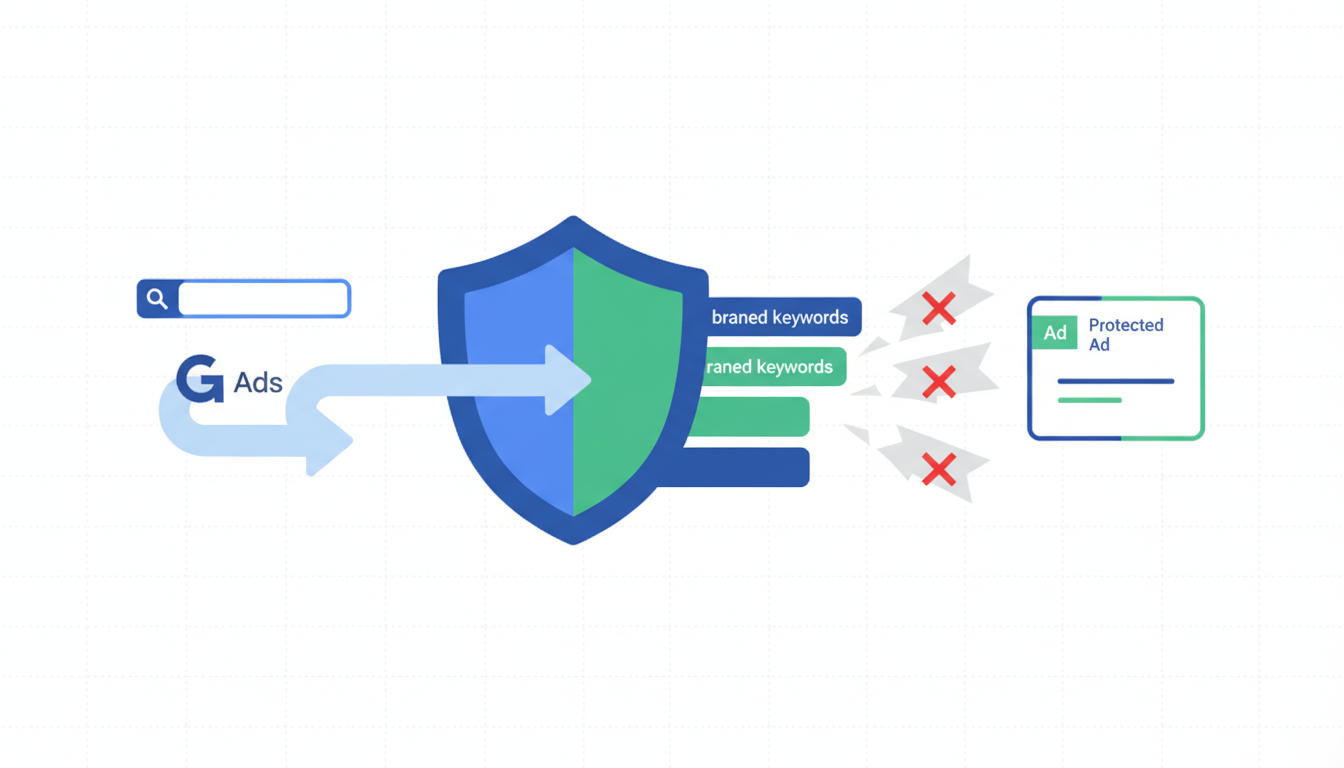
Shopify brand protection on Google Ads is the campaign every operator either overbuilds or skips entirely, and both mistakes cost real money. Skip it and a competitor shows up above your organic listing on your own brand name, pays $0.40 a click, and walks off with 12 to 18% of your branded traffic. Overbuild it and you spend 8% of your budget defending clicks you were going to get free anyway. The right answer lives in a narrow middle band. Brand queries should sit in their own isolated campaign, with their own budget line, their own match types, and their own conversion targets. Most Shopify stores we audit either have no brand campaign at all or have brand mixed into a non-brand Search campaign where the algorithm averages the two and wastes money on both. The math is simple once you run it. The structure is straightforward. The discipline is in not letting it drift.
- Always run a brand campaign. Skipping it invites competitor bidding on your name.
- Budget rule: 3% of total Google spend, capped at 8% for small accounts.
- Separate brand + product combos from pure brand. They behave differently.
- Measure incrementality with a geo holdout, not reported ROAS.
What brand protection actually means and why it pays
Brand protection on Google Ads is the practice of bidding on your own brand name (and close variants) to keep competitors from showing up above your organic listing. On Shopify, this matters because Shopify stores are usually the top organic result for their own brand name already, which feels like a reason not to bother. It is not. Google's ad layout on branded searches shows up to four paid listings above the organic result, so a competitor can outbid you and push your free organic click four positions down. In our audit data, that costs between 12 and 18% of branded traffic.
The short version: brand search campaigns on Shopify are cheap insurance. CPCs run $0.20 to $0.60, conversion rates sit between 18 and 28%, and reported ROAS usually lands between 8x and 15x. Not because the campaign is doing magical work, but because the traffic was warm already. That is also why measuring brand protection on reported ROAS alone is misleading, which we will get to.
The thing most operators miss: brand protection is not one campaign. It is three to five campaigns doing related but different jobs, each with its own budget and conversion target. A single brand campaign that lumps everything together always underperforms one of its pieces, because Google optimizes to the average and the average hides the real work.
The math: when brand search defends real revenue
The question every operator asks, usually in a skeptical voice: "If they are searching for my brand, will they not find me anyway?" Fair question. It depends on three variables, and the math changes hard depending on which ones apply.
The three variables that decide whether brand bidding shopify setups actually defend revenue:
- Competitor density on your brand terms. Run a search for your brand on an incognito window. Zero competitor ads = lower priority. One or more competitors bidding on your brand = you are losing traffic right now. Most stores we audit have at least one.
- Organic position strength. If your Shopify store is position 1 organically with sitelinks and no competitor paid ads are showing, skipping brand is defensible. If your organic is below the fold (new domain, Reddit outranking you), brand paid is real recovery work.
- Brand search volume. Below 500 monthly branded searches, brand protection is a rounding error. Above 5,000, it compounds into real revenue. Scale changes the math.
Typical Shopify economics on a brand search campaign, from our 2025 audit sample:
- Average brand CPC: $0.35
- Average brand conversion rate: 22%
- Average branded AOV: $89 (higher than non-brand because intent is higher)
- Average reported brand ROAS: 11.2x
- Incremental brand ROAS (after geo holdout): 3.4x
That last number is the real one. Reported 11x looks magical because most of those conversions would have happened through organic anyway. Incremental 3.4x is the revenue you actually defended. Still positive, still worth running, just not 11x worth. The incrementality math is what tells you whether to fund at 3% or 8%. More in the measuring incrementality section.
The 5-campaign brand protection structure
A proper brand search campaign shopify setup has five campaigns, not one. Each serves a different job, each gets its own budget, and each runs on different match types and negatives. Collapsing them is the single most common mistake we see, because Google averages the performance and high-intent queries subsidise low-intent ones.
The five campaigns:
- Exact brand. Just your brand name on exact and phrase. "mybrand", "my brand". Highest ROAS, 40 to 50% of total brand spend. This should basically never fail.
- Brand + product type. "mybrand shoes", "mybrand candles", "buy mybrand hoodie". Still high intent, further along in decision-making. Separate budget so you can see CPA by category. 25 to 30%.
- Brand + generic modifier. "mybrand reviews", "mybrand coupon", "is mybrand legit". High intent shopping for reassurance or a deal. 10 to 15%. Landing pages matter here.
- Brand + competitor. "mybrand vs competitor", "mybrand alternative". Defensive, aimed at comparison shoppers. Needs a comparison landing page, not the homepage. 5 to 10%.
- Misspellings and close variants. "myrband", "mybrnd", hyphenation variants. Cheap, usually uncontested, 5% max. Stops misspelling arbitrage from competitors or SEO spam sites.
A brand keyword shopify structure that bundles all five is the main reason operators look at brand performance and say "it is fine." It is fine on average. It is leaking on the edges, and you cannot see where because the campaign aggregates five intent levels into one line.
Best to build campaigns 1, 2, and 3 on day one. Add 4 and 5 after 30 days of data on the first three. Launching all five at once usually means none has enough volume to exit learning cleanly.
Brand + product keyword combos that catch competitors
This is the campaign that does the most defensive work and the one most often missing from accounts we audit. Brand + product combos are searches where a user already knows you sell candles and is typing "mybrand vanilla candle" to buy one. That query is where competitors see the softest defense and where the highest-margin conversions live.
These queries pull disproportionate revenue per click because the user has self-selected for both brand intent and product category. Conversion rates on brand + product combos run 28 to 35%, higher than pure brand, because the user has pre-filtered twice.
The structure that works:
- One ad group per product category. "brand + candles", "brand + diffusers", "brand + gift sets". Not one mega ad group.
- Phrase and exact match only. Broad pulls in non-brand category traffic and blows the budget in an afternoon.
- Negative keywords for all competitor brand names at campaign level. You do not want your ad on "competitor + product" searches.
- Landing page is the product category collection, not the homepage. Candles search = candles page.
Common failure mode: Shopify stores put brand + product queries inside their pure brand campaign (cannibalises exact brand data) or inside non-brand Search (averaged with category queries at 3x higher CPCs). Neither works. Own campaign, own budget, own baseline.
One wrinkle. Brand + product is where PMax tries to eat your lunch. Without brand exclusions at the account level, PMax will bid on "mybrand candles" queries and report them as PMax success, double-counting against your brand Search campaign. Google's brand exclusions documentation covers the toggle. We go deeper in our Performance Max Shopify guide, because PMax cannibalisation is the most under-discussed problem with running PMax alongside brand.
Budget: the 3% rule for brand spend
The rule we use across the audit book, refined over about 40 Shopify stores a month since 2023: brand protection runs at 3% of total Google Ads budget, floor of $300 a month, ceiling of 8% for smaller accounts. Above $50k a month, 3% is usually exactly right. Below $10k, the percentage floats to 6 to 8% because absolute dollars are too small otherwise to cover all five campaigns.
The math on a $30k a month Google Ads budget:
- Total brand protection: $900 a month (3%)
- Exact brand: $400 (44%)
- Brand + product: $250 (28%)
- Brand + generic modifiers: $130 (14%)
- Brand + competitor: $80 (9%)
- Misspellings: $40 (5%)
At $10k a month total, the same 3% ($300) is too thin to cover all five campaigns with enough data each to exit learning. We collapse misspellings into exact brand and run four campaigns at 5 to 6% of total. At $100k a month, 3% ($3k) is a comfortable floor that rarely needs to flex.
The trap: starting at 3% on a small account, seeing the dollar number is $200, and either not running brand at all (mistake one) or funding it from the non-brand budget (mistake two, because brand and non-brand have completely different CPAs and mixing them breaks both campaigns' learning). Brand is its own line item. Always. Fund it from its own bucket, not from whatever is left over.
One note on pacing. Brand search volume is stable week to week unless you run a big PR moment or a launch. If branded CPCs spike 40% in a week, it is almost always a competitor starting to bid on your name, not organic auction pressure. Check competitor ads in an incognito search before you raise budget.
When brand protection is unnecessary (and you are wasting money)
Not every Shopify store needs a brand protection campaign. Running one when you do not need it is paying Google for clicks you were getting free. Three situations where skipping is the right call:
- Zero competitors bidding, zero brand-name ambiguity. Search your brand on incognito across mobile and desktop, from at least five physical locations (VPN or friends in other cities). If nobody is bidding and your brand is unique enough that Google never shows ambiguous results, you are getting the click for free. Do not pay.
- Brand search volume below 200 a month. Below 200 monthly searches, you cannot gather enough data to optimise, the 5-campaign structure collapses into a single ad group, and incremental revenue is a rounding error. Wait until volume grows.
- Very new stores with no brand equity. Less than 50 branded searches a month means there is nothing to defend. Skip it. Focus on non-brand acquisition until recognition builds.
The math clearly flips toward running brand the moment a competitor is visibly bidding on your brand name. Even if the click was warm, the competitor's bid is pushing your organic down. $0.35 to stay in position one, or hand the competitor 12 to 18% of branded traffic. Obvious trade.
The other situation where brand is non-negotiable: ambiguous or shared names. "Luna", "Atlas", anything overlapping a generic word or another brand. Google routinely shows confused results on those searches and you need paid to anchor the top. Ambiguous names pay a premium for defense. No clean way around it.
Measuring incrementality on brand search
This is the section most brand guides skip, and it is the most important one. Reported ROAS on a brand campaign is systematically misleading because Google's attribution counts the conversion as paid even when the user would have converted through organic anyway. The reported 11x is not the question. The question: how much of that 11x is incremental revenue the campaign actually caused, and how much is revenue the campaign took credit for?
The only clean way to measure this is a geo holdout. Pause brand search in test regions for 2 to 4 weeks, leave it running in control regions, and measure the delta in total branded revenue (paid + organic combined) between the two groups. Whatever shows up is the incremental contribution. Anything smaller was cannibalising organic.
How to run it:
- Pick 3 to 5 states or provinces as holdout. Roughly match the rest of the country on demographics and revenue share. Do not pick your biggest market, the test will cost too much if brand turns out incremental.
- Exclude those geos from your brand campaigns for 2 to 4 weeks. Document the pause date.
- Compare branded revenue between test and control geos, normalised to baseline pre-test share. Pull from Google Search Console + GA4 site search + referral tags.
- The delta in total branded revenue, as a ratio of the brand spend you would have incurred in those geos, is your incremental ROAS.
Our audit sample across 28 Shopify stores that ran this test in 2025: incremental ROAS averaged 3.4x, ranged 1.2x to 6.8x. High competitor bidding density scored highest. Unique brand names with zero competitor bidding scored lowest.
Decision rule: above 2x, keep brand at 3% of total spend. Between 1x and 2x, keep at 1 to 2% as insurance. Below 1x, you are paying for clicks you already had. Scale back or kill.
Google's incrementality testing guide covers the experimental design principles. The methodology is straightforward. Getting operators to actually run the test is the hard part, because the result is sometimes "your beloved brand campaign is less valuable than you thought." Better to know.
Frequently asked questions
Do I need a brand protection campaign if my brand name is unique and no one is bidding on it?
How much should I budget for brand protection on a $10k a month Google Ads account?
Will running brand search hurt my organic rankings on the same query?
Should my brand campaign use Smart Bidding or manual CPC?
How do I keep PMax from stealing my branded clicks?
Can I skip the geo holdout and just trust Google's ROAS number?
Meta CAPI setup on Shopify is one of those fixes that looks small on the dashboard and compounds for months afterward. Dedup cleanly, raise EMQ above 8.5, validate in Test Events before you push live, and the algorithm finally has signal it can trust. That is when ROAS stops wobbling and budget scales predictably, instead of collapsing every time you push daily spend past the last tested ceiling. Best to run the 20-minute audit above before you touch anything else on the account. If the audit surfaces two or more of the problems in the "Why Shopify stores get CAPI wrong" section, fix those first, then revisit creative testing. The creative never was the problem, nine times out of ten the tracking was lying the entire time.
Get a full X-ray of your ad account
Paste your Meta and Google Ads. See exactly where signal is leaking. Free. 60 seconds.