Shopify cart abandonment: 9 playbooks that recover revenue
 By Dror Aharon
·
CEO, COREPPC
·
Updated April 17, 2026
·
11 min read
By Dror Aharon
·
CEO, COREPPC
·
Updated April 17, 2026
·
11 min read
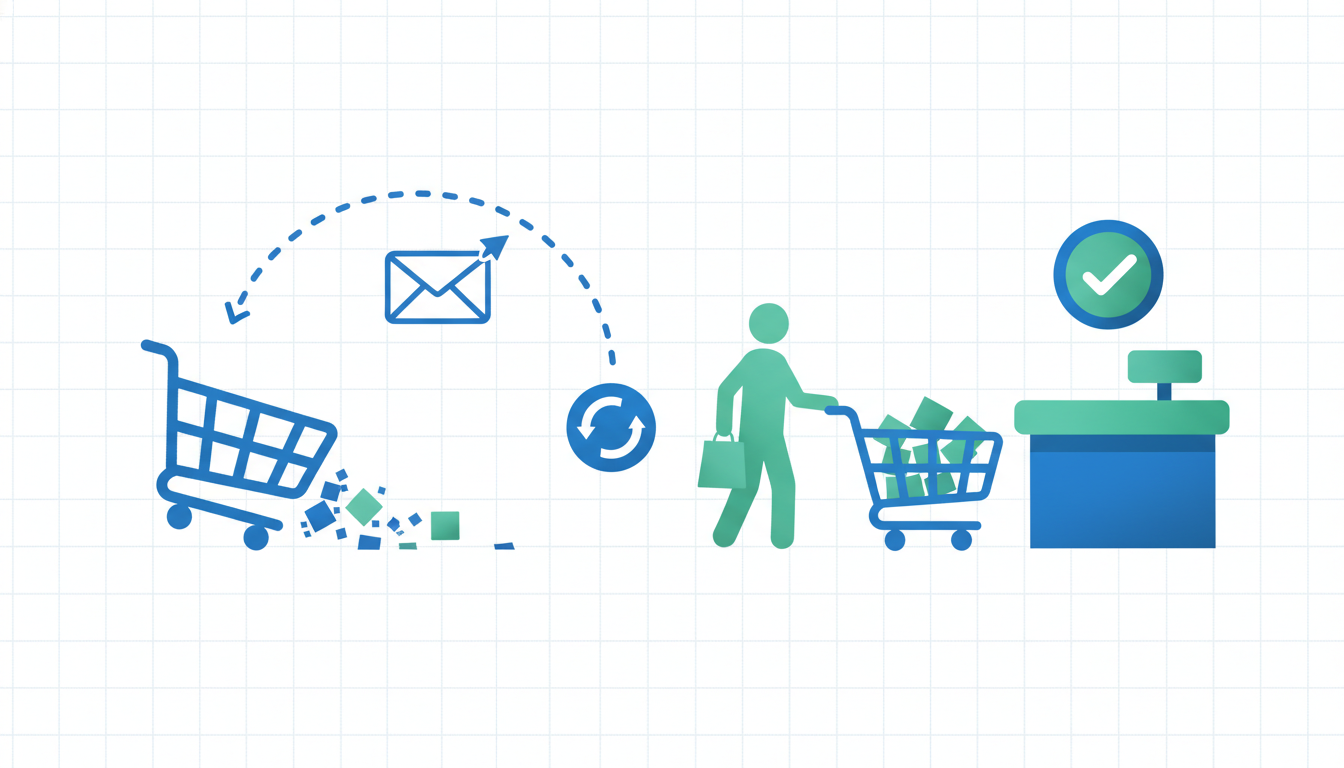
Shopify cart abandonment is the single largest pool of recoverable revenue most stores never touch, because the default Shopify abandoned checkout email recovers around 1% of lost carts and operators assume that is the ceiling. It is not. Across 200+ Shopify stores we have audited since 2023, a properly sequenced recovery stack (email at 1 hour, 24 hours, 72 hours, SMS at hour 4 with TCPA-compliant opt-in, retargeting ads from day 1 to day 7, on-site exit intent on the cart page) recovers 10 to 15% of abandoned carts on average. For a store doing $1M a year with a 70% abandonment rate, that is roughly $90k to $135k a year in recovered revenue from work that ships in two weeks. The catch is that 4 of the 9 playbooks below actually do 80% of the lifting, and most stores skip those 4 in favor of the easy ones. Order matters. Channel sequencing matters more.
- The 4 playbooks that do 80% of the work: hour-1 email, hour-4 SMS, day-1 retargeting, exit-intent on cart.
- Default Shopify abandoned checkout email recovers ~1%. A 3-email sequence recovers 6 to 9%.
- SMS recovery rates run 3x email when the opt-in is collected at checkout, not popup.
- 35% of cart abandonment is actually a checkout problem, not a recovery problem. Diagnose first.
What cart abandonment actually costs Shopify stores
The Baymard Institute's cart abandonment rate research puts the global average at 70.19% across 49 studies since 2006. The number has barely moved in a decade. What changed is the recovery side: stores running a serious recovery stack get 10 to 15% of those carts back, while stores running only Shopify's default abandoned checkout email get around 1%. The gap is the cost of doing nothing.
For a $1M store with 70% abandonment, the math: total cart value attempted is roughly $3.3M. Abandoned cart value is $2.3M. Recovering 1% is $23k a year. Recovering 12% is $276k. Delta is $253k, work ships in 2 weeks.
Cart abandonment rate by itself is a vanity metric. The number that matters is recovery rate as a percentage of abandoned cart value. A store with 80% abandonment and 15% recovery makes more money than a store with 60% abandonment and 1% recovery. Stop optimizing the rate. Optimize the recovery.
One nuance worth flagging. About 35% of cart abandonment we see in audits is not a recovery problem, it is a checkout problem. Forced account creation, surprise shipping, broken Apply Coupon button. No recovery sequence fixes those. Best to read the diagnosis section at the end of this guide before building any flows.
The 9 playbooks ordered by revenue lift
Here are the 9 playbooks, ordered by average revenue lift across our audit sample. The top 4 do roughly 80% of the recovered revenue. The bottom 5 are worth doing once the top 4 are stable.
- Hour-1 abandoned cart email. Recovers 3 to 5% of abandoned carts on its own. Highest open rate of any cart email because the user remembers the product. Subject line uses the product name, not "you left something behind."
- Hour-4 SMS recovery. Recovers another 4 to 7% on top of email if the opt-in was collected at checkout (TCPA-compliant). Click-through runs 3x email. Skip if your opt-in was collected by popup, which often violates TCPA and risks $500 to $1,500 per message in penalties.
- Day-1 retargeting ad. Recovers 1 to 3% directly attributed plus another 1 to 2% in assisted conversions. Dynamic product ads (DPA) showing the exact product abandoned, not collection-level retargeting.
- Exit-intent on cart page. Recovers 0.8 to 1.5% before the user even leaves. Single-field email capture with a 10% off code, only on cart page (not PDP, not homepage).
- 24-hour follow-up email. Recovers 1.5 to 2.5% additional. Different angle than hour-1: social proof or shipping reassurance, not the same product reminder.
- 72-hour final email. Recovers 0.8 to 1.2%. Last-touch with a meaningful discount (15% or free shipping). After this, the cart is cold.
- Browse abandonment email. Recovers 0.5 to 1% by catching users who viewed but never added to cart. Lower priority because intent signal is weaker.
- Post-purchase cross-sell. Not strictly cart recovery, but lifts AOV 6 to 11% on the same buyer flow. Worth bundling into the same project.
- WhatsApp abandoned cart (international). Recovers 5 to 9% in markets where WhatsApp is dominant (Latin America, India, parts of Europe). Not relevant for US-only stores.
The order is not arbitrary. Each top-4 playbook catches a different abandonment reason. Email catches "I got distracted." SMS catches "I forgot." Retargeting catches "I am still shopping around." Exit intent catches "I never planned to buy at this price." Skip one and you leave that cohort uncaught.
Email timing: the 1 hour, 24 hour, 72 hour sequence
The 3-email cart recovery sequence is the spine of the whole stack. Most stores either send one email at 1 hour and stop, or send three emails that all sound the same and burn deliverability. The sequence that works has 3 emails with 3 different angles, sent on 3 different time horizons.
Email 1 at hour 1. Subject line: "Still thinking about [product name]?" Body: product image, single CTA back to cart, 1-line shipping reassurance. No discount. Klaviyo's abandoned cart benchmark data shows hour-1 open rates of 45 to 55% on product-name subject lines, vs 28 to 35% on "you left something behind."
Email 2 at hour 24. Subject line: a question or a benefit, not the product name (same image twice in 24 hours hits the spam filter). Body: social proof (a 5-star review), a 1-line FAQ answer, the cart link. Still no discount. Recovery 1.5 to 2.5%.
Email 3 at hour 72. Subject: the discount ("$15 off your cart, expires tonight"). Body: discount code, 24-hour expiry, cart link. Last touch. Recovery 0.8 to 1.2%, AOV 5 to 8% lower because of the discount.
Three rules across all three. First, the cart link has to deep-link to a pre-filled cart, not the homepage. Klaviyo and Shopify Email both do this natively, but the URL parameter has to carry the cart token. Test it before you ship. Second, suppress the flow when the user converts on email 1. Third, the from-name should be a person, not the brand. "Sarah from [Brand]" outperforms "[Brand]" by 8 to 12% on open rate.
What kills cart email: same product image in all three (looks like a robot wrote it), discount-stacking (trains customers to wait for the bigger offer), and forgetting to suppress the flow when the user buys on a different channel.
SMS timing and opt-in mechanics that comply with TCPA
SMS is where stores either find a 4 to 7% recovery lift or end up paying $500 to $1,500 per unsolicited message in TCPA penalties. The split comes down to how the opt-in was collected. Get this wrong and the legal exposure eats the revenue.
The clean opt-in for cart abandonment SMS is an unchecked checkbox at Shopify checkout, with explicit consent language. Shopify's SMS marketing setup docs walk through the checkout field. The language has to be specific: "Yes, I want to receive recurring marketing text messages from [Brand], including cart reminders. Message frequency varies. Reply STOP to unsubscribe." Pre-checked boxes do not count. Popup opt-ins often do not count either, depending on jurisdiction. Best to default to the checkout checkbox and skip popups entirely for SMS.
Once the opt-in is clean, the timing that works:
- Hour 4. First SMS. "Hi [first name], your [product name] is still in your cart at [Brand]. Tap to grab it: [short link]. Reply STOP to opt out." Click-through runs 18 to 26%.
- Hour 22. Optional second SMS only for high-AOV stores ($150+). Different angle (shipping reassurance or social proof). For low-AOV stores, skip it. The second SMS hits unsubscribe rates 3x higher than the first.
- Day 3. Final SMS with the discount code if email did not convert. "[First name], here is 10% off your cart: SAVE10. Expires tonight: [link]. STOP to opt out."
Three is the cap. More than three SMS in a 72-hour window pushes opt-out rates above 8% per send, which burns the list inside a quarter.
SMS opt-in at Shopify checkout runs 12 to 22% vs 35 to 45% for email. Smaller audience, much higher engagement. Recovery on the SMS-opted segment runs 18 to 28%, roughly 4x the email recovery rate, so the economics work even on the smaller list.
International note. TCPA covers US numbers. Other jurisdictions have their own laws (PECR in UK, CASL in Canada, Privacy Act in Australia). Segment your list by region and apply the strictest jurisdiction's rules globally.
Retargeting ads for cart abandoners: creative and budget
Retargeting cart abandoners is where channel sequencing pays off. Email and SMS catch the user in inbox or phone. Retargeting catches them everywhere else: scrolling Instagram, watching YouTube, reading the news. The user sees the abandoned product in 2 to 3 contexts within 24 hours, which is the repetition that converts comparison shoppers.
The setup that works on Meta:
- Audience. Custom audience of "Initiated Checkout" minus "Purchase" in the last 7 days. Not "Add to Cart minus Purchase," which captures too many low-intent users.
- Creative. Dynamic Product Ads pulling the exact abandoned product, not a collection-level catalog ad. Same image, same price.
- Budget. $5 to $15 a day for stores under $1M annual revenue, $25 to $75 above that. ROAS runs 4x to 8x, so budget caps usually come from audience size, not spend efficiency.
- Frequency cap. 4 impressions per user per 7 days. Higher and CTR collapses, lower and reach is too thin.
- Window. Day 1 to day 7 only. Past day 7, the cart is cold and the audience performs like a regular prospecting one.
On Google, same logic but the audience runs through Google Ads Audiences (Cart Abandoners segment) and the creative is Responsive Display Ads or Performance Max with a feed. Recovery rate on Google runs 30 to 50% lower than Meta for most Shopify stores, because Display inventory is lower-intent. Best to start with Meta, layer Google after.
The biggest mistake we see is running the same DPA to abandoners and cold prospecting. Cold audience needs lifestyle imagery and brand context. Abandoner needs the product, the price, the reminder. Split the campaigns.
On attribution, Meta will overclaim cart recovery by 2x to 3x through view-through attribution. Directly attributed recovery from Meta DPA runs 1 to 3%, but the platform reports 3 to 6%. Best to use Shopify's first-party order tagging (UTM-based) as the source of truth, otherwise budget allocation skews toward whichever channel overclaims hardest.
On-site recovery: exit intent done right
Exit intent is the cheapest mechanism in the stack because it catches the user before they leave. No email. No SMS. No ad spend. Just a single popup on the cart page when the cursor moves toward the close button. Most stores either skip it or run it on every page, which trains users to ignore popups and collapses conversion at the one place it works.
Three rules.
First, exit intent on cart page only. Not PDP. Not homepage. The user on the cart page has already added a product, hesitated, and is leaving. That is the highest-intent abandonment moment in the funnel. Exit intent on the homepage annoys casual browsers and tanks bounce rate without producing recovery.
Second, single field. Email only. No name, no phone. The more fields, the lower the conversion. Single-field email exit intent on cart page converts at 8 to 14% of cart-abandoners. Two fields drops it to 4 to 7%.
Third, the offer matters. "Get our newsletter" converts at 1 to 2%. "Save 10% on your cart, expires in 15 minutes" converts at 8 to 14%. The 10% applied at the cart-recovery moment has higher net margin than the same discount as a sitewide promotion, because it converts a buyer who was already lost rather than discounting one who would have paid full price.
The user who entered email at exit intent gets pulled into the same 3-email recovery sequence. One sequence, same cadence. Privy, OptinMonster, Justuno, and Sumo run $20 to $50 a month and integrate with Klaviyo. Setup takes 20 minutes.
When cart abandonment is actually a checkout problem
About 35% of what looks like cart abandonment in our audits is actually checkout abandonment, which no recovery sequence fixes. The user got to checkout, hit a wall, and bailed. Sending them a "you left something behind" email tomorrow does not solve the wall, it just reminds them why they left. Best to diagnose this before building any recovery flows.
Baymard's 2024 ranking of US checkout abandonment reasons: extra costs too high (48%), required account creation (24%), didn't trust the site with credit card (19%), too long or complicated checkout (18%), couldn't see total cost upfront (17%), errors or crashes (13%), unsatisfactory return policy (12%), payment declined (9%), not enough payment options (7%), slow delivery (5%).
Five of those ten are fixable in an afternoon on Shopify:
- Required account creation. Settings, Checkout, Customer accounts, set to "Accounts are optional." Lifts completion 3 to 7%.
- Hidden shipping cost. Add a free shipping threshold progress bar to the cart, so the user sees the total before checkout.
- Limited payment options. Enable Shop Pay, Apple Pay, Google Pay, and PayPal at minimum. Each lifts completion 1 to 3% on the audience that prefers it.
- Trust signals at checkout. Security badge, return policy link, and a customer service contact (chat or phone) visible at checkout. Settings, Checkout customization panel.
- Coupon field placement. A visible "enter coupon code" field at cart hurts completion (users abandon to search for codes). Hide it or move it to a smaller field at checkout step 2.
Run the diagnostic before building flows. Open Shopify Analytics, Reports, Sales by checkout funnel. Gap between "added to cart" and "reached checkout" over 50% means the cart page is leaking. Gap between "reached checkout" and "completed" over 35% means checkout is leaking. Cart recovery emails do not solve either gap. They work on the user who got past both steps and bailed at payment for a non-checkout reason.
Fix the leaking step first. Then layer recovery on top of a fixed funnel, not as a band-aid for a broken one.
Frequently asked questions
What is a normal cart abandonment rate for a Shopify store?
Does Shopify's default abandoned checkout email work?
When should I add a discount to abandoned cart emails?
How do I make sure my SMS cart abandonment is TCPA-compliant?
How much budget should I put on retargeting cart abandoners?
Can I use the same recovery flow for international shoppers?
Shopify cart abandonment recovery is one of the highest-impact projects a growth-stage store can ship in a quarter. The default Shopify email recovers about 1%. A serious recovery stack (3-email sequence, TCPA-compliant SMS, day-1 retargeting, exit intent on cart) recovers 10 to 15%. The delta on a $1M store is $90k to $135k a year in recovered revenue, and the build takes about 2 weeks for a working setup. The order matters: top 4 playbooks first, bottom 5 once the top 4 are stable. Channel sequencing matters more than count of touches. And about 35% of what looks like cart abandonment is actually a checkout problem, so best to run the funnel diagnostic above before you build any flows. If the diagnostic surfaces a checkout leak, fix that first. Recovery emails do not solve broken checkouts, they just remind users why they bailed.
Get a full X-ray of your ad account
Paste your Meta and Google Ads. See exactly where signal is leaking. Free. 60 seconds.