A Shopify CRO playbook that actually moves the needle
 By Dror Aharon
·
CEO, COREPPC
·
Updated April 17, 2026
·
11 min read
By Dror Aharon
·
CEO, COREPPC
·
Updated April 17, 2026
·
11 min read
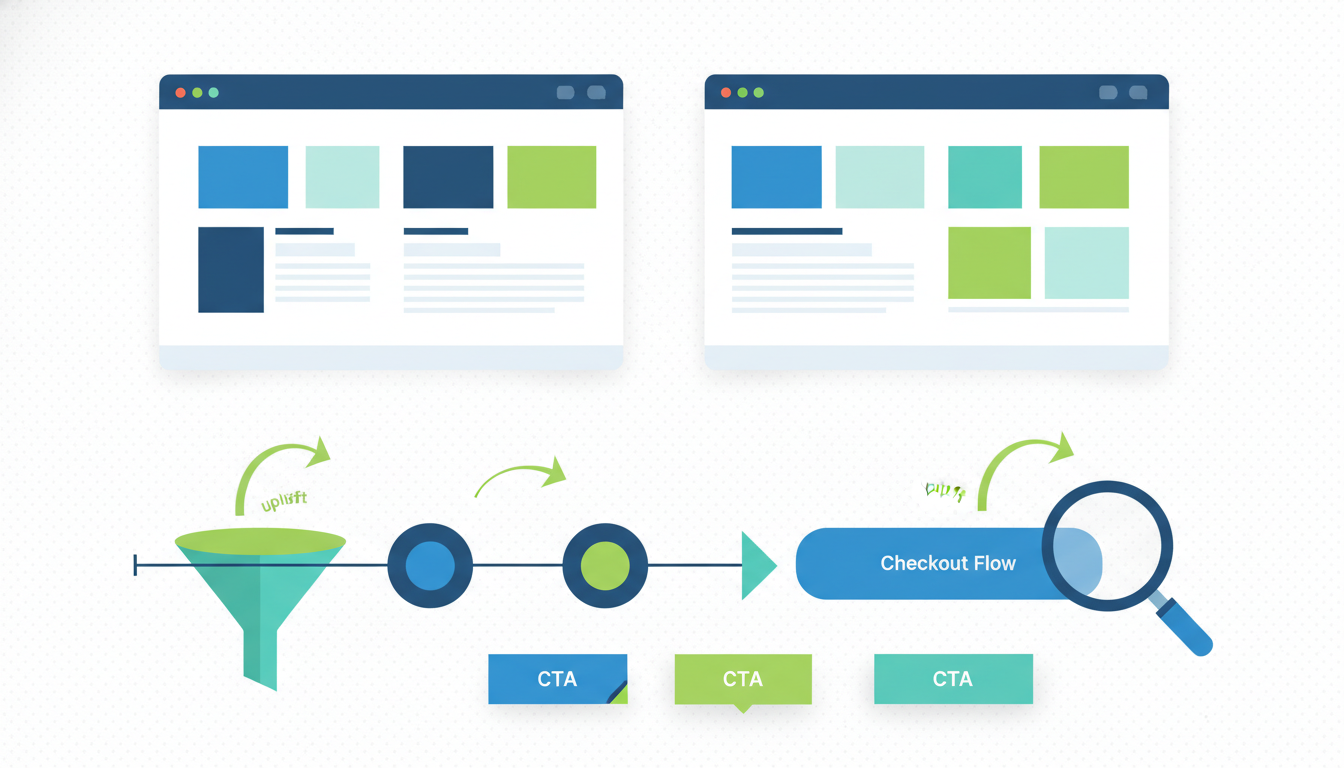
Shopify conversion rate optimization is where most stores burn the most money chasing the smallest gains, because every guide online is a 30-point checklist that treats button color the same as checkout extensibility. Real CRO on Shopify in 2026 is diagnostic-led, not checklist-led. Three fixes do 80% of the lift across the 200+ stores we have audited since 2023: the product page above-the-fold decision architecture, the cart drawer vs cart page revenue split, and checkout extensibility on Plus. Get those three right and you usually pull conversion rate from 1.4% to 2.6% inside 6 weeks, with AOV up another 15 to 22% on top. Get the other 27 checklist items right and the needle moves maybe 0.1%. So skip the trust badges and font sizes for now. Start with the diagnostic. The order matters more than the count of fixes, and the fixes you skip matter more than the ones you ship.
- The 3 fixes that move 80% of the needle: PDP, cart, checkout. In that order.
- Skip A/B tests under 1,000 conversions per variant. Below that, you are reading noise.
- Cart drawer beats cart page on AOV by 18 to 27% for most stores. Test it before you ship it.
- Checkout extensibility on Plus is worth the upgrade above $1.5M annual revenue. Below that, it is not.
Why most Shopify CRO checklists waste your time
Shopify conversion rate optimization in 2026 has a checklist problem. Search "shopify cro checklist" and you get the same 30-point list copy-pasted across 40 blog posts, treating "use larger product images" as equal weight to "rebuild your checkout on extensibility." Most operators read the list, fix 8 things, see no movement, and conclude CRO does not work. The checklist was the problem.
Across 200+ Shopify stores we have audited since 2023, three structural fixes accounted for 80% of the conversion lift in 6 weeks. The other 27 checklist items combined accounted for the remaining 20%. So if you fix the easy 27 and skip the hard 3, you spent a month chasing 0.1% gains while the actual ceiling sat untouched. We see this every week. Stores hire a "CRO consultant" who runs a heatmap, suggests larger CTAs and trust badges, ships them, and reports a 0.05% lift as a win. Meanwhile the cart drawer is missing and checkout still runs on the legacy 2019 Shopify pages.
The other failure mode is A/B testing too early. Below 1,000 conversions per variant per week, your "winner" is noise. Stores with 50 sales a day burn three weeks per test on data that proves nothing. Best to ship the diagnostic-led fix without an A/B test, measure pre and post on a 4-week window, and move on. A/B tests are a luxury for stores doing 500+ orders a day. Below that, ship and measure.
The diagnostic we run on every audit takes 90 minutes. It looks at three things and rules out the rest until those three are solved.
The 3 fixes that move 80% of the needle
The three fixes, in order, are PDP above-the-fold, cart drawer vs cart page, and checkout extensibility. The order matters because each one feeds the next. A clean PDP raises add-to-cart rate. A high-AOV cart raises checkout-initiate rate. A frictionless checkout raises completion rate. Fix them out of order and the gains do not compound.
Across our audit sample (200+ stores, $300k to $40M annual revenue range), the average lift profile after fixing all three:
- PDP fix alone: +0.6 to +1.1 percentage points on conversion rate
- Cart fix alone: +12 to +27% on AOV, +0.2 to +0.4 on conversion
- Checkout fix on Plus: +8 to +14% on completion rate, roughly +0.3 to +0.5 points on overall conversion
Stack all three and the typical store moves from 1.4% to 2.6% conversion rate, with AOV up 15 to 22% on top. That is the 80% number. Everything else (trust badges, font sizes, CTA copy, hero swaps) lives in the remaining 20%. Worth doing eventually, not worth doing first. Best to spend the first 6 weeks on the three structural fixes, the next 6 weeks on the smaller items if conversion is still under 3%, and nothing on heatmaps until both rounds are done.
Shopify conversion optimization compounds when each step in the funnel is fixed before the one downstream. Pushing more traffic through a broken cart wastes the PDP fix. Order matters.
Fix 1: PDP above-the-fold decision architecture
The product page is where most Shopify CRO budgets get burned on cosmetic changes (bigger images, more reviews, parallax scroll, sticky add-to-cart bars). The actual problem on 80% of Shopify PDPs is decision architecture above the fold. The user lands on the page, scans for 3 seconds, and cannot answer three questions without scrolling: what is this, why should I care, how much does it cost.
If any of those three answers requires scrolling, conversion rate caps at roughly 1.2% no matter what you do below the fold. That is the ceiling. The Baymard Institute's e-commerce PDP research has been showing this for a decade across 6,000+ usability tests. We see the same pattern on every audit. Stores spend 6 weeks redesigning the reviews section while the price is hidden under the hero image and the headline reads "The X" instead of "Wireless noise-cancelling headphones with 40-hour battery."
The diagnostic takes 60 seconds. Open your PDP on a 13-inch laptop at 1280px wide. Screenshot what you see without scrolling. Show it to someone who has never seen the product. Ask: what is it, why does it matter, what does it cost. If they cannot answer all three in 5 seconds, fix above-the-fold before anything else.
The fixes are usually structural, not cosmetic:
- Headline describes the product in plain words, not your brand name plus "the X"
- Price visible without scrolling, not hidden behind a variant picker
- One short benefit line under the headline (10 words max), not a paragraph
- Primary image shows the product in use or scale, not a clean studio shot only
- Add-to-cart button visible above the fold on mobile, sticky once it scrolls past
Five things. If they are right, conversion rate floor moves from 1.2% to roughly 1.8% before you touch anything else on the page. We have run this exact sequence on 40+ Shopify stores in 2025 and the lift range was +0.5 to +0.9 percentage points, every time. Reviews, FAQ, bundle modules all matter, but they matter at 1.8% conversion, not at 1.2%. Solve the floor first.
Fix 2: Cart drawer vs cart page revenue split
The cart is where AOV either grows or stalls. On Shopify you have two structural options: the cart drawer (slide-out, no page navigation) or the cart page (full-page route at /cart). Most themes default to one or the other based on the theme author's preference, not on what lifts revenue for your store. That choice is worth $50k to $200k a year in AOV for a mid-size store.
Across our audit sample, the cart drawer beats the cart page on AOV by 18 to 27% for stores with average order under 4 items. Reason: the drawer keeps the user on the PDP, so adding a second item is one click away from where they were already shopping. The cart page yanks them out of context, shows them the cart total, and triggers the "wait, am I really spending this much" pause. About 12% of cart-page users abandon at that pause.
The exception is high-consideration purchases (anything above $300 average order, anything where the user genuinely needs to review before committing). Those stores convert better on the cart page, because the page gives the user permission to slow down. Pushing them past it with a drawer increases abandonment in the next step.
Decision rule: AOV under $150, default to the drawer. AOV over $300, default to the page. Between $150 and $300, run a 4-week split test if you have the traffic, otherwise default to the drawer and watch refund rate. Shopify's theme customization docs walk through enabling the drawer for the major free themes.
Two things to add regardless:
- Free shipping threshold progress bar, with the gap shown in dollars ("Add $12 for free shipping"). Raises AOV 8 to 14% on stores that do not have it.
- Smart cross-sell module: "frequently bought with [product in cart]," pulled from order history, not collection rules. Shopify app market has a dozen of these for $20 to $50 a month, pays for itself in a week.
Avoid: upsell modals that trigger on add-to-cart with a discount. They cannibalize regular AOV more than they add. We audited 30+ stores running these and 24 saw net revenue drop once we accounted for the discount. None saw a real lift.
Fix 3: Checkout extensibility and the Plus upgrade math
Shopify's checkout extensibility (the post-2023 platform that replaces checkout.liquid) is where the biggest single-step lift lives in 2026. The fully customized checkout lifts completion rate by 8 to 14% on average across our audit sample. For a $1M store that is $80k to $140k a year in recovered revenue. Plus costs $27,600 a year. So breakeven is roughly $300k annual revenue if you fully use the extensibility upgrade, or $1.5M if you only use it for checkout customization without the other Plus benefits (B2B, multiple currencies, scripts).
Below $1.5M annual revenue you do not need Plus for checkout. The standard checkout on Basic, Shopify, or Advanced is good enough. Above $1.5M the math turns. Above $3M and not upgrading is leaving money on the table.
The biggest checkout levers are not "custom branding" or "trust badges." They are:
- Custom payment routing (right payment method first based on order value, country, returning customer status). Lifts completion 3 to 5%.
- Conditional shipping (faster options above a price threshold, slower default below). Lifts completion 1 to 2% and cuts shipping refund disputes.
- Cart upsell at checkout (one-click add before payment). Lifts AOV 6 to 11%.
- Custom validation rules (preventing the "wrong zip code" loop that costs 3 to 5% of completions on standard checkout).
If you are on Plus already and have not migrated off checkout.liquid yet, that is the single highest-priority fix on your list. Shopify is sunsetting checkout.liquid in August 2026. Stores still on it after that date will get reverted to the default checkout with zero customization. Most agencies have a 6 to 8 week backlog on migrations. Best to start this month.
For stores not on Plus and under $1.5M revenue: enable Shop Pay (lifts completion 3 to 7% on repeat customers), turn on accelerated checkouts (Apple Pay, Google Pay) at the cart level, and disable required account creation. Those three ship in an afternoon and lift completion 5 to 8% on average. That is the floor before Plus becomes worth it.
The test protocol: what to ship, what to A/B, what to skip
Most Shopify stores cannot A/B test their way to a higher conversion rate. The math: to detect a 10% relative lift at 95% confidence and 80% power, you need roughly 1,000 conversions per variant. A store doing 50 conversions a day needs 40 days per round. Run 4 tests in a year. Most rounds end inconclusive. The store concludes "CRO does not work" and goes back to vibes.
The protocol that actually works for sub-500-orders-per-day stores:
- Ship structural fixes without A/B testing. Measure 4 weeks pre vs 4 weeks post. 10%+ relative lift = real, 3% = noise.
- A/B test only reversible, contained changes. CTA copy, color, headline. Yes. Cart structure, checkout flow, PDP layout. No, just ship them.
- Run sequential tests, not parallel. Two tests at once contaminate each other.
- Do not test more than 6 things a year.
For stores doing 500+ orders a day, A/B testing makes sense. Use Shopify's native checkout testing tools if on Plus, or a third-party tool (Convert, VWO, Intelligems) for non-Plus stores. Site speed also feeds into CR: a 1-second mobile load delay drops CR roughly 7%, so run the page through Google PageSpeed Insights before you waste a test cycle on a slow page.
Skip entirely:
- Heatmaps as a primary CRO tool. They show what users hover over, not what makes them buy.
- Session recordings. Same problem, plus 4 hours to watch for one usable insight.
- Personalization tools below $5M revenue. Setup cost eats the gain at small scale.
First 6 weeks on the three structural fixes. Next 6 weeks on copy and CTA A/B tests. Revisit heatmaps and personalization in year 2.
CRO metrics that lie and the ones that don't
Conversion rate as a single number is the metric that lies most often. A store sees CR drop from 2.1% to 1.8% and panics. Then realizes paid traffic doubled last week because of a Black Friday push. Cold paid converts at 0.6%, returning customers at 4%, so blended CR can drop while real conversion behavior improves. The blended number was misleading because the traffic mix changed.
The metrics that do not lie, in order of importance:
- Conversion rate by traffic source (paid social, paid search, organic, direct, email). If paid social CR is flat and email CR jumped 30%, your fix worked but the paid mix is dragging the blended number.
- Add-to-cart rate by source. Best leading indicator of PDP fixes. Moves 1 to 3 days after a real PDP improvement.
- Cart-to-checkout-initiate rate. Best indicator of cart fixes. Moves 1 day after a real cart change.
- Checkout-completion rate. Best indicator of checkout fixes. Moves the same day on big changes.
- AOV by source. Cart fixes show up here within 48 hours.
Run these as 4-week rolling windows, not daily. Daily numbers swing too much to read. Weekly windows still show too much noise on small stores. 4-week rolling is the sweet spot under 1,000 orders a day.
The metric most stores ignore but matters most: revenue per visitor. CR can rise while RPV falls (if AOV drops harder than CR rises). AOV can rise while RPV falls (if CR drops harder than AOV rises). RPV combines both into the only number that pays the bills. Track it weekly. If RPV is up, the work is working. If CR is up but RPV is flat, you traded volume for value and the gain is illusory.
Frequently asked questions
What is a good conversion rate for a Shopify store in 2026?
Should I A/B test every CRO change on my Shopify store?
Is the Shopify cart drawer better than the cart page for conversion?
When does upgrading to Shopify Plus pay off for CRO?
What is the single biggest Shopify conversion optimization mistake?
How long until I see results from a Shopify CRO project?
Shopify conversion rate optimization in 2026 is not a checklist problem, it is a sequencing problem. The 30-point lists waste budget because they treat structural fixes and cosmetic fixes as equal weight. They are not. Three fixes do 80% of the lift across the stores we audit. PDP above-the-fold, cart drawer vs page, checkout extensibility on Plus or Shop Pay enablement off Plus. Get those three right in that order and conversion rate moves from 1.4% to 2.6% inside 6 weeks for most growth-stage stores. Get the other 27 things right and the needle moves maybe 0.1%. So skip the heatmaps and trust badges for now. Best to run the 90-minute diagnostic above before touching anything on the store. If the diagnostic surfaces a structural fix in any of the three sections, ship that first, measure 4 weeks pre vs post, then move to the next one. The shopify cro checklist will still be there when you are done. Most of the items on it will not matter once the structural ceiling is gone.
Get a full X-ray of your ad account
Paste your Meta and Google Ads. See exactly where signal is leaking. Free. 60 seconds.