Which Google Ads bidding strategy for Shopify
 By Dror Aharon
·
CEO, COREPPC
·
Updated April 17, 2026
·
11 min read
By Dror Aharon
·
CEO, COREPPC
·
Updated April 17, 2026
·
11 min read
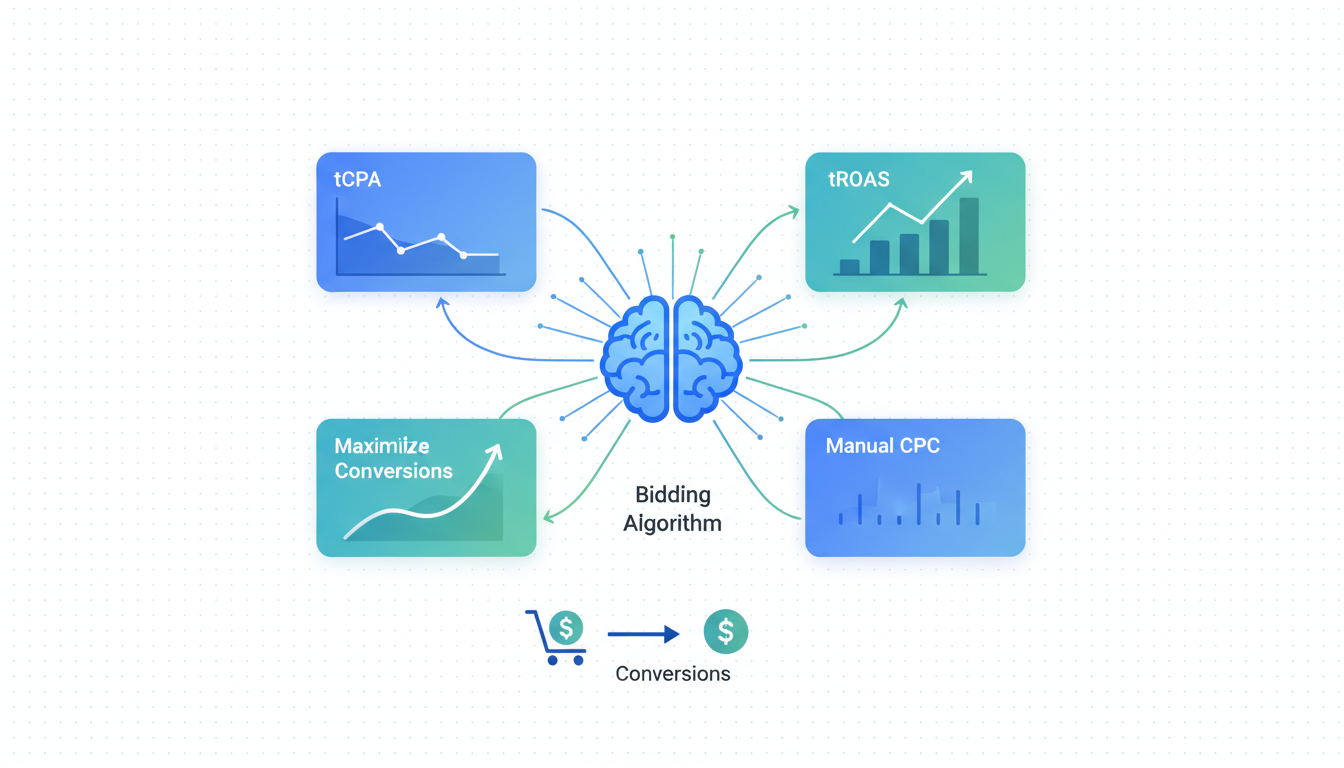
Your Shopify Google Ads bidding strategy decides how fast you scale and how hard the learning phase hits every time you touch the account. The wrong strategy costs a typical DTC store 25 to 40% of potential ROAS, not because the ads are bad but because the algorithm is optimizing for the wrong number. Most Shopify stores we audit are running tCPA on Search when they should be on tROAS, or Max Conversions on PMax when they should be on Max Conversion Value. The gap is usually one setting deep and nobody ever changed it after the first campaign launch in 2022. Five strategies cover 95% of Shopify use cases, and each one wins in a specific revenue band and data state. Below $5k a month in spend the choice is narrower than Google wants you to think. Above $30k the choice is different again. The switch is free. The compounding lift runs for months.
- tROAS is the default for Shopping and PMax once you have 50+ conversions a month.
- tCPA wins for lead-gen funnels and low-AOV stores with thin margin bands.
- Max Conversion Value is the upgrade from tROAS when you stop needing a floor.
- Manual CPC is still right for two specific cases, and nothing else.
The 5 bidding strategies that actually matter in 2026
Google lists around a dozen bid strategies, and most are legacy options or variants that should not exist for a Shopify store in 2026. Five cover almost everything a DTC operator needs.
The five that matter, ranked by how often they fit a Shopify campaign:
- Target ROAS (tROAS): Google optimizes to hit a specific return on ad spend. Default for Shopping and Performance Max above 50 conversions a month.
- Maximize Conversion Value: Same engine as tROAS but no ceiling. Best when you have room to scale and the funnel is proven.
- Target CPA (tCPA): Google optimizes to a cost-per-acquisition target. Right for lead-gen and low-AOV stores where every conversion is worth roughly the same.
- Manual CPC: You set bids yourself. Mostly obsolete, but still right for brand Search and a couple of niche cases below.
- Enhanced CPC (eCPC): Manual CPC with Google allowed to adjust bids up to 30% based on conversion probability. The middle ground most operators pretend they do not use.
Strategies you can mostly ignore on Shopify: Target Impression Share (only useful for brand-defense Search), Maximize Clicks (a budget-burner on revenue campaigns), Maximize Conversions without a target (optimizes for volume not value, nukes ROAS on low-margin SKUs). If a "shopify google ads bidding strategy" recommendation starts with "try Maximize Clicks for awareness," close the tab.
The frame to hold: all Smart Bidding strategies work better with more data. Below 15 conversions a month, Smart Bidding is guessing. Between 15 and 50, it is finding its feet. Above 50, it stabilizes. So the right strategy depends almost as much on conversion volume as on campaign goal, and most "wrong bidding strategy" audits trace back to picking tROAS at 8 conversions a month and blaming the platform.
tCPA: when it wins for Shopify
tCPA shopify setups are the right call in three situations and usually wrong everywhere else. First, lead-gen funnels where the conversion is a form fill, quote request, or email signup and value per lead is roughly consistent. A custom-furniture store optimizing on "request a quote" fits. So does a subscription funnel optimizing on free-trial signup.
Second, low-AOV stores where margin is thin and you need a hard ceiling on cost per order. If AOV is $28 and margin is $9, you cannot afford tROAS to chase higher-value orders that might not exist. tCPA at $5.50 caps it. tROAS at 4x on $28 AOV wants $7 CPA, and if the algorithm finds a $60 order it overshoots, which is catastrophic on every other one.
Third, new campaigns under 30 conversions a month. Smart Bidding needs less data to optimize volume than value, so tCPA is cleaner signal early. Once you cross 50 conversions, switch to tROAS or Max Conversion Value. Leaving a mature campaign on tCPA is one of the most common audit findings.
Good tCPA targets for Shopify, by campaign type:
- Brand Search: No tCPA needed. Use Manual CPC. Intent is so high any cost target is a drag.
- Non-brand Search on category terms: tCPA at 65-75% of gross margin per unit. If margin is $20, start at $13-15 and tighten over 2-3 weeks.
- Standard Shopping: tCPA at roughly AOV minus CAC target. Caps spend per order cleanly.
- PMax with low conversion volume: tCPA is the safer start below 30 conversions a month. Switch to tROAS once the campaign stabilizes.
A common trap: setting tCPA way above actual target "to give Google room to find the traffic." All this does is let Google spend more per conversion than the business can afford. The in-platform recommendation engine routinely suggests a tCPA 40% above what the margin supports.
tROAS: the default for Shopping and PMax
troas shopify google ads campaigns are the right default for almost every revenue-focused setup once you pass 50 conversions a month. tROAS tells Google to chase orders weighted by value, so a $200 order counts 4x more than a $50 one, and budget flows to segments producing higher-AOV conversions. This is what a DTC store actually wants, even though most operators instinctively set tCPA.
The practical setup:
- Run the campaign 2-3 weeks on Maximize Conversions (no target) to collect baseline data.
- Pull the actual ROAS hit. Call that N.
- Set tROAS at 85-90% of N. If Max Conversions delivered 4.2x, set tROAS at 3.6-3.8x.
- Hold 2 weeks. If ROAS overshoots target by 20%+, raise tROAS 10%. If it undershoots, lower 10% or investigate what changed (creative fatigue, seasonality, feed).
- Never change tROAS more than 15% in a single adjustment. It restarts learning.
tROAS works best on Shopping and PMax because Google has per-product value data from the Merchant Center feed. On Search the value signal is thinner, so tROAS on Search typically underperforms Shopping by 15-25% for the same budget.
What tROAS does badly: starves high-value, low-frequency queries. If a query converts at 7x ROAS but only once every 200 impressions, tROAS may not bid at all. Splitting a Shopping campaign into "hero SKUs" and "long tail" with different tROAS targets (4x on hero, 2.5x on long tail) catches the upside tROAS alone would miss.
A decent tROAS starter matrix by AOV band:
- AOV under $40: start 2.5x-3x. Margin bands are usually too thin for higher targets on cold traffic.
- AOV $40-80: start 3x-3.8x. The sweet spot for most mid-tier DTC brands.
- AOV $80-150: start 3.5x-4.2x. 45%+ gross margin brands can push toward the top.
- AOV above $150: start 4x-5x. Premium brands should target above 4x on non-brand, full stop.
The most common tROAS mistake: setting the target equal to break-even ROAS. tROAS is a statistical target, not a floor. Google hits it on average, which means half the days are below. Set tROAS above break-even by at least 25%, ideally 40%.
Maximize Conversion Value: the upgrade from tROAS
max conversion value shopify campaigns are what you graduate to when tROAS starts feeling like a ceiling. tROAS with a target of 3x tells Google "hit 3x and stop." Maximize Conversion Value tells Google "chase as much revenue as budget allows, no ROAS floor." For growth-stage stores with proven unit economics and budget that has not maxed the efficient frontier, this is the better strategy.
The moment to switch from tROAS to Max Conversion Value:
- Campaign is hitting tROAS within 10% of target for 4+ weeks.
- You are spending less than 40% of the efficient daily budget.
- Conversions per campaign are above 100 per month.
- Business economics support a wider CPA band (higher LTV, subscription revenue, healthy repeat).
Max Conversion Value can outperform tROAS by 15-30% on total revenue for the same budget, but reported ROAS will be lower because the campaign captures lower-ROAS orders tROAS would have rejected. Usually a good trade for stores with strong repeat-purchase economics, where the first order is acquisition cost and the second and third are where profit lives.
The failure mode: running Max Conversion Value with no eye on the efficient frontier. Google will spend the daily budget even if the last $500 produces 0.8x ROAS. Check the ROAS-vs-spend curve weekly and cap daily budget where marginal ROAS approaches 1.5x.
Who should not use Max Conversion Value:
- Lead-gen funnels without dynamic lead values passed through.
- Stores under 25% gross margin. No ROAS floor is too dangerous at low margin.
- Accounts in their first 60 days of data. Algorithm needs history, not freedom.
- Anything under 50 conversions a month. Too sparse for the value layer to help.
The upgrade path: Max Conversions no target (2-3 weeks), then tROAS at 85% of observed ROAS (8-12 weeks), then Max Conversion Value once consistent. Skipping steps is how stores end up with campaigns that look like they are scaling but are burning efficient frontier spend on sub-margin orders.
Manual CPC: still relevant for 2 specific cases
Manual CPC is mostly dead on Shopify, but there are two cases where it is still the right answer in 2026.
The first is brand Search. When somebody types your brand name, intent is at peak. Conversion rate is 5-10x non-brand. Smart Bidding here is overkill because it adds cost to chase conversions the bid strategy did not cause. Manual CPC at $0.50-1.50 wins branded queries at the lowest possible cost, because Quality Score on your own brand is usually 9-10 and competition is almost zero. Switching brand Search from Manual CPC to Maximize Conversions or tCPA routinely raises CPC 2-3x for zero incremental lift. We see this in audits constantly.
The second is new campaigns in the first 2 weeks with under 15 conversions of data. Smart Bidding needs signal. Manual CPC lets you gather signal without the algorithm making expensive guesses. The sequence: launch Manual CPC, run 10-14 days, collect 20+ conversions, then switch to Smart Bidding. Especially useful for new product launches where nothing in the account has history to lean on. Launching directly on tROAS with no data is a good way to spend $2k before the campaign converts.
What Manual CPC is not for:
- Shopping campaigns. Auctions move too fast for manual bid management, and the per-product complexity defeats most operators. Always use Smart Bidding on Shopping.
- PMax. Not an option in the UI. Moving on.
- Non-brand Search at scale. Once you have data, Smart Bidding beats manual adjustment by 15-30% on ROAS.
Enhanced CPC (next section) is often a better alternative for the "new campaign, low data" case, because it lets Google nudge bids up to 30% for high-probability conversions without the conversion volume tROAS needs.
Enhanced CPC: the middle ground nobody admits to using
Enhanced CPC sits between Manual CPC and full Smart Bidding. You set bids. Google adjusts up or down based on conversion probability, capped at 30% in either direction. It is the strategy most experienced operators never recommend publicly but actually use on about a third of their campaigns.
When eCPC wins on Shopify:
- New campaigns with 5-25 conversions a month. Too much data to leave unused, not enough for Smart Bidding cleanly.
- Campaigns with volatile conversion rates (flash sales, seasonal peaks) where Smart Bidding keeps misreading signal.
- Brand Search where you want Manual CPC economics with a small upside on high-intent long-tail queries.
When eCPC loses:
- Mature campaigns with 50+ conversions a month. Full Smart Bidding outperforms by 10-20%.
- Shopping campaigns. Smart Bidding was built for Shopping. eCPC is a compromise that shows on the ROAS line.
- PMax. Not available.
The honest assessment: eCPC is a stopgap. Right answer for a 3-6 week window in most campaigns' lives. Leaving a campaign on eCPC for a year is usually a sign the operator never revisited the setting. Most Shopify stores we audit have at least one campaign on eCPC with 80+ monthly conversions, which is past the zone where it helps. Switching those to tROAS or Max Conversion Value is the easiest ROAS lift available, and it takes 30 seconds.
Switching bidding strategies without tanking learning
Switching bid strategies restarts the learning phase. Every time. Even changes to tROAS or tCPA targets above 15% restart learning. This is the single most expensive mistake Shopify operators make on Google Ads, and most do not know the rule exists.
The sequence to switch without wasting 10-14 days of spend:
- Schedule the switch for Monday. Traffic is steadiest Monday-Thursday.
- Do not change anything else. No new audience signals, no new creative, no budget changes above 10%. One variable at a time.
- Hold the new strategy 14 days minimum before judging. Days 1-7 are learning, 8-14 are stabilization. Anything before day 8 is noise.
- Do not panic on days 3-5. CPA will spike, ROAS will dip. Pausing at day 4 guarantees the money is wasted.
- Keep the previous target as reference. If you were on tCPA $14 and switch to tROAS 3x, know what $14 CPA implies given AOV. If the new strategy undershoots by 25%+ after day 14, something is wrong structurally.
- Budget changes above 20% during learning extend learning another week. Change bid strategy OR budget, never both in the same week.
The one exception: if the previous strategy was obviously broken (ROAS below 1x for 30+ days), restart cost is already sunk and the switch happens immediately.
How to pick the next strategy:
- Max Conversions to tROAS, once you have 50+ conversions a month.
- tCPA to tROAS, once AOV spread exceeds 40%.
- tROAS to Max Conversion Value, once you hit target consistently and have budget room.
- Manual CPC to eCPC to Smart Bidding, the standard ramp for new campaigns.
Most stores should move up this ladder, not across or down. Downgrading from tROAS to Max Conversions because "tROAS is restricting spend" is almost always a sign the target is set too high. Lower the target before abandoning the strategy. Google's Smart Bidding documentation covers the mechanical setup. Which one to pick, and when to move off it, is what most shopify google ads bidding strategy guides skip.
Frequently asked questions
What bidding strategy should I use for a new Shopify store under $3k a month in Google Ads spend?
Is tCPA or tROAS better for a Shopify store with variable AOV?
How often should I adjust my tROAS target on a Shopify campaign?
Does switching bidding strategy really restart the learning phase?
Can I use different bidding strategies on different campaigns in the same Shopify account?
Why is my Shopify Google Ads campaign spending budget but not converting on Smart Bidding?
The shopify google ads bidding strategy question has a cleaner answer than most of what gets published on it. Start on Maximize Conversions while you collect baseline data, move to tROAS once you cross 50 monthly conversions, upgrade to Max Conversion Value once tROAS is hitting target consistently and you have budget room to keep scaling. Use tCPA for lead-gen and low-AOV stores where every conversion is roughly equal. Use Manual CPC on brand Search and new-campaign ramps, nothing else. Switch strategies deliberately, not reactively, and never change bid strategy and budget in the same week. Most of the "my Google Ads is broken" audits we run trace back to a bid strategy that was right in 2022 and wrong by 2024, and nobody ever revisited it. The right answer compounds for months. The wrong answer costs 25-40% of potential ROAS every single month until somebody finally checks the dropdown.
Get a full X-ray of your ad account
Paste your Meta and Google Ads. See exactly where signal is leaking. Free. 60 seconds.