Shopify headless with Hydrogen: when it is worth it
 By Dror Aharon
·
CEO, COREPPC
·
Updated April 17, 2026
·
11 min read
By Dror Aharon
·
CEO, COREPPC
·
Updated April 17, 2026
·
11 min read
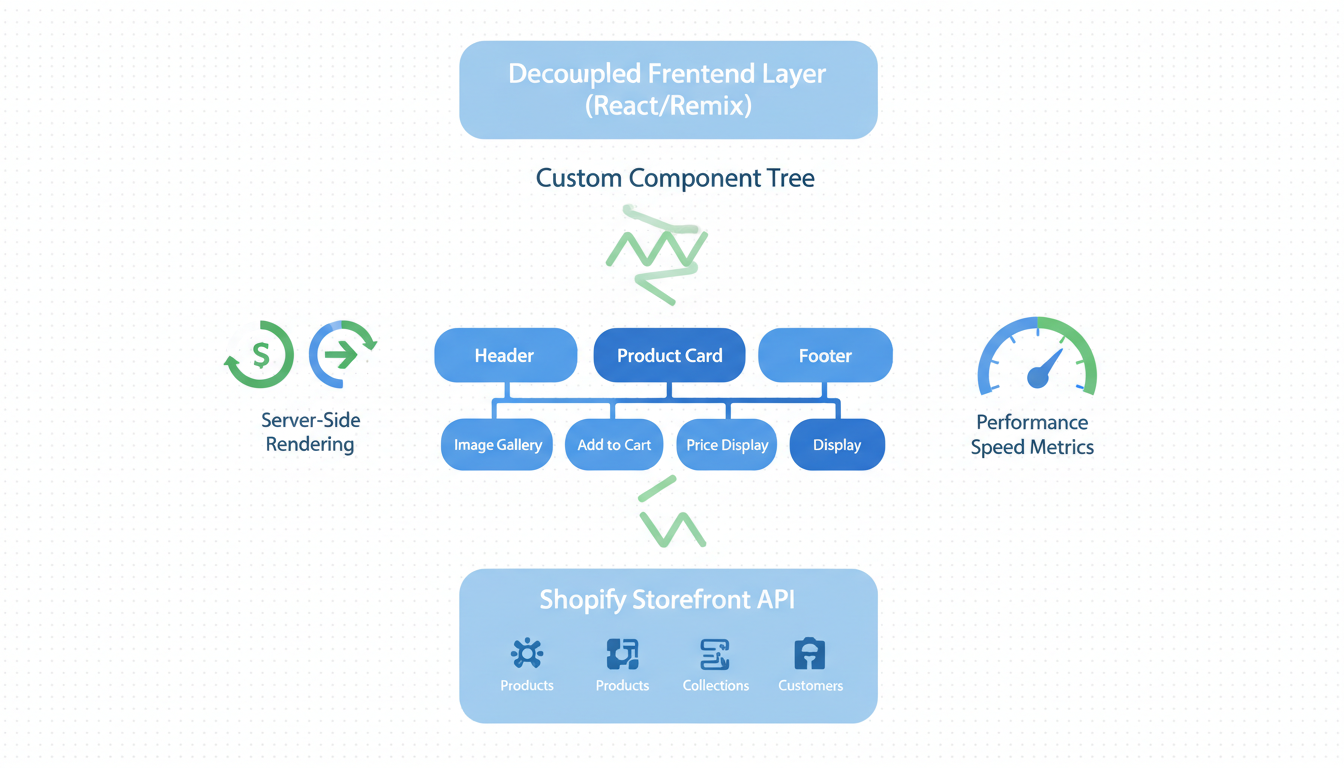
Shopify Hydrogen headless is the upgrade that sounds like a performance story and is actually a team and budget story, and most stores asking the question are asking it two years too early. Hydrogen is Shopify's React-based storefront framework that renders against the Storefront API, hosted on Oxygen or Vercel, while checkout and admin stay native on Shopify. On paper you get a 0.5 to 1.0s LCP win and total creative freedom. In practice you get a $120k to $300k build, an 8 to 14 month timeline, and an ongoing engineering bill that stock Shopify themes do not carry. The math works at $10M+ annual revenue with a real dev team and a specific reason (custom configurators, content-commerce at scale, multi-region complexity). Below that, the same budget spent on CRO and acquisition usually returns 3 to 5x more. The real question is whether your store is one of the 3 where headless pays back. Hydrogen being good is the easy part, and also the wrong filter.
- Hydrogen pays back at $10M+ annual revenue with a dedicated dev team.
- Oxygen hosting is free on Plus but locks you in. Vercel is flexible and costs $500 to $3,000 a month.
- Migration timelines run 8 to 14 months honestly, not the 4 to 6 months quoted.
- Below $5M GMV, a stock Shopify theme with a speed pass beats Hydrogen on ROI.
What Hydrogen actually is in 2026
Shopify Hydrogen is a React-based storefront framework built on Remix, shipped in 2022 and matured after Shopify acquired Remix in 2023. It is headless in the sense that the frontend is decoupled from the admin and renders against the Storefront API over GraphQL. Checkout still runs on Shopify, product data still lives in the admin, but everything the customer sees is code you own, hosted on infrastructure you pick.
What you get over a stock Shopify theme:
- A React frontend with server-side rendering and full DOM control, so pages can behave like a custom app instead of a theme.
- The Storefront API over GraphQL (sub-200ms under normal load), handling all commerce primitives: products, variants, collections, cart, customer accounts.
- Native integration with Shopify checkout, so you do not rebuild the highest-converting part of the funnel.
- Oxygen hosting, free on Shopify Plus, shipping edge-rendered pages from Shopify's global CDN.
The thing most operators get wrong: Hydrogen is not a better theme, it is a different product. You are replacing your Shopify experience with something that needs engineering resources a theme never needed. Shopify's Hydrogen documentation is good, and it is also the first sign of the shift. If reading it feels like a framework tutorial instead of a CMS guide, that is because it is. Theme developers without React experience will stall.
State of Hydrogen in 2026: the framework is stable, and Shopify has shipped real primitives for cart, checkout redirect, customer accounts, and international routing. The team requirement has not changed. Hydrogen needs senior React engineers, full-time, not fractional.
Hydrogen vs Liquid themes: the real tradeoff
Hydrogen Shopify vs Liquid themes is the tradeoff every "should we go headless" conversation lands on, and the comparison is almost never framed honestly. Sales decks show a side-by-side where Hydrogen wins on everything. In practice Hydrogen wins on flexibility and performance ceiling, Liquid wins on everything else, and most stores get more value from "everything else."
The honest comparison:
| Dimension | Liquid Themes (Dawn-based) | Hydrogen |
|---|---|---|
| Build cost (new store) | $5k to $30k | $120k to $300k |
| Timeline to launch | 4 to 10 weeks | 8 to 14 months |
| Ongoing dev cost | $2k to $8k a month | $15k to $40k a month |
| LCP ceiling (mobile, well-built) | 1.8 to 2.2s | 1.2 to 1.6s |
| Design flexibility | High, bounded by Liquid | Unlimited |
| App ecosystem compatibility | Native, all apps work | Partial, many apps need rebuild |
| Team skill requirement | Shopify theme dev | Senior React + Remix + GraphQL |
| Content editor experience | Native theme customizer | Custom build or headless CMS bolt-on |
The two rows most operators underweight: app ecosystem and content editor. On Liquid, the 1,000+ app ecosystem works out of the box. On Hydrogen, roughly 40% of apps need custom integration because they rely on theme app extensions that do not exist on headless. So "creative freedom" comes with the hidden cost of rebuilding tools the merch team was already using.
The content editor piece kills merch teams. On Liquid, a marketer launches a collection page without engineering. On Hydrogen, unless you bolt on a headless CMS (another $500 to $2,000 a month plus integration), every content change is a dev deploy. That is the single most common regret we hear 12 months in. Best to treat Hydrogen as a tradeoff: faster ceiling and total frontend control, minus ecosystem fluency and zero-ticket merch. Whether the trade is worth it depends on which of those your business needs to win.
The 3 stores where headless pays for itself
Headless Shopify setup pays back in three patterns we have seen repeat across stores audited since 2023. If your store fits one cleanly, the Hydrogen math usually works. If not, it almost never does.
- High-revenue DTC brands ($10M+ annual) with a brand experience stock themes cannot deliver. Custom configurators, AR try-on, homepages that behave like apps, heavy editorial on the PDP. At $10M+, LCP and interaction improvements translate to measurable CR lift (0.3 to 0.6 points), which covers the build cost inside 18 to 24 months.
- Content-commerce hybrids with heavy editorial needs. Stores where blog, buying guides, or shoppable editorial drives 30 to 50% of revenue. Liquid handles blog content poorly. Hydrogen plus a headless CMS lets content ship at velocity while commerce stays native. Outdoor gear, beauty, and wellness brands show up here most often.
- B2B or multi-region operations with complex routing or gated experiences. Hydrogen makes server-side routing, conditional rendering, and geolocation-based experiences clean. Liquid makes them possible but painful. Separate storefronts across regions with different catalogs and pricing? Hydrogen's routing model pays for itself in operational clarity.
The common thread: revenue scale to absorb the cost, engineering capacity for the ongoing maintenance, and a specific reason a well-built Liquid theme cannot match. If you cannot name the reason in one sentence, the pattern does not apply. "We want it to be faster" is not a reason. "We need AR viewers on every PDP and Liquid chokes on it" is a reason.
The stores that saw the biggest Hydrogen ROI all moved after hitting a specific wall on Liquid, not because a Plus rep pitched them. Decision-driven, not aspiration-driven. That is the signal to watch for.
The 5 stores where headless burns budget
For every store where Hydrogen pays back, five we audit are using it as an expensive answer to a problem the stock theme would have solved. Five patterns where headless burns budget:
- Stores under $5M annual revenue. The build ($120k to $300k) plus $15k+ a month in maintenance does not return inside 36 months. Same budget on creative, acquisition, or CRO usually returns 3 to 5x more. Four of five stores we audited at $2M to $4M GMV on Hydrogen regretted it inside 18 months.
- Stores without a dedicated dev team. Hydrogen without a full-time senior React engineer becomes a liability. Updates stall, features take quarters instead of weeks, the ticket backlog grows.
- Stores that lived on the Shopify app ecosystem. If your stack was Klaviyo plus Judge.me plus ReCharge plus a quiz plus loyalty plus upsell, Hydrogen means rebuilding most of them. Integration cost can hit $30k to $80k on top of the build, and some apps never behave the same on headless.
- Stores where merch ships content daily or weekly. On Liquid, merch launches collections without engineering. On Hydrogen without a CMS bolt-on, every change is a deploy. Marketing velocity drops 60 to 80%, and the resentment shows up in team meetings within 3 months.
- Stores chasing a PageSpeed score instead of CR. Hydrogen delivers 0.5 to 1.0s of LCP over a well-built Liquid theme. Real, but at $3M to $8M the CR impact is usually 0.1 to 0.2 points because the store was already under 2.5s after a clean speed pass. ROI does not clear the build cost.
Three patterns repeat in the post-mortems: an agency sold them the idea, they underestimated engineering overhead, and they had no specific revenue lever. Best to stress-test against these 5 patterns before signing the contract.
Oxygen hosting, Vercel, and the infra bill
Oxygen Shopify is the managed hosting product for Hydrogen, included on Shopify Plus at no extra cost. Vercel is the common alternative, picked when teams want flexibility or already run on Vercel. Both work. The tradeoff is control vs cost, and the long-tail implications do not surface until 12 months in.
Oxygen, honest version:
- Free with Shopify Plus. Unlimited requests, global edge rendering, zero infra bill.
- Tight integration with Shopify's deploy pipeline. Push to GitHub, Oxygen builds and deploys.
- The lock-in: Oxygen only runs Hydrogen. Ever move to Next.js or another framework, migration is a full frontend rebuild.
- Limited server-side flexibility. No long-running jobs, no custom backends, no arbitrary server logic.
Vercel, honest version:
- Flexible, handles Next.js, Remix, and Hydrogen equally well. No framework lock-in.
- Costs money. Typical Hydrogen store on Vercel Pro or Enterprise runs $500 to $3,000 a month.
- Better observability tooling than Oxygen. If the team already uses Vercel, the consistency is valuable.
- Engineers who know Next.js feel at home immediately. Oxygen requires a learning curve.
The matrix most teams skip: if you already have a Vercel relationship, picking Vercel usually pays off in developer productivity even at $1k to $2k a month. Starting fresh and want the lowest-friction path, Oxygen is the right pick. Vercel's Hydrogen deployment guide covers the Vercel-specific setup if that is the direction.
One trap: the "free" part of Oxygen assumes Plus at $2,500+ a month. On Shopify Advanced, Oxygen is not available and Vercel becomes mandatory, pushing infra higher on a smaller plan. Total ongoing infra (hosting, CDN, image optimization, CMS if applicable, monitoring) runs $1,000 to $5,000 a month beyond the Plus contract. Budget honestly, because it will not show up in the build quote.
Dev team requirements honest edition
Hydrogen requires a team profile that stock Shopify does not, and the sales pitch understates this. The quote is "you need a React developer." The reality is "you need a small frontend engineering function with ongoing capacity, not a one-time build partner."
What the minimum Hydrogen team looks like:
- One senior React engineer, full-time. Must know React, Remix, and GraphQL. Storefront API can be learned. Salary load: $150k to $250k in-house, or $180 to $280 an hour on partner retainer.
- One part-time DevOps engineer. For deploy pipelines, observability, and integrations. Often the same engineer at smaller stores.
- Design system owner. Hydrogen encourages component-driven design, which means maintaining a system in code.
- Content system owner if using a headless CMS. Sanity, Contentful, Storyblok all require schema work and ongoing maintenance.
Total ongoing engineering cost runs $15,000 to $40,000 a month. Steady-state, not the build. Stores that underbudget this end up in the same place 12 months in: a frontend nobody maintains, dependencies drifting, feature requests piling up.
The skill profile mismatch is the part most stores discover too late. Theme developers without React and Remix will struggle for 3 to 6 months before becoming productive, and some will not transition at all. If your current dev relationship is a theme partner, assume you are replacing it, not extending it.
Best to evaluate the team question before the build cost question. The build cost is finite. The team cost is forever. Most stores that regret Hydrogen regret the ongoing engineering overhead more than the one-time build. The good news: if you do have the team, the Hydrogen developer experience in 2026 is genuinely good. Engineers who work on Hydrogen for 6 months usually do not want to go back to Liquid. That is both a compliment and a warning.
Migration cost and timeline reality
When to upgrade Shopify to Hydrogen is less a question than how long migration takes, because timeline is where most projects run aground. Sales quotes land at 4 to 6 months. Our audit sample across 2024 to 2025 puts the honest median at 8 to 14 months from contract to full feature parity. The gap is where budget overruns and frustration live.
Realistic phase breakdown for a $10M GMV DTC store going Liquid to Hydrogen:
- Months 1 to 2: discovery, scope, team hiring. Cataloguing every page template, app integration, and custom feature takes real time. If you are hiring the React engineer for this project, add 4 to 6 weeks for search and ramp.
- Months 3 to 5: foundation build. Project setup, Storefront API integration, routing, homepage, collection template, product template, cart. Looks fast until the first app integration breaks.
- Months 6 to 8: app migration and content system. Klaviyo, reviews, upsell, subscriptions, quiz, loyalty. Each is 1 to 3 weeks to rebuild. Plus CMS integration if using Sanity or Contentful.
- Months 9 to 11: SEO parity, accessibility, QA, phased rollout. Hydrogen does not automatically match the SEO output of your Liquid theme. Structured data, meta tags, canonical URLs, sitemap, robots.txt all rebuilt and tested. Most stores do a traffic-split rollout to catch regressions.
- Months 12 to 14: post-launch stabilization. Edge cases, analytics discrepancies, app behavior gaps. Always happens.
Total build cost runs $120k to $300k in professional services plus internal labor, plus $20k to $80k in app retrofitting, plus $10k to $40k in CMS integration if applicable.
The overrun pattern: stores budget $150k, the build hits $220k. The extra comes from integrations that took 3x the estimate, content migration not scoped in month 1, and post-launch stabilization nobody budgeted. Best to add 40% to the initial quote.
The stores that hit budget share three traits: they retained the engineering team before the build started, they cut scope ruthlessly in month 1, and they did not try to ship "everything new" at cutover. The ones that overrun tried to redesign, migrate, and launch new merchandising in the same sprint. It does not work.
Frequently asked questions
What is the real cost of a Shopify Hydrogen build in 2026?
Is Hydrogen faster than a well-built Shopify theme?
Can I use a headless CMS with Hydrogen?
What happens to my Shopify apps when I go headless?
Should I use Oxygen or Vercel for hosting?
When should I not go headless, even if I can afford it?
Shopify Hydrogen headless is a real product that genuinely works, ships fast pages, gives teams total frontend control, and pays back handsomely at the right scale. It is also the upgrade most stores are evaluating two years too early because the pitch sounds like a performance story and the reality is a team and budget story. Below $10M annual revenue with no dedicated dev team, almost no math justifies Hydrogen over a well-built Liquid theme with a proper speed pass. Above $10M with a specific revenue lever the headless build opens up (custom configurators, content-commerce at scale, multi-region complexity), Hydrogen pays back inside 18 to 24 months and stays paid back as long as the team maintains it. The trap is the "headless sounds futuristic" framing that treats the upgrade as an inevitable next step. It is not. It is a tradeoff, and the stores that win with Hydrogen are the ones that named the specific problem first, built the team second, and picked the framework third. The ones that get burned almost always picked the framework first, built the team in parallel, and spent 14 months hunting for a problem worth the price tag.
Get a full X-ray of your ad account
Paste your Meta and Google Ads. See exactly where signal is leaking. Free. 60 seconds.