Shopify international (Markets) setup: the real playbook
 By Dror Aharon
·
CEO, COREPPC
·
Updated April 17, 2026
·
11 min read
By Dror Aharon
·
CEO, COREPPC
·
Updated April 17, 2026
·
11 min read
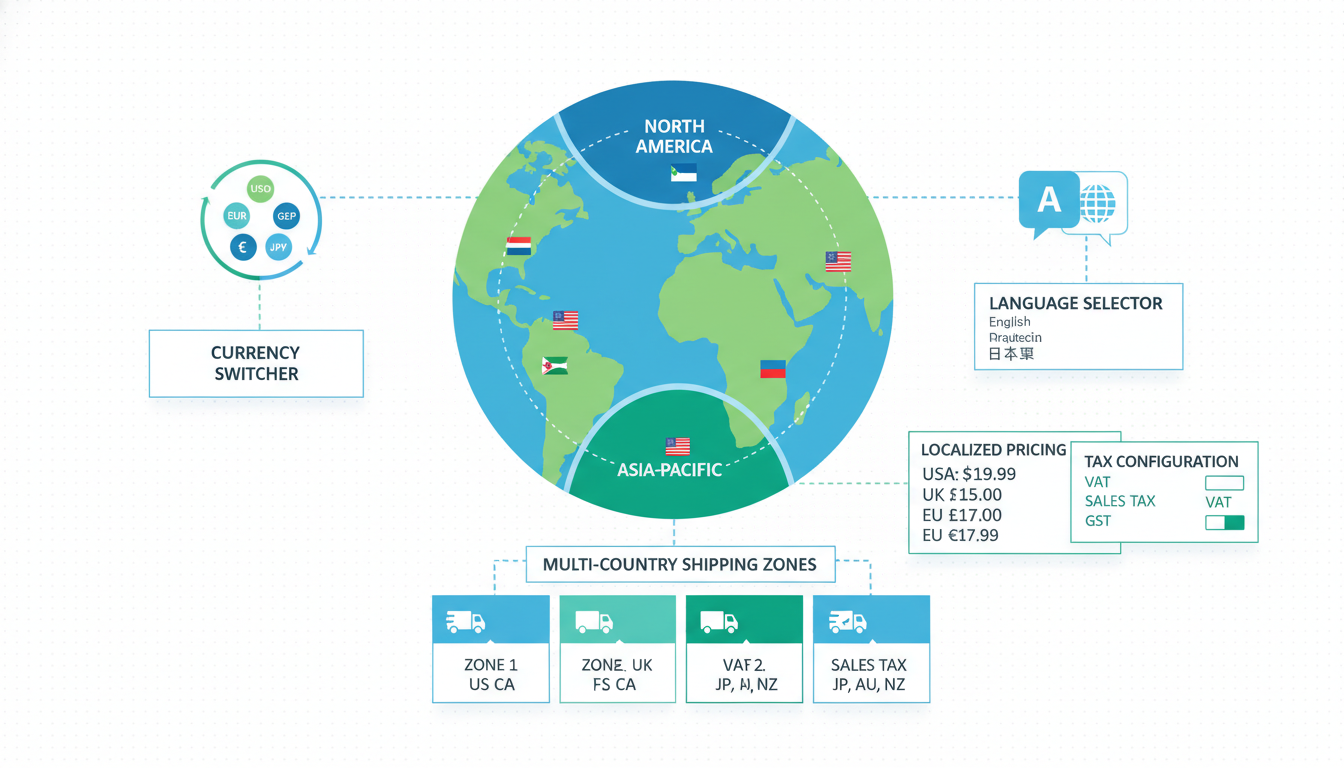
Shopify international setup is the project most stores half-finish, because Markets makes the first 20% of the work feel like a product launch and the remaining 80% is tax, duties, and localization nobody wanted to own. Markets covers multi-currency, multi-language, and country-level pricing on Advanced and up, and for most stores under $3M in international GMV that is enough. The upgrade path to Plus opens separate storefronts per region, which matters only when your regional businesses are operationally distinct. What actually breaks margin is duties and tax: EU VAT at the point of sale under IOSS, UK VAT on orders under £135, AU GST under A$1,000, all collected at checkout. Get those three right, pick a subfolder domain strategy, localize product copy and policies per market, and Shopify international selling quietly works. Skip any of those and it quietly leaks money instead.
- Markets on Advanced handles most sub-$3M international stores without needing Plus.
- Duties at checkout, not at the door, or your refund rate spikes 12 to 18%.
- Subfolders (`/en-gb/`) beat subdomains for SEO equity on a single Shopify store.
- EU VAT via IOSS, UK VAT under £135, AU GST under A$1,000, all at checkout.
When Shopify Markets earns an upgrade to Plus
Shopify Markets setup is the first step every store selling across borders runs into, and the upgrade-to-Plus question usually comes six months later after the ops team realizes one storefront can't carry three regional catalogs. On Advanced, Markets handles multi-currency pricing, language switching, country-specific pricing, and regional domains. Enough for most stores under $3M international GMV. What it doesn't give you is fully separate storefronts with different catalogs, themes, or brand names per region. For that you need Plus and its multi-store architecture.
The honest test is three questions. Two or more yes and Plus probably earns the upgrade.
- Do you need a different product catalog per region? Not just different prices or translations, but genuinely different SKUs sold in the UK versus the US for regulatory or brand reasons?
- Do you need a different brand presentation per region? Different domain, theme, homepage hero, or trust badges?
- Are you filing taxes across enough jurisdictions that one Shopify tax configuration can't cleanly serve all of them, and you need separate tax IDs and fiscal entities?
Two yes and the math for Plus starts working, especially combined with the other Plus levers covered in the Shopify Plus vs Advanced breakdown. One yes and Markets on Advanced is probably still the right call. Pattern we see in audits: stores cross the $3M international GMV line, feel the ops pressure, and assume the fix is Plus. More often the fix is finishing the Markets setup they half-configured 18 months ago, because duties, tax, and localization were parked as "phase 2" and phase 2 never shipped. See Shopify's Markets documentation for the feature surface, but read it after you've checked what you already have.
Currency, language, and pricing: the 3-lever decision
Shopify multi currency is the lever most stores pull first, because it is the most visible. A UK customer sees £ instead of $, checkout converts to GBP, conversion lifts in the first week. What stores forget to pull next are the two levers that actually make multi-currency profitable.
The three levers, in order of revenue impact:
- Country-specific pricing rules. Mark up or down per market with a fixed percentage or per-product override. Most stores leave this at "auto-convert from USD" and lose 8 to 15% of margin in markets where the conversion lands at an awkward retail price. A $49 product auto-converts to €45.30, which no retailer would ever price. Round up to €49, recover 7% margin, and conversion barely moves because the customer has no USD reference.
- Currency display per market. Force-display the local currency at storefront level, not just checkout. Stores that show USD on the product page and convert at checkout see 12 to 20% higher cart abandonment in non-US markets, because the mental math feels like a surprise bill.
- Language per market. Translate & Adapt is free up to 2 languages on Advanced. Translating product titles is table stakes. The lift from translating ad copy and email flows is 2x the lift from the product page alone, and almost no one does it.
The trap with multi-currency is the "one currency for all of Europe" decision. Stores that launch with EUR and then discover real volume in Sweden (SEK), Denmark (DKK), and Poland (PLN) have to retrofit, and the migration is annoying because historical order data lives in EUR. Best to decide upfront whether the EU is one market or five.
Shipping and duties: the hidden cost that breaks margin
Duties are the landmine most Shopify international selling projects step on. A customer in Germany orders a $120 product from a US store, the package lands at customs, the carrier collects €24 VAT plus a €12 handling fee at the door, the customer refuses delivery, the package ships back. You're out shipping both ways plus the refund. Our audit sample puts the "duties at the door" refund rate at 12 to 18% on EU shipments from US stores that haven't configured checkout duty collection. That alone wipes out the margin gain from opening international markets.
The fix is duties at checkout. Shopify's Duties and Import Taxes feature (DDP, Delivered Duty Paid) calculates duty and VAT at checkout based on HS code, destination country, and cart value. Customer sees full landed cost before paying. Carrier gets a pre-paid shipment and delivers without collecting at the door. Refund rate drops from 12-18% to 2-4%.
What DDP setup requires:
- HS codes on every product. Shopify's classifier is 70 to 85% accurate by category. Budget 10 to 20 hours of manual review, especially for apparel and food.
- Country of origin on every product. Where manufactured, not shipped from. This affects the rate under free trade agreements (EU-UK TCA, USMCA, CPTPP).
- A carrier that supports DDP labels end-to-end. DHL Express, FedEx International Priority, UPS Worldwide Express. Economy services often don't, which is why "why is my duty showing at the door" tickets are almost always on the cheapest tier.
- The "prepay duties and import taxes" toggle on in each market. Off by default.
Math worth running: $120 order to Germany with duties-at-the-door sees 15% refund rate, $25 per refund. Expected cost: $6.66 per order. Same order with DDP: 3% refund rate, $0.75 per order. Clears about $2,500 a year per $100k international GMV, which more than covers the HS code work.
Tax and compliance by region: EU VAT, UK VAT, Australia GST
Shopify international setup breaks most often at the tax layer, because the rules changed in 2021 (EU IOSS, UK post-Brexit) and keep moving in 2026 as EU CBAM rolls in for certain categories. The three big markets every DTC store faces are the EU, the UK, and Australia.
EU VAT via IOSS:
- Threshold: orders under €150 require VAT at point of sale.
- Rate: 17% to 27% by destination country.
- Registration: one IOSS number covers all 27 EU countries via a fiscal representative ($500 to $2,000 setup, $100 to $300 a month).
- Filing: monthly, through your intermediary.
- Trap: orders above €150 clear as standard customs, so you need a dual flow.
UK VAT:
- Threshold: orders under £135 require VAT at checkout. Over £135 clears as standard import VAT.
- Rate: 20% standard, 5% on some categories, 0% on books and kids' clothing.
- Registration: UK VAT number via HMRC, required from first sale under £135.
- Filing: quarterly via Making Tax Digital software.
- Trap: Brexit rules caught a lot of stores by surprise, and plenty are still filing late. HMRC penalties compound.
Australia GST:
- Threshold: GST applies to imported goods under A$1,000 if Australian sales exceed A$75,000 a year.
- Rate: 10% flat.
- Registration: ATO simplified GST for non-residents.
- Trap: the A$75,000 threshold is global to Australia, not per product line. Cross it once, you're registered for everything.
Shopify Tax calculates rates cleanly but does not file for you. Plug in Avalara or Taxually for automated filing ($300 to $1,200 a month), or hand reports to an accountant. Accountant path is cheaper under $1M international GMV, automated path is cleaner above it. One thing that catches everyone: threshold rules read ship-to country, not billing. A US-billed card with a UK shipping address triggers UK VAT.
Domain and subfolder strategy for international SEO
The domain decision is where most Shopify international setup projects make the call they regret 18 months later, because it compounds across every piece of SEO equity the store builds. Three options, honest tradeoffs:
- Subfolders (
example.com/en-gb/). Preferred for most stores. Domain authority concentrates on one property, hreflang handles region-language matching, and Markets generates the subfolder structure automatically. Right answer for 80% of stores. - Country-code top-level domains (
example.co.uk,example.de). Strongest local trust signal. Cost: you build authority from zero on every new ccTLD, so the first 12 to 18 months of SEO in each region is flat. Requires Plus for multi-store. - Subdomains (
uk.example.com). Weakest option. Google treats subdomains as separate properties for equity, so you pay the ccTLD authority-from-zero cost without the local trust signal.
Subfolders win on equity concentration, lose slightly on local trust. Over a 24-month window on a store doing $2M to $10M internationally, equity concentration almost always wins. Google's own multi-regional site guidance leans subfolders for the same reason.
Hreflang is the piece most stores get wrong even after picking subfolders. Markets generates hreflang tags automatically for each enabled market, but they only fire if the market is "active" and has at least one published language. Stores with Markets enabled but never flipped the language toggle end up with hreflang missing on 40% of international URLs, and Google serves the wrong regional version. Best to check Search Console's International Targeting report inside week one after each market launch.
One more trap: product URLs. Markets uses the same product handle across markets by default, so /products/red-hoodie lives at /en-gb/products/red-hoodie. Fine for SEO. What breaks is translating the handle, since that creates redirects and fragments link equity. Leave handles in English, translate titles and descriptions only.
Localization: product copy, descriptions, policies
Localization is where Shopify international selling stops being a platform problem and becomes a content problem. Translate & Adapt makes the mechanical part easy (paste English, machine translation fills in French and German, human reviews). What nobody warns you about is that machine translation gets product titles right about 80% of the time and policy pages right about 40%, because legal language is tight and region-specific.
The priority stack, ranked by revenue impact:
- Product titles and descriptions. Machine translate, then have a native speaker review the top 50 SKUs by revenue. 4 to 8 hours per language, meaningful lift versus auto-translated browser pages.
- Checkout copy. Shopify translates the checkout UI natively, but custom extensions or theme overrides don't carry over. Audit every checkout string after launch.
- Size and measurement units. Category norms matter more than country norms (UK apparel is inches, UK shoes are UK sizing, not EU). Check category conventions per market before translating.
- Shipping and return policies. These need rewriting, not translation. EU returns are 14 days minimum by law (CRD Directive), UK returns are 14 days post-Brexit, AU has no mandatory window but consumer guarantees apply. A US-friendly "30-day returns" can be fine, but legal framing has to match the region.
- Ad copy and email flows. Where most stores never finish. English ads to a French audience convert 30 to 50% worse than native-language ads on the same creative.
Stores that do localization well spend about 15% of international marketing budget on copy review, not translation. Translation itself is cheap. The review, cultural check, legal check, per-category convention check, that's where the value lives.
Measuring international vs domestic on Shopify analytics
The measurement layer is where most international projects quietly fail the post-launch review, because Shopify analytics aggregates cross-market data by default. A store with strong US and struggling EU looks "healthy" right up until inventory notices EU is sitting while US is sold out.
The breakdowns to set up on day one:
- Sales by market. In Shopify's Markets reports. Weekly for the first quarter, monthly after. Watch AOV, conversion rate, and refund rate per market, because domestic benchmarks don't apply for the first 6 months.
- Traffic source by market. Split campaigns by market in Google Ads and Meta, not just geo-targeting inside a shared campaign, so channel reporting tells you which ads work per region.
- Shipping as percentage of AOV, per market. If UK shipping runs at 18% of AOV and US runs at 8%, UK unit economics are bleeding and the blended P&L hides it.
- Refund rate and reason codes by market. Duties-at-the-door refunds look different from sizing refunds. Break out the reasons so you fix the right thing.
- Cart abandonment by market. If one market runs 15 points higher than others, it's usually a checkout friction issue specific to that region (payment method mismatch, unexpected duties, currency display).
Shopify's native reports cover most of these but not cleanly. Most stores past year one run a monthly market-level P&L in a spreadsheet outside Shopify. Worth setting up in month 2, not month 12. One blind spot: most analytics apps (Triple Whale, Polar, Northbeam) aggregate gross revenue without splitting tax per market, so "true revenue" on the EU line can read high by 15 to 20% if the app counts VAT as revenue. Check the tax column before reporting blended numbers.
Frequently asked questions
Do I need Shopify Plus to run Shopify Markets?
Is Shopify Markets enough or do I need a third-party app?
How long does Shopify Markets setup take?
What's the difference between Shopify multi currency and Shopify Markets?
How do I handle duties for international Shopify orders?
Should I use subfolders, subdomains, or ccTLDs for international SEO?
example.com/en-gb/) for most stores, ccTLDs (example.co.uk) only with a strong strategic reason to commit to a region separately, and almost never subdomains. Subfolders concentrate domain authority on one property, which is the biggest SEO lever on a growing international site. ccTLDs send the strongest local trust signal but require building authority from zero on each new ccTLD, and the first 12 to 18 months of traffic in each region is flat. For a US-based DTC brand launching into the EU and UK, subfolders via Shopify Markets are the default right answer.Shopify international setup is the project that separates stores ready to scale across borders from the ones that thought Markets was a one-weekend job. The platform side (currency, language, pricing, domains) is genuinely easy and Shopify ships it cleanly. The rest (duties, tax, localization, SEO, analytics per market) is where revenue either compounds or quietly leaks for a year. Best to run the three-question upgrade test before spending money on Plus, fix duties at checkout before spending on ads into new markets, and treat localization as a quarterly content review, not a one-time project. If the audit surfaces missing HS codes, a VAT registration you never filed, or hreflang gaps in Search Console, fix those first and revisit growth budgets after. The stores that make international work aren't the ones with the biggest platforms, they're the ones that finished the unglamorous 80% most teams park as "phase 2."
Get a full X-ray of your ad account
Paste your Meta and Google Ads. See exactly where signal is leaking. Free. 60 seconds.