Shopify Plus vs Advanced: when the upgrade pays for itself
 By Dror Aharon
·
CEO, COREPPC
·
Updated April 17, 2026
·
11 min read
By Dror Aharon
·
CEO, COREPPC
·
Updated April 17, 2026
·
11 min read
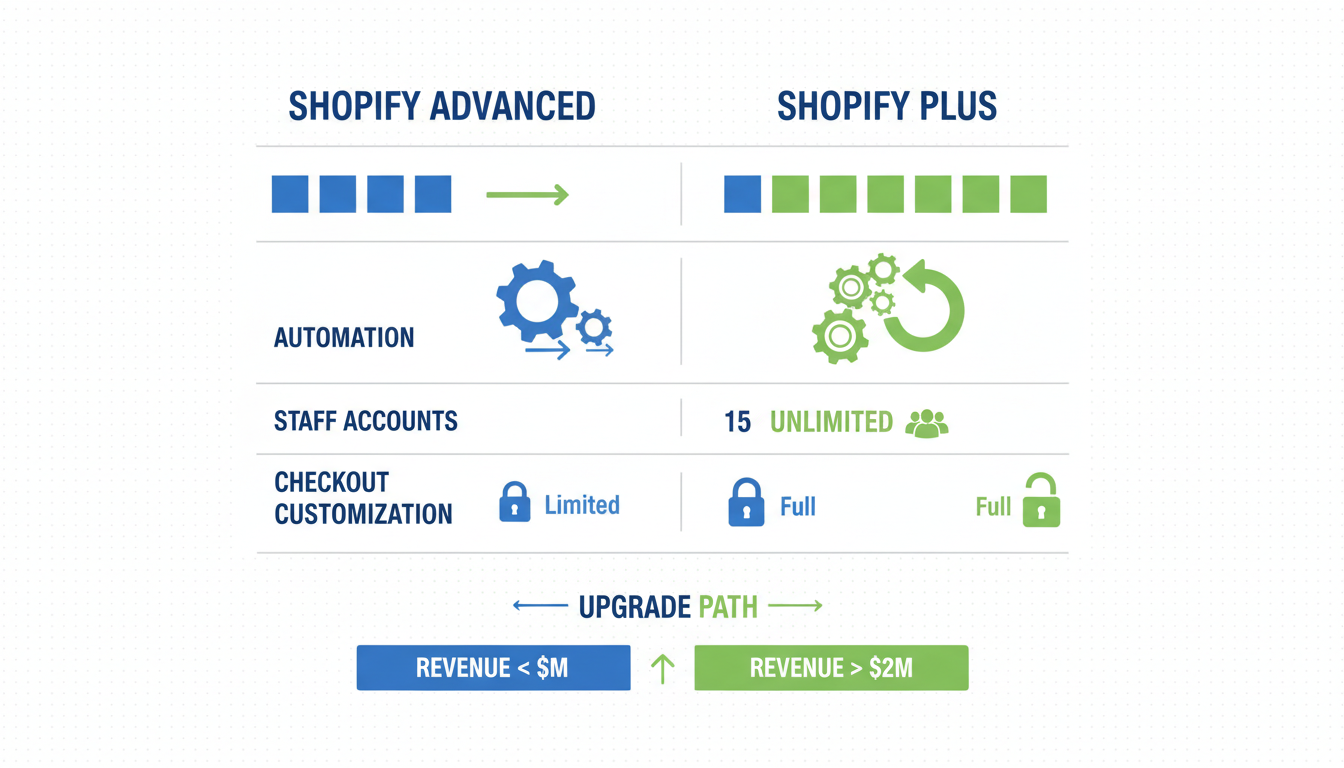
Shopify Plus vs Advanced is the wrong question for most stores asking it, because the honest answer below $5M in annual GMV is "stay on Advanced and stop reading sales pitches." Plus starts at $2,500 a month and tops out closer to $40,000 for high-volume merchants on variable pricing. Advanced sits at $399. The math only flips in your favor when transaction fee savings, checkout extensibility, and one or two genuinely Plus-only features (Shopify Functions at scale, B2B catalogs, multi-store) clear the $25,000-a-year delta. Most stores never get there. The ones that do usually waited 18 months too long because the sales rep made it sound urgent at $1.5M GMV. The five Plus features that actually move revenue are checkout customization, Shopify Functions, dedicated launch manager, Flow at scale, and the multi-store architecture. Almost everything else is theater.
- Below $5M GMV the upgrade rarely pays back inside 12 months.
- Checkout Extensibility is the one Plus-exclusive moat that's worth real money.
- Transaction fee math favors Plus around $3M GMV if you self-host payments.
- The 6-month migration timeline most reps quote is closer to 9 months in practice.
The honest "do you need Plus yet" test
Shopify Plus or Advanced is a pricing question that a lot of operators answer emotionally. The sales rep is good. The deck is shiny. The "you've outgrown Advanced" framing is hard to argue with at the end of a long quarter. So stores upgrade at $2M GMV, pay $30,000 extra a year for two features they actually use, and call it a strategic move. That's how most Plus migrations actually happen. The honest test is shorter than the sales deck.
Run these five questions in order. If you answer no to three or more, you don't need Plus yet, no matter what the rep says.
- Are you doing $5M+ in annual GMV, or will you cross it in the next 6 months based on real run-rate, not optimistic projection?
- Is your checkout the bottleneck right now? Specifically, do you need custom validation rules, hidden payment methods for specific segments, or B2B-style approval flows that the standard checkout can't handle?
- Are you running (or about to run) a B2B catalog alongside DTC, with separate pricing, payment terms, and tax rules per customer group?
- Do you have an internal dev team (or a dedicated Shopify dev partner) who can actually build with Shopify Functions and checkout UI extensions? Without dev capacity, you're paying for an empty toolbox.
- Are you running multiple storefronts (regional, brand-portfolio, or wholesale + retail) where the multi-store architecture saves you from running 3 separate Shopify accounts?
Three or more yes answers and the math probably works. Two or fewer and you're upgrading for status, not revenue. Best to read Shopify's own Plus positioning after you've answered the test, not before. The marketing site is excellent and that's exactly the problem if you read it first.
The trap to watch: "but my support response time will improve" is not a reason to spend $25,000 a year extra. It's a reason to fix your help docs and train one in-house person on Shopify ops. Plus support is faster, but most Advanced support tickets get resolved inside 24 hours anyway, and the merchants paying $30,000 a year extra for "priority" usually have one urgent ticket a quarter.
Pricing reality: Advanced at $399 vs Plus at $2,500 start
Shopify Advanced is $399 a month on the standard contract. Plus starts at $2,500 a month for stores under $800k monthly GMV, then moves to a variable-rate contract above that, capped around $40,000 a month for the largest merchants. The gap at the entry point is $25,212 a year. That's a real number, not a rounding error, and it's the number every "should we upgrade" conversation has to start from.
Inside the $2,500 starter Plus contract you get nine sandboxes (versus one expansion store on Advanced), Shopify Functions API access, checkout extensibility, the launch manager program for the first 6 months, Flow at higher trigger limits, B2B catalogs, and the multi-store architecture. You also get a lower transaction fee on Shopify Payments (0.20% versus 0.50% on Advanced) and 0% on third-party gateways above the platform fee. The fee math we walk through below is where Plus starts to pay for itself, but only above a specific GMV threshold and only if your payment mix is right. Shopify's pricing page shows the headline numbers but doesn't surface the variable-rate contract terms, which is where the real conversation happens.
The variable-rate piece matters because it's the part most "Plus vs Advanced" comparisons skip. Above roughly $1M monthly GMV, Plus moves to a percentage-of-revenue contract. At $5M GMV you're paying somewhere between $4,000 and $7,000 a month depending on category and contract terms. At $20M GMV the number is closer to $15,000 a month. Sales reps don't volunteer this breakdown, you have to ask. The honest framing is: Plus pricing scales with you, which is good if your margins scale too, and bad if you're a thin-margin category like fashion or food where every basis point matters.
One pattern from our audit sample of stores that migrated in 2024 to 2025: about 30% of them were paying the same effective monthly rate they'd have paid on Advanced if you add up Advanced + the Shopify apps they replaced with Plus features. The other 70% saved money on apps but spent more on dev time customizing the new toolset. Net cost stayed roughly flat for the first 18 months. The upgrade paid back, when it paid back, in revenue lift from checkout extensibility and B2B, not in cost savings.
The 5 features that actually make Plus worth it
Most lists of "Plus features" run 30 items deep. The honest list is 5. Here are the ones that actually move revenue and operations cost in our audit sample.
- Checkout Extensibility. The Plus-exclusive moat. Lets you customize the checkout step itself with React-based UI extensions and Shopify Functions. Used to be a $30,000-a-year custom dev project on Plus pre-2024. Now it's the standard pattern, and it's the single biggest reason Plus migration pays back. Covered in detail in section 5 below.
- Shopify Functions at scale. Server-side custom logic for discounts, shipping, payment methods, and bundling. Advanced gets limited Functions access. Plus gets the full surface and higher invocation limits. If you're running stacked discount logic (BOGO + spend-threshold + segment-based), Functions replace 4 to 6 paid apps and run faster.
- The dedicated launch manager (first 6 months only). A real human at Shopify who project-manages your migration and the first wave of feature builds. Saves about 80 hours of internal coordination time across the migration, which on most teams works out to $8,000 to $15,000 of loaded labor. After 6 months you lose them, so the value is front-loaded.
- Flow at higher trigger limits. Advanced caps Flow at fewer triggers per minute than most growth-stage stores need. Plus removes most of the practical limits. If you're running automated CX flows (refund-and-rebill, abandoned-cart re-engagement at scale, fraud screening), this is where you actually feel the bottleneck on Advanced.
- Multi-store architecture and B2B. One contract covers up to 9 expansion stores plus a B2B catalog. If you're running US + Canada + UK as separate stores on Advanced today, you're paying $1,200 a month just in Advanced licenses. Plus consolidates that and lets you share inventory, customers, and reporting across all stores. The B2B catalog is the killer feature here, because the alternative is a separate $200-a-month wholesale app that does 60% of the job.
That's the list. Five things. If your business model needs 3 or more of those today (not someday, today), Plus probably pays back inside 12 months. If you need 1 or 2, the math is harder. If you need zero, you're upgrading for the wrong reasons.
The 10 Plus features that sound great and do nothing for most stores
This is the section the sales deck doesn't include. Ten Plus features that look impressive on a comparison chart and rarely move the needle for stores under $20M GMV.
| Feature | Why it sounds great | Why it usually does nothing |
|---|---|---|
| Wholesale channel (legacy) | "B2B built in" | Replaced by B2B catalogs, but the legacy version still ships and confuses everyone |
| Script Editor (legacy Ruby scripts) | "Custom checkout logic" | Deprecated in favor of Functions, do not build new logic on Scripts in 2026 |
| Launchpad | "Schedule promotions" | A glorified cron job. Most stores already use Flow or a free app for this |
| Transform Pages app | "Page builder" | Worse than PageFly or GemPages, both of which work on Advanced |
| Multipass | "Single sign-on between sites" | Useful only if you actually have 2+ properties with shared accounts. Most stores don't |
| Higher API rate limits | "More headroom for integrations" | Advanced rate limits handle 99% of use cases. Hit them and you have a different problem |
| Plus-only theme support | "Premium themes" | Same Liquid templating, same Dawn baseline. The "Plus themes" are mostly marketing |
| Audit logs | "Compliance and security" | Useful for SOC 2 audits. Most DTC stores never need this |
| Organization admin | "Multi-store management" | Only valuable if you run multiple stores. Single-store merchants ignore it |
| Customer accounts (Plus tier) | "Branded customer portal" | The new customer accounts are available on Advanced too. Plus gets minor extras |
The pattern: half of these are legacy features kept around for backward compatibility, and the other half are useful only at scale or in specific business models. None of them, on their own, justify the $25,000+ annual delta. If a sales rep is leading with three of these as your reason to upgrade, you're being sold the wrong story.
Checkout Extensibility: the Plus-exclusive moat
Checkout Extensibility is the one Plus feature that genuinely changed the game in 2024 and is worth the upgrade on its own merits if you need it. Before extensibility, customizing the Shopify checkout meant paying $30,000+ for checkout.liquid edits and praying your customizations survived the next platform update. After extensibility, you build React-based UI extensions and Shopify Functions that plug into specific checkout extension points, and Shopify maintains the underlying checkout for you. The upgrades stop breaking things.
What you can actually do with it that you can't on Advanced:
- Add custom fields at any checkout step (gift messages, delivery instructions, B2B PO numbers) without touching theme code.
- Hide payment methods or shipping methods conditionally based on cart contents, customer segment, or geography. Functions run server-side so customers can't bypass them.
- Add upsell offers between checkout steps, post-purchase, or on the thank-you page. The post-purchase upsell alone lifts AOV 8 to 14% in most stores that ship it.
- Custom validation rules. Block specific zip codes, require certain customer fields for B2B, enforce minimum cart values per product category.
- Loyalty point redemption at checkout, gift card stacking, custom discount logic that the standard discount engine can't express.
The catch: extensibility requires a developer who knows React and Shopify's UI extensions API. If you don't have that on staff or on retainer, you're paying $2,500 a month for a toolbox you can't use. Plan on $8,000 to $25,000 in dev cost for the first wave of extensibility builds, depending on how custom your checkout needs to be. Read the Shopify Checkout Extensibility documentation before you sign the Plus contract, not after, so you know what you're actually buying.
The merchants getting the most value from extensibility in our audit sample share three traits: high AOV ($120+), repeat-purchase business model, and at least one full-time developer or a Shopify dev partner on retainer. If two of those three are missing, the extensibility advantage is mostly theoretical.
Transaction fee savings: the math at $5M and $20M GMV
The transaction fee math is the part of the Plus pitch that actually holds up. Run it honestly and you can see exactly when the upgrade pays for itself in fee savings alone, before any feature value is added on top.
Shopify Payments transaction fees by plan:
| Plan | Shopify Payments fee | Third-party gateway fee |
|---|---|---|
| Advanced ($399/mo) | 0.50% | 0.50% |
| Plus ($2,500+/mo) | 0.20% | 0.15% |
| Difference | 0.30% | 0.35% |
Note: these are the platform fees on top of the underlying card processing fee (typically 2.4% to 2.9% + $0.30 per transaction). The platform fee is what changes between plans.
The break-even math at three GMV bands, assuming Shopify Payments handles 100% of volume:
- $3M GMV: fee savings of $9,000 a year. Plus delta is $25,200. Net cost: $16,200 a year for everything else Plus gives you.
- $5M GMV: fee savings of $15,000 a year. Plus delta is $25,200 (still on the $2,500/mo entry contract). Net cost: $10,200 a year.
- $10M GMV: fee savings of $30,000 a year. Plus contract probably moved to variable rate, call it $5,500/mo, so the delta is $61,200. Net cost: $31,200 a year.
- $20M GMV: fee savings of $60,000 a year. Plus contract around $11,000/mo, delta of $127,200. Net cost: $67,200 a year.
The fee savings alone never fully pay for Plus inside the first 12 months, even at $20M GMV, because the variable contract scales faster than the fee savings. What changes the calculus is feature value. Checkout extensibility lifts AOV and conversion. B2B catalogs open a new revenue line. Functions replace $400 to $1,500 a month in apps. Stack the savings on top of the fee differential and the math turns favorable somewhere around $5M GMV for most stores, with two big caveats: you need to actually use the Plus features (not just have them), and you need a dev team that can build with them.
If you're using a third-party gateway (PayPal Braintree, Adyen, Stripe direct), the fee savings flip in your favor faster because the third-party gateway fee differential is bigger (0.35% vs 0.30%). Still not enough to justify Plus on its own below $5M GMV, but it tightens the math.
The 6-month migration reality
When to upgrade Shopify Plus matters as much as whether to upgrade. Sales reps quote a 6-month migration timeline. The actual median in our audit sample is closer to 9 months from contract signature to "fully migrated and using Plus features in production." The 3-month gap is where most of the budget overruns and team frustration live.
The realistic phase breakdown:
- Months 1 to 2: contract negotiation and account setup. Account provisioning is fast (a week). Negotiation drags because the variable rate terms, the discount on the first year, and the launch manager hours all happen here, and your CFO will have questions.
- Months 3 to 4: theme migration and app audit. Most stores discover they have 12 to 25 paid apps installed and 8 of them won't work the same way on Plus or are now redundant with native features. Audit, decision, removal, replacement. This phase always takes longer than planned.
- Months 5 to 6: checkout extensibility and Functions buildout. The dev work that justifies the upgrade. Plan on 200 to 400 hours of senior Shopify dev time depending on how custom your checkout needs to be.
- Months 7 to 8: B2B catalog setup if applicable, multi-store provisioning if applicable, customer migration and data hygiene. The launch manager helps here but you still need internal owners.
- Month 9: production cutover, monitoring, post-launch fixes. Plan a 2-week war room around the cutover, especially if you're moving from a third-party checkout app to Shopify-native checkout.
The migration costs money beyond the Plus contract itself. Budget $40,000 to $120,000 in total professional services and internal labor for a clean migration on a $5M to $15M GMV store. The high end covers stores with B2B, multi-region, and heavy customization. The low end covers single-store DTC migrations with a tight scope and a competent in-house dev. The stores that come in under budget all share one thing: they cut scope ruthlessly in months 1 and 2, and they did not try to ship "everything new" in the first quarter on Plus.
A pattern worth flagging: the stores that regret the migration almost always migrated for the wrong reason ("our agency said we should") and underbudgeted dev time for the new features. The stores that don't regret it migrated to open a specific revenue lever (B2B, checkout customization, multi-region) and budgeted accordingly.
Frequently asked questions
What's the actual price of Shopify Plus in 2026?
When does Shopify Plus actually pay for itself versus Advanced?
Can I get checkout extensibility without upgrading to Plus?
How long does Shopify Plus migration actually take?
What about Shopify Markets, do I need Plus for international expansion?
Should I downgrade from Plus to Advanced if my GMV drops?
Shopify Plus vs Advanced is not actually a feature comparison question, it's a math question with a few honest inputs. Below $5M GMV, almost no math justifies the upgrade unless you have a specific revenue lever (B2B, checkout customization, multi-region) that Plus uniquely enables. Above $5M GMV with the right team and the right business model, Plus pays back inside 12 months and stays paid back as long as you use the features you're paying for. The trap is upgrading for status, for "support response time," or because the sales rep is good. Best to run the 5-question test in section 1 against your actual business, not your projected business. If you answer no to three or more, the upgrade can wait. If you answer yes to four or five, the math probably works and the only remaining question is whether your dev capacity can keep up with the new toolbox. The merchants who get burned on Plus aren't the ones who waited too long, they're the ones who jumped too early because nobody told them the math.
Get a full X-ray of your ad account
Paste your Meta and Google Ads. See exactly where signal is leaking. Free. 60 seconds.