Shopify pop-up strategy that does not tank UX
 By Dror Aharon
·
CEO, COREPPC
·
Updated April 17, 2026
·
11 min read
By Dror Aharon
·
CEO, COREPPC
·
Updated April 17, 2026
·
11 min read
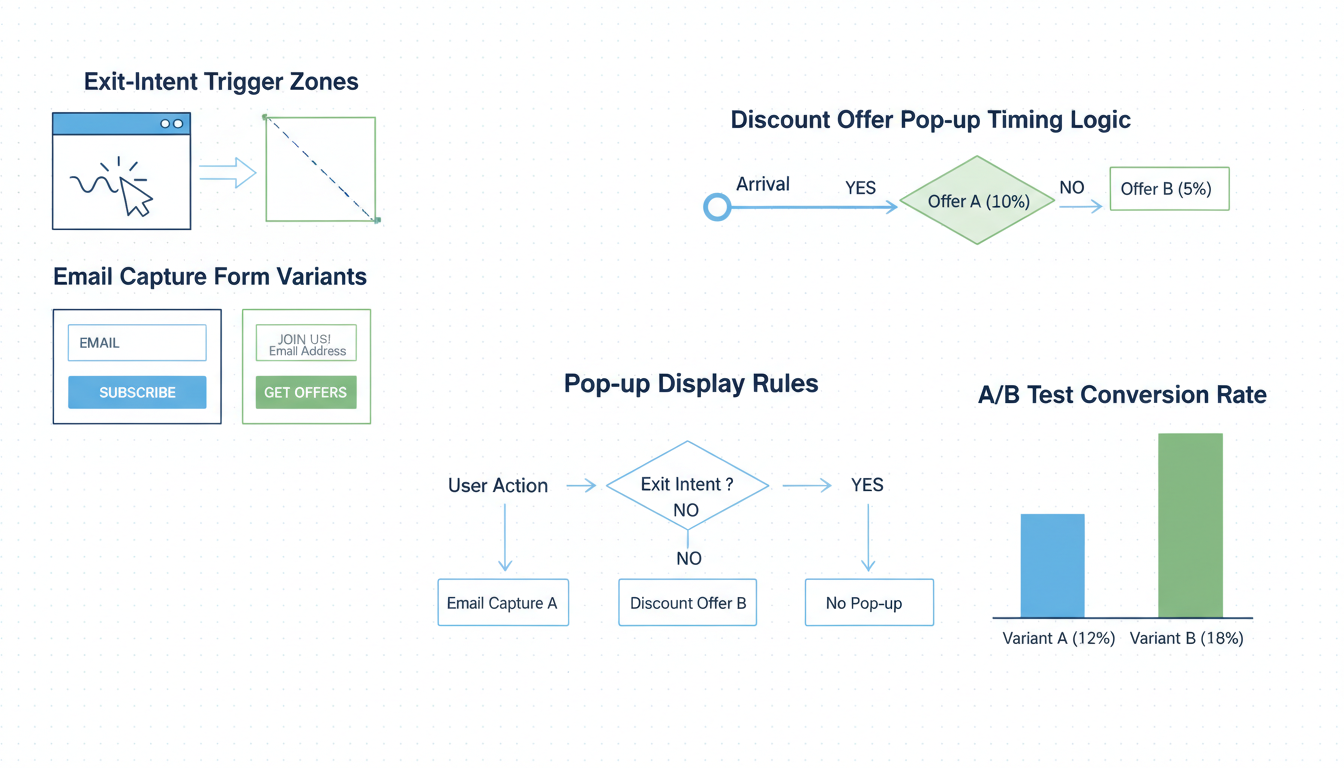
A bad shopify pop up strategy is the fastest way to torch conversion rate while convincing yourself the email list is growing. We see it every week. A 10% pop-up signup rate looks like a win on the dashboard, but if conversion rate dropped 0.4 points to get there, the store just traded $40 of revenue for every $1 of future email value. Most stores never run that math. Across the 200+ Shopify stores we have audited since 2023, the worst offender is the on-load 2-second pop-up, which kills bounce rate on paid traffic and tanks Quality Score on Google Ads at the same time. The fix is not "no pop-ups." The fix is a stacked timing rule, exit-intent on desktop, no interstitials on mobile, and one offer per visitor session. Get those four right and signup rate stays above 4% without the UX collapse. Do it wrong and the email list grows while revenue per visitor falls.
- On-load pop-ups under 5 seconds drop conversion rate 0.3 to 0.6 points on most stores.
- Exit-intent on desktop is the only pop-up that does not hurt CR. Use it.
- Mobile interstitials trigger Google's intrusive interstitials penalty. Avoid them entirely on landing pages.
- One pop-up per session, one offer. Stacking pop-ups cuts signup rate in half.
Why most Shopify pop-ups tank UX and CR at the same time
A bad shopify pop up strategy fails invisibly until you look at the right report. Signup count goes up. Klaviyo dashboard looks healthy. Meanwhile CR by traffic source quietly drops 0.3 to 0.6 points on paid traffic, and nobody connects the numbers because they live on different dashboards. Around 7 in 10 Shopify stores we audit have at least one pop-up that is net-negative on revenue. They just never ran the math.
The on-load 2-second pop-up is the worst offender. A user clicks an ad, lands on the PDP, and before the hero finishes painting, a modal blocks 80% of the screen asking for email in exchange for 10% off. About 60% close. About 25% bounce. Maybe 12% sign up. The 12% goes into the report. The 25% bounce nukes ROAS, because Meta's algorithm reads it as a low-quality audience signal and quietly downweights it. Two weeks later, CPA is up 30% and nobody knows why.
The second failure mode is stacked pop-ups. Welcome on entry, exit-intent on the way out, cart abandonment at checkout. Each looks fine in isolation. Together they feel like nagging, and signup rate on the second and third pop-up usually sits below 1% because users have learned to dismiss anything that moves. The second and third cost UX without buying list growth. Just delete them.
The honest test: pull CR by traffic source for the 30 days before you launched the pop-up and the 30 days after. If paid social CR dropped more than 0.2 points, the pop-up costs more than it earns. Best to look before you assume.
Timing: the 15-second and 45-second windows that convert
Pop-up timing is the single biggest lever in shopify popup best practices, and most stores get it wrong by a factor of 5. The default in every app is "show on page load." That setting was designed in 2014 and has never been updated. The data on stores we audit since 2023 is clear: pop-ups firing under 5 seconds convert worse than pop-ups firing at 15 to 45 seconds, and they hurt CR while doing it.
The two windows that work:
- The 15-second window. User has scrolled at least 30% of the page or spent 15 seconds on the PDP. Signup rate around 4 to 6%, CR impact roughly neutral. Best for new visitor email capture.
- The 45-second window. User has spent 45 seconds across at least 2 page views and has not added to cart. Signup rate around 7 to 10%, CR impact slightly positive because the pop-up captures a user who was about to bounce anyway. Best for "10% off your first order" offers.
The under-5-second window: signup rate sits around 10 to 14% (looks great) but CR drops 0.3 to 0.6 points and bounce jumps 8 to 15% on paid traffic. Net revenue is negative on every audit we have run. Skip it.
Why the 15 and 45 second windows work: by then the user has shown intent. They scrolled, they read, they did not bounce in the first 3 seconds. A pop-up at that point feels like a reward. Before then it feels like a paywall, and users treat it the same way (close, leave, never come back). The Nielsen Norman Group's research on modal pop-ups has shown the same pattern across hundreds of usability studies since 2017.
One more rule: do not show the same pop-up twice in the same session. Most apps default to "show again after 7 days." Change it to "once per session, once per 14 days per user." This alone usually adds 0.1 to 0.2 points to CR inside a week.
Exit-intent: the only pop-up that does not hurt CR
Exit-intent is the one pop-up format that consistently improves both signup rate and CR at the same time. The mechanic: when the user's mouse moves toward the tab close or back button, the pop-up triggers. By definition this user was leaving anyway. Capturing them with a 10% off code converts roughly 4 to 8% of would-be bounces into signups or purchases. Net CR effect is positive in 9 out of 10 stores we audit.
The catch: exit-intent only works on desktop. Mobile browsers do not surface the leave signal in a way JavaScript can detect early enough. Apps that claim "exit-intent for mobile" usually trigger on scroll-up (catches readers, not leavers), after X seconds (that is a timed pop-up), or on tab switch (fires when the user opens email to check a confirmation, hostile UX). All three hurt CR on mobile. Skip them.
The right exit-intent setup on desktop:
- Trigger on mouse movement toward the top 100px of the viewport, with a velocity threshold
- One offer, clearly stated. "10% off your first order, code WELCOME10"
- One field. Email only. Ask for phone or birthday on the confirmation page
- Easy close button, top right, at least 24px tall, no dark patterns
- Show once per session, once per 30 days per user
That setup typically captures 6 to 10% of would-be bounces and lifts overall CR by 0.1 to 0.3 points, because some captured users come back and convert within 7 days using the code. A store with 10,000 desktop sessions and 50% bounce rate captures 300 to 500 emails per month from exit-intent and recovers $1,500 to $4,000 in revenue from users who would otherwise have left. The only pop-up format where the math is reliably positive.
Offer architecture: discount vs value vs content
The offer inside the pop-up matters as much as the timing. Most stores default to "10% off your first order" because every app pre-fills it as the example. The problem: 10% off conditions every new visitor to expect a discount, and on a $50 product at 60% margin you just gave away $5 to acquire an email worth maybe $8 in lifetime value. Net is thin, and the brand pays a long-term cost in margin compression.
Three offer formats, ranked by effective margin:
- Free shipping above a threshold. Signup rate 3 to 5%, AOV impact +6 to +12%, no discount conditioning. Best for AOV above $40 and shipping cost above $7. The "add $X for free shipping" psychology raises basket size and makes the pop-up feel like a benefit.
- Content magnet (size guide, fit quiz, recipe pack, ingredient guide). Signup rate 4 to 7%, lower unsubscribe rate (around 0.4% per send vs 0.9% for discount signups). Best for high-consideration categories where buyers want info before purchase.
- Discount code. Signup rate 6 to 10%, AOV neutral to negative, conditions discount-seeking on repeat visits. Use only if margin absorbs the discount and you have a Klaviyo welcome flow set up to deliver the code.
Best to test the content magnet first if you sell above $50 average order. Signup rate is lower than the discount, but list quality is dramatically better. Welcome-flow open rates on content-magnet signups run 45 to 55% on the first email, vs 30 to 35% for discount signups. The discount-only list looks bigger but converts worse, six months in.
One anti-pattern to kill: "spin to win" pop-ups with discounts from 5% to 50%. Signup rate looks high (often 12 to 18%) but average discount delivered is around 22%, and most high-discount winners never come back at full price. Downstream LTV is lower than every other format. Skip them.
Mobile pop-ups: what Shopify + Google will tolerate
Mobile is where most Shopify pop-up strategies quietly destroy revenue. The same pop-up that converts at 6% on desktop converts at 1.5% on mobile and triggers Google's intrusive interstitials penalty, which costs you organic ranking. Most stores do not realize the SEO cost until 6 weeks later when organic traffic drops 15 to 25% and nobody can figure out why.
Google's intrusive interstitials guidance has been clear since 2017: a mobile pop-up that covers most of the content immediately after a search click will demote that page in mobile rankings. Three formats trigger the penalty: full-screen interstitials on entry, modals blocking above-the-fold content, and pop-ups the user must dismiss before reading. Two formats are safe: small banners under 15% of the viewport, and user-triggered pop-ups (scroll past 50%, tap a button).
The mobile rules:
- No pop-up on entry. None. The penalty is real and costs more than the email is worth.
- Allow user-triggered pop-ups (scroll past 50%, tap on a "save 10%" link). Not penalized because the user opted in.
- Allow small bottom banners under 15% of viewport with a clear close button. Penalized only if they cover the main content.
- Move email capture to a footer signup form and a dedicated landing page (
/save,/welcome) linked from the announcement bar. Lower volume, zero SEO cost.
For paid traffic the pop-up has to clear a different bar: Meta and Google both quietly penalize landing pages with intrusive interstitials in their auction algorithms, even if the page is not in organic search. Lower Quality Score, lower relevance score, both translating to higher CPC. We have measured 12 to 25% CPC increases on stores running on-entry mobile pop-ups for more than 4 weeks. Google's landing page experience guidance spells out the criteria. The pop-up app does not show you that line item. The Google Ads dashboard does, two weeks later.
Honest move on mobile: skip the pop-up. Use the announcement bar for the offer, link to a clean signup landing page.
Attribution: where pop-up signups get double-counted
Pop-up attribution is where most stores fool themselves. Klaviyo shows "email signups: 1,200 this month, attributed revenue: $48,000." Looks great. Now look at the same revenue inside Shopify's Sales by Marketing channel report. The same orders are also attributed to Meta Ads (last-click) and Google Ads (first-click). Three channels claiming the same dollar. Real incremental revenue from the pop-up is closer to $8,000 to $12,000, not $48,000.
This matters because most stores use Klaviyo's number to justify keeping the pop-up alive even when CR is dropping. The math says the pop-up is paying for itself. The math is wrong because it double-counts. We see this in roughly half the stores we audit.
The honest attribution model:
- Pop-up signup that converts within 24 hours: usually a paid traffic conversion that would have happened anyway. Attribute the sale to paid, the email value to pop-up.
- Pop-up signup that converts 3 to 30 days later via email click: real pop-up incremental revenue. Count it.
- Pop-up signup that never converts: count the email cost (Klaviyo storage, send cost) against the welcome-flow conversion rate (usually 1 to 3% over 30 days).
The cleanest way to measure incrementality: run a 4-week holdout where the pop-up is hidden for 25% of randomly selected sessions. Compare RPV (revenue per visitor) between live and holdout. If the pop-up is genuinely lifting net revenue, the live group shows higher RPV. If it is just shifting attribution between channels, RPV is flat or negative. Most stores have never run this test. The ones that do usually keep the pop-up but change the offer or timing.
Same trap on the welcome flow itself. Klaviyo attributes any purchase after a welcome email open to the flow, even if the user would have bought without it. Hold out 25% of new signups for 30 days and compare LTV. Lift is usually real but smaller than the dashboard suggests.
Pop-up apps ranked: Privy, Klaviyo, Justuno, Optimonk
Picking a Shopify pop-up app matters less than timing and offer, but it still matters at the margins. The four apps covering 90% of Shopify stores in 2026: Privy, Klaviyo (built-in forms), Justuno, Optimonk. Switching apps mid-stream is annoying, so best to pick the right one upfront.
Honest ranking based on stores we audit:
- Klaviyo built-in forms. Free if you already pay for Klaviyo. Triggers, segmentation, templates are solid. Falls short on A/B testing and mobile templates. Best under $2M revenue already on Klaviyo.
- Privy. $30 to $90 a month. Cleanest UI of the four, fastest setup, integrates with Klaviyo and Shopify Email. A/B testing built in but limited. Best for stores starting their first pop-up program.
- Justuno. $39 to $399 a month. Most feature-dense. Real exit-intent, audience targeting by source, A/B testing with statistical significance. Steeper learning curve. Best above $3M revenue running multiple pop-ups across segments.
- Optimonk. $39 to $249 a month. Strongest on personalization (offers per traffic source, products viewed, cart value). Best above $5M with multiple SKU verticals.
The honest take: most stores under $2M revenue should just use Klaviyo's built-in forms. Timing, offer, and mobile rules matter 10x more than which app sends the modal. Switching from Klaviyo to Justuno will not fix a bad timing rule. Tool choice is downstream of strategy.
One thing to avoid regardless of app: pre-built templates with countdown timers ("ONLY 2:34 LEFT"). CR looks decent in week one, then crashes once users notice the timer resets every visit. Trust collapses, bounce on returning users jumps. Dark-pattern stuff costs more than it earns, every audit.
Frequently asked questions
What is the best email popup shopify timing for a new store?
Do Shopify pop ups actually hurt conversion rate?
Which shopify pop up apps are worth paying for in 2026?
What is the right offer for a Shopify pop up: discount or content?
Why does Google penalize mobile pop-ups on Shopify?
How do I test if my Shopify pop up is actually making money?
A working shopify pop up strategy in 2026 is small, late, and quiet. One desktop timed pop-up at 15 seconds, one desktop exit-intent pop-up for users who skipped the first one, no mobile pop-up at all, one offer per visitor session, and a holdout test once a quarter to confirm the whole thing is net-positive. Get those four rules right and signup rate stays in the 4 to 8% range without dropping conversion rate or triggering Google's mobile penalty. Get them wrong and the email list grows while revenue per visitor falls, which is the worst kind of failure because the dashboard says you are winning. Best to pull conversion rate by traffic source for the 30 days before and after your current pop-up went live. If paid social CR dropped more than 0.2 points, the pop-up is the prime suspect. Fix the timing first, then the offer, then the mobile rules, then re-run the holdout. The list will still grow. The revenue line will grow with it instead of against it.
Get a full X-ray of your ad account
Paste your Meta and Google Ads. See exactly where signal is leaking. Free. 60 seconds.