Search campaign structure for Shopify stores
 By Dror Aharon
·
CEO, COREPPC
·
Updated April 17, 2026
·
11 min read
By Dror Aharon
·
CEO, COREPPC
·
Updated April 17, 2026
·
11 min read
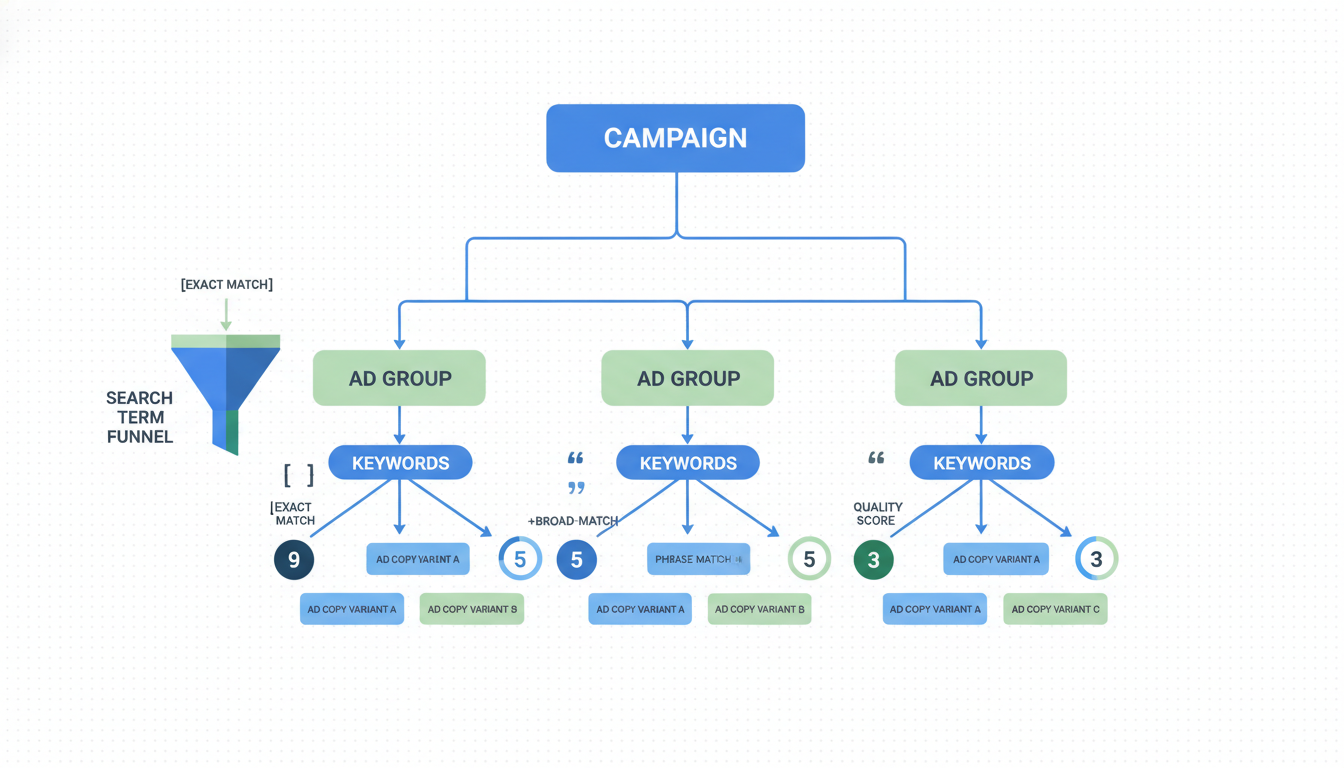
Shopify search campaigns are the defense layer PMax needs, and most operators either skip them or cram every keyword into one ad group and wonder why CPCs climb every month. The right shopify search campaign structure is four separate campaigns. Brand, non-brand, category, competitor. Each has a different job, a different budget share, a different CPA target, and a different ad copy angle. Running them underneath PMax (as a single catch-all "Search" campaign) is how ecommerce search ads end up paying $4 a click for the store's own brand name while PMax eats the real intent queries. We audit around 40 Shopify stores a month since 2023, and 8 out of 10 have google ads search shopify structure so mixed it is impossible to tell which keywords actually work. Fix the structure first. CPCs drop 20 to 35% inside three weeks. Quality scores climb. ROAS stabilizes. The setup is a day of work. The win compounds for months.
- Four campaigns: brand, non-brand, category, competitor. Never mixed.
- Brand gets cheap clicks and high conversion. Protect it from competitors.
- Non-brand runs on a keyword pyramid with match-type discipline.
- Category campaigns match intent to ad copy. No generic product feeds.
Why Search still matters on Shopify even in the PMax era
Performance Max was supposed to kill Search. It did not. It pushed Search into a more specialized role, and the Shopify stores that figured that out early are the ones running 3.5x ROAS on their Google spend in 2026. The stores that folded Search into PMax are paying unknown prices for their own brand queries while competitors bid on trademarked terms with no defense in place.
Shopify search campaigns do four things PMax cannot. Query-level visibility (PMax hides it). Brand search protection at a known low CPC. Ad copy matched to specific category intent (PMax asset groups flatten this). And bidding on competitor terms, which PMax will never do.
Google's Q1 2026 partner data shows stores running a dedicated brand Search campaign alongside PMax see a 12 to 18% lift in blended ROAS. The gap is almost entirely defensive. Competitors bid on your brand name, and if you are not there, they take clicks you already earned through organic demand. The official Google Ads Search documentation is the starting point. Best to think of Search and PMax as paired, not competing. Search is the intent layer. PMax is the volume layer.
The 4-campaign structure: brand, non-brand, category, competitor
The structure that works is four campaigns, each with its own budget, bid strategy, and CPA target. Not one campaign with four ad groups. Four campaigns. The difference matters because Google optimizes at the campaign level, and mixing brand (15 to 25% CR) with non-brand (1.5 to 3% CR) inside the same campaign teaches the algorithm nothing useful.
Budget split for most Shopify stores between $10k and $100k a month:
- Brand: 10 to 15% of Search budget. Exact and phrase. Target Impression Share, 95%+ top of page.
- Non-brand: 50 to 60%. Phrase and broad on head terms, exact on long-tail. Maximize Conversions, then Target ROAS after 50 conversions.
- Category: 20 to 25%. Phrase on category intent queries. Target ROAS, CPA slightly above account average.
- Competitor: 5 to 15%, only if the math works. Exact match on competitor names. Manual CPC with tight caps.
Each campaign gets its own negatives. Brand needs almost none. Non-brand needs a long list. Category needs intent-filtering negatives ("how to", "DIY"). Best to build four separate campaigns from day one. Splitting a mixed campaign later is painful and you lose the learning history.
Brand Search: budget, match types, landing pages
The brand campaign is the cheapest win in the account. Brand queries convert at 15 to 25%. CPCs run 50 to 80% below non-brand. And yet most Shopify stores either skip brand entirely or run a budget that caps by 10am.
The math. Someone searches your brand. Either you show up organically for free, a competitor shows up above you and takes the click for $3 to $8, or you show up as an ad above your own organic and pay $0.30 to $1.20 for a click that converts 5x better than non-brand. Option three wins every time. You are blocking competitors and controlling the message above the fold.
Match types: exact on brand name and obvious misspellings. Phrase on "brand + product" combinations. No broad on brand, it wastes budget on adjacent queries that do not mention you.
Budget sizing: monthly organic branded search volume × 0.4 CTR × average brand CPC. Add 30% for growth. If the campaign caps before 10am, you are losing clicks the rest of the day.
One thing most guides skip: add your own brand name as a negative on non-brand and category campaigns. Otherwise phrase-match terms pick up "[brand] + [category]" queries and charge you non-brand CPCs for cheap brand traffic.
Non-brand Search: keyword pyramid and bidding
Non-brand is where most of the budget lives and where most of the waste happens. The structure that works is a keyword pyramid. Three tiers, each in its own ad group.
Tier 1: Head terms (phrase first, broad later). High volume, medium intent. "Scented candles", "soy candles". Graduate to broad only after clean conversion data and a long negative list. Broad without negatives is how stores burn $2k a week on wrong searches.
Tier 2: Modifier terms (phrase). Medium volume, higher intent. "Luxury soy candles", "organic candles for gifts". These convert 2 to 3x better than head terms at roughly the same CPC. Most of the account value lives here.
Tier 3: Long-tail exact. Low volume per keyword, high intent. "Best soy candles for anxiety". Conversion rates run 6 to 10%. You need 40 to 80 of these keywords to add up to meaningful traffic.
Bidding: start every new campaign on Maximize Conversions for 14 days or 50 conversions, whichever comes first. Switch to Target ROAS after. Set the target 15 to 20% below what you actually need, because Target ROAS over-shoots the first two weeks. Tighten at 30 days.
Negatives matter more than keywords for non-brand. Review Search Terms weekly. After three months of consistent negative work, non-brand CPC typically drops 25 to 40% and quality scores climb from 4-5 to 7-8. That compounds.
Category campaigns: intent-matched ad copy
Category queries sit between brand and non-brand in intent. The searcher knows what kind of product they want ("running shoes for flat feet") but has not picked a brand. Match your ad copy to that exact intent and you outbid generic non-brand competitors at a lower CPC.
Structure: one campaign, one ad group per category. For a 12-category store, 12 ad groups, each with 8 to 15 phrase-match keywords.
Ad copy rule: headline must match query. "Ceramic cookware set" gets "Ceramic Cookware Sets", not "Premium Kitchenware". Google rewards this with higher quality scores and lower CPCs. Most Shopify stores write category ads at the brand level, which tanks quality score because the ad does not match the searcher's language.
Landing pages go to the category page, not the homepage. The page needs a headline matching the ad, three to five filters above the fold, top 8 to 12 products (not the full catalog), and a trust row near the top.
CPA targets run 15 to 25% above account average. Too tight and Google pulls back impressions. Too loose and CPA drifts. Best to audit category ad copy quarterly. Fifteen minutes of refresh per category usually lifts CTR 10 to 20%.
Competitor campaigns: when to run them, when to skip
Competitor Search is the most misunderstood campaign type in Shopify Google Ads. Operators either run it aggressively and burn budget at 0.5x ROAS, or refuse to run it and miss clean wins. The right answer depends on three factors.
Brand recognition gap. If your brand is smaller than the competitor, it can work. Searchers of the bigger brand are open to alternatives if your offer is compelling. If your brand is bigger, skip it.
Your offer vs. theirs. Competitor campaigns only convert when you have a real differentiator visible in the ad. "Free shipping" is not one. "30% cheaper than [competitor]" is. "Vegan version of [competitor]" is. Without a sharp comparison, clicks convert at 0.3 to 0.8%, below break-even.
Trademark. Google allows bidding on competitor names but not using the name in ad copy unless you are a reseller. The workaround is a generic ad ("The skincare brand with the cleanest ingredient list"). CTR runs lower, but when the offer is strong, conversion holds.
Structure: one campaign, one ad group per competitor. Exact match only. Start at 5% of Search budget. If CPA tracks within 1.3x of account average after two weeks, scale to 10%. Over 1.5x, pause. Skip entirely when the competitor is 10x your size, you have no comparison angle, or your margin is under 30%.
One trick most guides miss. Before you launch, check if the competitor is bidding on your brand. If they are, match them. If they are not, consider whether you want to start a bidding war. Once it starts, both of you pay more forever.
Ad copy and sitelinks that move conversion rate
Most operators write three ad variations at launch, let Google optimize, and never revisit. Accounts running 3x ROAS or better treat ad copy like a creative test that runs continuously. Three lines matter, in order:
- Headline 1: match query intent exactly. "Organic sunscreen" gets "Organic Sunscreen", not "Premium Skin Care". Quality score is built on this.
- Headline 2: differentiator. One crisp proof point. "Dermatologist-Approved", "4.8 Stars on 12,000 Reviews". Specific, checkable.
- Description 1: the offer. Free shipping threshold, return policy, bundle discount. Whatever makes the click worth taking.
Use all 15 headlines and all 4 descriptions in a Responsive Search Ad. Pin only Headline 1 when query-match is critical (category campaigns).
Sitelinks are the underrated lever. Each lifts CTR 8 to 15%. Most Shopify stores use generic sitelinks ("Shop All", "About Us") and leave 60% of the value on the table. What works is intent-matched to the campaign:
- Brand: "Best Sellers", "Reviews", "Bundle Deals".
- Non-brand: "Shop by Category", "Under $50", "Free Shipping".
- Category: specific sub-categories ("Men's", "Gifts under $30").
- Competitor: comparison-heavy ("Why Switch", "Price Comparison").
Callouts stack well. Four to six per ad, short and factual. "30-day returns", "Free shipping over $50", "Cruelty-free". Blank fields are wasted ad real estate. Structured snippets are the one extension most stores skip. Add a "Types" snippet listing categories. The more extensions you load, the larger your ad footprint, which lifts CTR, which lifts quality score, which drops CPC. Best to refresh ad copy monthly on high-spend campaigns, quarterly on everything else.
Fix the structure, fix the account
Four campaigns, each with a clear job. Brand defends and converts cheap intent. Non-brand scales on the keyword pyramid. Category matches ad copy to intent. Competitor runs only when the math works. If you want a second set of eyes on your current Search structure, the free Google Ads audit covers exactly this: campaign structure, match type discipline, negative coverage, and where budget is actually landing vs. where it should be. We send back a shareable report with the three biggest leaks and how to fix them.
Frequently asked questions
How many Shopify search campaigns should I run?
What percent of my Google Ads budget should go to Search vs. PMax?
Should I run brand campaigns if I already rank first organically?
What match types should I use on non-brand search?
How do I know if my competitor campaigns are actually working?
Do I still need Search campaigns if PMax is crushing it?
Meta CAPI setup on Shopify is one of those fixes that looks small on the dashboard and compounds for months afterward. Dedup cleanly, raise EMQ above 8.5, validate in Test Events before you push live, and the algorithm finally has signal it can trust. That is when ROAS stops wobbling and budget scales predictably, instead of collapsing every time you push daily spend past the last tested ceiling. Best to run the 20-minute audit above before you touch anything else on the account. If the audit surfaces two or more of the problems in the "Why Shopify stores get CAPI wrong" section, fix those first, then revisit creative testing. The creative never was the problem, nine times out of ten the tracking was lying the entire time.
Get a full X-ray of your ad account
Paste your Meta and Google Ads. See exactly where signal is leaking. Free. 60 seconds.