Post-purchase upsell strategy for Shopify
 By Dror Aharon
·
CEO, COREPPC
·
Updated April 17, 2026
·
11 min read
By Dror Aharon
·
CEO, COREPPC
·
Updated April 17, 2026
·
11 min read
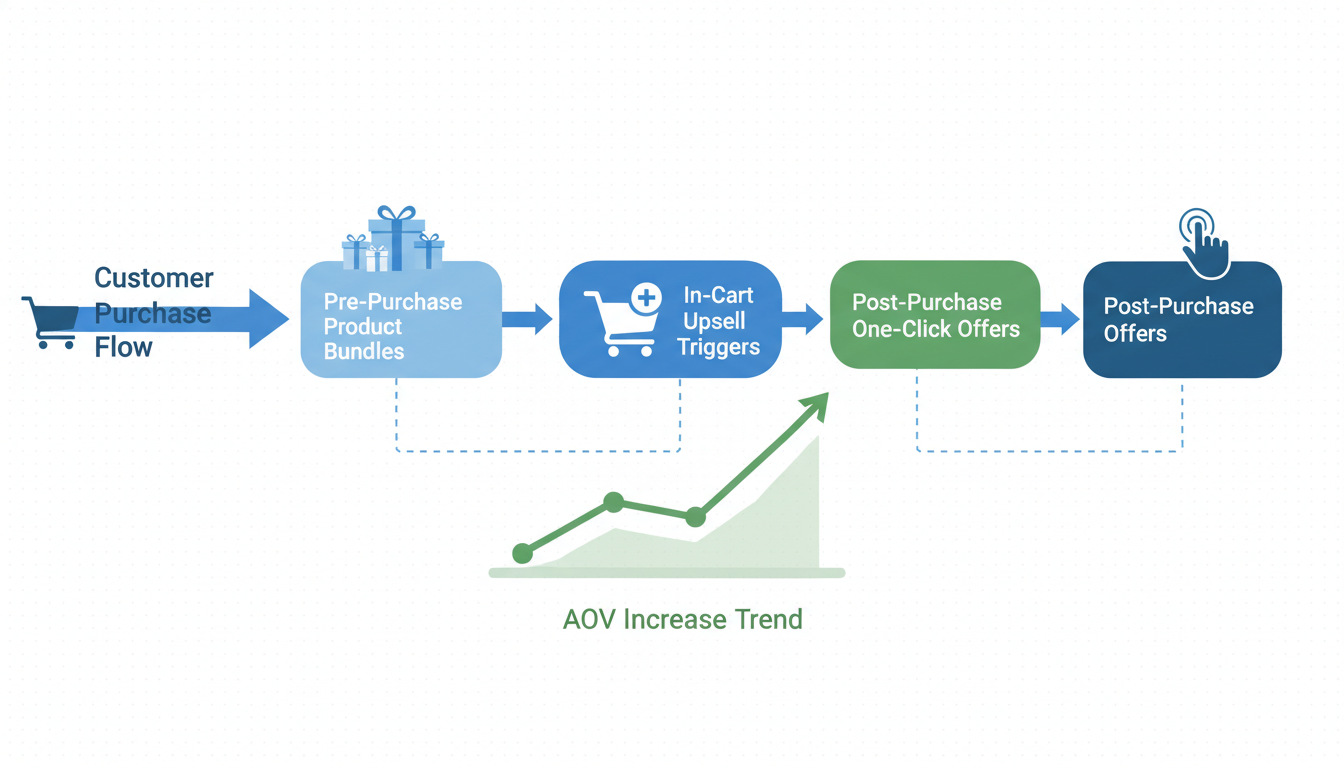
A Shopify upsell strategy is the highest-margin lever a growth-stage store has in 2026, and most operators run it at the wrong altitude with the wrong offers in the wrong position. Pre-checkout, checkout, and post-purchase are three completely different surfaces with three different conversion behaviors, and the same offer dropped into the wrong one converts at a third the rate. The post-purchase page is where the real money sits, with acceptance running 8 to 14% on offers that fit, but only when the discount math, the product pairing, and the one-click mechanics line up. Get any one of those wrong and the upsell either cannibalizes the main order or trains customers to wait for the popup. The four failure modes we see in audits show up over and over, and they cost the average store $40k to $120k a year in left-on-the-table revenue.
- Post-purchase converts 3 to 5x better than pre-checkout for the same offer, because payment is done.
- The 15 to 25% discount band is the sweet spot. Below 10% nobody clicks, above 30% trains discount-hunting.
- Product pairing matters more than copy. A wrong pair at 25% off beats nothing, but a right pair at 15% off wins.
- Measure incrementality vs cannibalization or you will scale a metric that just shifts revenue around.
Why post-purchase upsell is the highest-margin conversion a Shopify store runs
A post-purchase upsell on Shopify is the cheapest revenue a store will ever earn, and most operators do not run one. The customer already paid. Acquisition cost is absorbed in the first order. Anything they accept on the thank-you page is gross margin minus product cost, with zero incremental ad spend and a fulfillment cost that rounds to a second pick-and-pack line. On stores we audit running a clean post-purchase offer, contribution margin on accepted upsells lands between 55 and 78%, roughly double what the same product earns on a cold-traffic acquisition order.
Compare that to a pre-checkout cart upsell. Same product, same price, same customer. Pre-checkout, you are competing with payment anxiety and the small voice asking whether they really need it. Post-purchase, that emotional load is gone. The upsell is a separate transaction, processed against the card on file, one tap to accept. Acceptance climbs 3 to 5x for the same offer. Same store, same product, same discount, just moved from cart drawer to post-purchase, acceptance jumps from 2 to 4% to 9 to 14%.
Post-purchase also protects the main conversion. Cart and checkout upsells, badly placed, distract from the primary purchase and tank completion. Post-purchase runs after the order is locked in, so it cannot hurt the primary metric no matter how aggressive the offer. When we audit and see pre-checkout upsells lifting AOV by 6% but completion dropping 4%, the right move is to migrate the offer to post-purchase. You earn the upsell revenue without paying for it in completion losses.
The 3 upsell positions: cart, checkout, post-purchase page
Most shopify cross sell setups treat all three positions as the same surface, which is why they convert badly. Each has a different psychological context, attention budget, and conversion ceiling. Best to pick the position based on what the customer is doing at that moment, not on what the app makes easy.
Cart drawer is the discovery surface. The customer has opened the drawer and is in browse mode, not committed yet. Offers here should be cheap, complementary, and low-cognition. Think "add a $9 shaker to your protein order" or "gift wrap for $4." Acceptance runs 2 to 5%, AOV lift 3 to 7%. The mistake is offering a high-ticket second product. Anything above 30% of cart value tanks acceptance, because the customer has to recalculate whether they can afford both.
Checkout page (Shopify Plus only, via Checkout Extensibility) is the commitment surface. Attention is locked on completing the transaction. Offers have to be glanceable in under three seconds and tied to what is in the cart. Acceptance runs 3 to 7%. The risk is real: a poorly placed checkout upsell drops checkout completion by 2 to 5%. We only recommend checkout-page offers when AOV lift exceeds the completion-rate cost by a clear margin in A/B testing.
Post-purchase page is where the math actually works. Customer paid. One tap to accept. No card re-entry. Acceptance runs 8 to 14% on offers that fit, AOV lift sits at 12 to 22%, and completion on the main order is untouched. This is where 70 to 80% of upsell revenue should come from on a properly configured store, with cart and checkout playing supporting roles for low-friction add-ons. If your post-purchase acceptance is below 5%, the offer is wrong, not the position.
Product pairing logic: what to offer when
Pairing is the part most stores get wrong, because they default to "show our bestseller" and call it a day. That works on stores where the bestseller is complementary to everything in the catalog, which is roughly never. Real pairing looks at what the customer just bought and offers something that completes, extends, or upgrades that purchase. The lift from generic to paired is usually 2 to 4x acceptance.
Four pairing patterns hold up across categories:
- The accessory pair. Customer buys the camera, offer the case. Customer buys the dress, offer the bag. Customer buys the protein, offer the shaker. Obvious in hindsight, almost always under-used. Acceptance runs 10 to 16% because the customer already wanted the accessory.
- The consumable refill pair. Customer buys a 30-day supply, offer a 60-day at a small discount. Works on supplements, beauty, pet food, household consumables. Acceptance runs 8 to 12%, and LTV compounds because you compress the next purchase into this one.
- The category cross-sell. Customer buys protein, offer creatine. Customer buys mascara, offer eyeliner. Same brand, different SKU. Acceptance runs 6 to 10%, lower than accessories but with higher AOV expansion.
- The upgrade pair. Customer buys the standard model, offer the premium with a switch credit. Customer buys the single, offer the bundle. Acceptance runs 4 to 8%, but upsell revenue is 2 to 3x higher because the second product is the more expensive variant.
The mistake to avoid: offering a product the customer just rejected. If the cart has the accessory, do not offer it again post-purchase. If they viewed the upgrade and chose standard, do not push it post-purchase. Both signal the engine is not reading cart context. Most upsell apps let you exclude items already in cart, but the toggle is not on by default. Turn it on.
Discount depth: the 15%-25% sweet spot
Discount depth is the lever operators tune wrong more often than any other, usually by going too deep because they want the lift to look big. The math is more interesting. Below 10% off, acceptance barely moves vs no discount. Between 15 and 25%, acceptance climbs sharply and contribution margin still works. Above 30%, acceptance plateaus and you start training customers to wait for the discount instead of paying full price the first time.
The sweet spot lands at 15 to 25%. At 15%, margin is typically 65 to 78%, acceptance 8 to 11%. At 20%, margin drops to 58 to 70%, acceptance climbs to 10 to 13%. At 25%, margin is 50 to 62%, acceptance hits 11 to 15%. Contribution dollars per impression usually peak around the 20% band, because acceptance gains stop outpacing margin compression. Stores running 30%+ post-purchase discounts almost always earn lower total contribution per impression than stores running 20%, even though headline acceptance looks better.
The structural risk does not show up in week-one numbers. Customers who accept a 35% post-purchase upsell once start expecting one. At 15 to 20% discount depth, 90-day repeat rate runs 38 to 46%, in line with non-upsell cohorts. At 30%+ depth, repeat rate drops to 24 to 31%, because the customer is anchored on the discounted price. This is the cannibalization tax most operators never measure, and the biggest reason aggressive upsell discounting looks like it is working in the AOV report and bleeds LTV in the cohort report.
The exception: high-ticket ($200+ AOV) where 10% off equals real dollars. There, 8 to 12% works fine. Best to test 15%, 20%, and 25% in a clean three-arm split for 4 weeks, then pick the band that maximizes contribution dollars per impression, not acceptance.
Creative: copy, imagery, one-click mechanics
Post-purchase upsell creative gets less attention than ad creative and matters almost as much. The customer's attention budget on the thank-you page is short, maybe 8 to 12 seconds before they tab away. Everything has to read in that window: what the offer is, why it pairs with what they bought, what the discount is, what to tap. Miss any one and acceptance drops 30 to 50%.
Copy patterns that hold up:
- Headline names the product specifically and ties to what was just bought. "Add the matching belt for 20% off" beats "Special offer just for you" by 4 to 6x.
- Subheadline explains the pairing in one sentence. "Pairs with the dress you just ordered." Concrete, no marketing language.
- Price shown as both original and discounted. "$45 $36 (save 20%)" beats "$36" alone.
- Single CTA, present tense, action verb. "Add to my order" works. "Click here to claim" does not.
Imagery matters more than operators expect. Use the product photo on a clean background, ideally the same one on the product page. Lifestyle shots underperform here because the customer needs to recognize the product fast. Stores swapping a lifestyle hero for a clean product shot on the post-purchase page see acceptance lift of 12 to 18% in our split tests, no other change.
One-click mechanics matter most. Native one-click acceptance, where the second purchase processes against the saved card with no re-entry, is the ceiling for acceptance. Anything that adds a confirmation step, a card prompt, or a separate checkout drops acceptance by 3 to 6 points. This is why Shopify's Checkout Extensibility framework and apps that integrate with it are the only path to maximizing post-purchase conversion in 2026. See Shopify's post-purchase page documentation for framework specifics.
Measuring upsell incrementality vs cannibalization
Incrementality is the question most upsell strategy ecommerce conversations skip, and the only one that matters financially. The question is not "did the customer accept the upsell," it is "would the customer have bought this anyway, on a future order, at full price." If the answer is yes, the upsell did not add revenue, it shifted revenue forward and gave a discount along the way. That is cannibalization, and it shows up as lower LTV per cohort even when AOV climbs.
The right way to measure: hold-out tests. Run a 4-week A/B where 50% of customers see the upsell and 50% do not, then compare 90-day revenue per customer between groups. If the upsell cohort has higher 90-day revenue, the upsell is incremental. If they converge, the upsell is cannibalizing. Most stores never run this test, which is why they cannot tell whether the upsell program is earning real money or just rearranging it. Shopify's customer LTV guide walks through the cohort math.
In our audit data, post-purchase upsells on accessory pairs and category cross-sells are usually genuinely incremental, 65 to 80% of accepted revenue counting as net-new. Consumable refills are partially incremental, around 40 to 55%, because some revenue would have come back as a future repeat. Upgrade pairs are mostly incremental, 70 to 85%. Aggressive discount upsells (30%+) are the worst, often only 20 to 35% incremental, the rest being shifted-forward revenue at a worse margin.
Run hold-out tests once per offer type, learn the incrementality multiplier for your store, then trust those multipliers. Without the data, the AOV report lies to you systematically.
The 4 failure modes we see in audits
The same four failure modes show up in nine out of ten Shopify upsell audits. None are exotic. All are fixable in an afternoon once spotted.
First, the offer is generic instead of paired. The store shows the same bestseller to everyone, and acceptance sits at 3 to 5% because the offer is not relevant. Switching to a cart-context paired offer (accessory, refill, or category cross-sell) lifts acceptance to 9 to 14% on the same traffic. The fix takes one afternoon in the upsell app's rule builder.
Second, the discount is too deep. The store offers 35 to 50% off post-purchase because somebody read that "post-purchase upsells should be aggressive." Acceptance looks decent, margin is mediocre, and 90-day repeat rate quietly drops. Pulling the discount back to 15 to 20% usually preserves 80 to 90% of acceptance and protects LTV.
Third, the offer cannibalizes the main cart. Customer adds Product A. Drawer offers B. Customer adds B, removes A. AOV report flatters the change because totals are similar, but the store lost the higher-margin product and replaced it with a discounted lower-margin one. The fix is rule-based: do not offer a product if it would replace a higher-margin item already in cart. Most apps support this exclusion rule. Almost no stores have it on.
Fourth, placement is wrong for the AOV. Sub-$30 AOV stores try post-purchase upsells with $40 second offers, and acceptance lands in the low single digits because the second offer is bigger than the original. The right move at low AOV is a cart-drawer add-on at $5 to $10. Stores at $100+ AOV are the opposite: cart-drawer offers feel small and post-purchase is where lift sits. The shopify post purchase upsell that converts is priced as 30 to 60% of the order it follows, not 100%+ of it.
Frequently asked questions
What is the best upsell app for Shopify in 2026?
How much should I discount on a post-purchase upsell?
Will post-purchase upsells hurt my checkout conversion rate?
How do I measure if my upsell strategy is actually working?
Should I offer the same upsell to every customer or personalize?
Can I run upsells on cart, checkout, and post-purchase at the same time?
A real Shopify upsell strategy is not about installing an app and turning on the default offer. It is picking the right surface, pairing the second product to what the customer just bought, holding the discount in the 15 to 25% band, and measuring incrementality instead of acceptance alone. Get those four right and the upsell program becomes the highest-margin revenue line in the store. Get them wrong and you build a system that flatters AOV while cannibalizing future revenue at worse margin. Best to audit the four failure modes above before adding any new app or offer, fix what surfaces, then test new positions. The wrong upsell strategy is more expensive than no strategy, because it trains customers in patterns that are hard to undo.
Get a full X-ray of your ad account
Paste your Meta and Google Ads. See exactly where signal is leaking. Free. 60 seconds.