YouTube ads for Shopify stores
 By Dror Aharon
·
CEO, COREPPC
·
Updated April 17, 2026
·
11 min read
By Dror Aharon
·
CEO, COREPPC
·
Updated April 17, 2026
·
11 min read
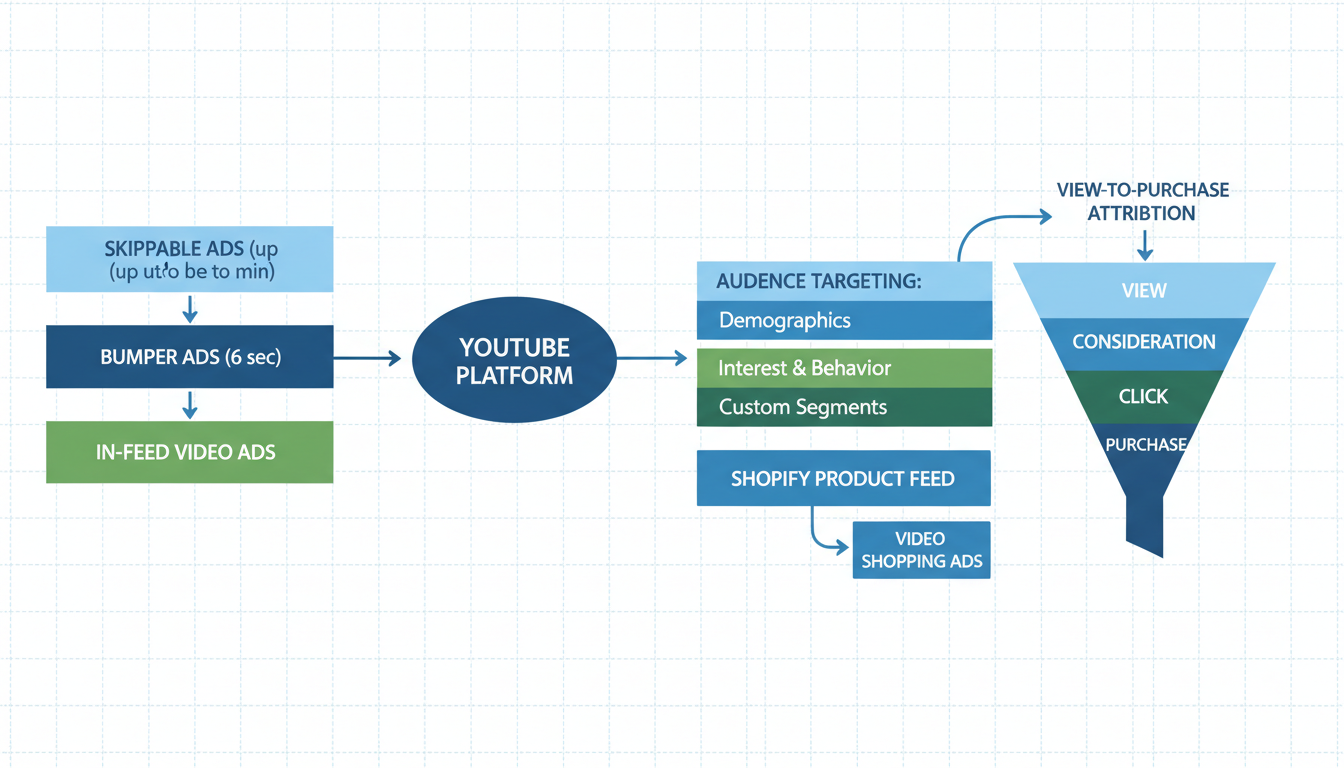
Shopify YouTube ads are the channel most DTC stores either avoid because "video is hard" or bolt on to Performance Max and quietly burn 25% of the budget on placements that never touch revenue. Both paths leave money on the table. In 2026 YouTube finally earned a seat at the direct-response table, mostly because YouTube Shopping now pulls products from Merchant Center straight into the video feed and because Demand Gen replaced the old Discovery campaign type with actual conversion optimization. The stores running it well are pairing Video Action Campaigns for bottom-funnel with Demand Gen for mid-funnel and feeding both off the same creative pool. The ones getting it wrong are running one 30-second brand video on auto-placement and wondering why ROAS reads 0.4. Fix the creative, pick the right campaign type, and YouTube starts contributing 15 to 25% of incremental Shopify revenue inside 60 days.
- YouTube earns a budget slot once Meta and Google Search are saturated. Not before.
- Demand Gen, Video Action, and Shorts each solve different problems. Do not mix them.
- Creative is 80% of the outcome. Hook in 3 seconds or you are paying for skips.
- Attribution via view-through is noisy. GA4 path reports tell the real story.
When YouTube earns a slot in a Shopify paid mix
YouTube is the channel most Shopify stores add too early or too late. The right time is when Meta ads have plateaued at whatever ROAS they run at, Search and Shopping are capped by branded plus category demand, and you still have headroom to scale. That usually happens between $30k and $60k a month in blended paid spend. Below that, the money buys more signal on Meta. Above it, Meta frequency climbs past 7 a week on top audiences and incremental spend stops moving revenue.
What changed in 2026 is that YouTube for Shopify finally works as a direct-response channel, not just a brand layer. The YouTube Shopping integration pulls products from Merchant Center into the video itself. Demand Gen replaced Discovery as the mid-funnel campaign type and now optimizes for conversions, not just engagement. Video Action Campaigns got an asset-level reporting view that actually tells you which headline is working. Three upgrades inside twelve months, and most operators still run YouTube the way they did in 2022, with one 30-second cutdown on auto-placement.
Shopify YouTube ads are not a first-dollar channel. They are a scale amplifier for stores that have already proven unit economics on Meta and Search. We audit around 40 Shopify stores a month since 2023, and the ones running YouTube profitably treat creative as the whole game and run YouTube as a third channel. The ones running it badly bolt it onto Performance Max, let YouTube eat 25 to 30% of PMax spend on junk placements, and never figure out why ROAS keeps slipping. Google's official YouTube advertising documentation is the starting point. This guide is about what moves the number.
YouTube Shopping: the direct-response shift
YouTube Shopping Shopify stores can now run is the piece that makes video worth running in 2026. Before it launched in North America in late 2023 and globally through 2024, YouTube ads for ecommerce were basically a brand channel with a shopping card bolted on. Now products appear as tappable cards inside the video, pulled directly from Merchant Center, and the viewer can add to cart without leaving YouTube. That collapses the path from watch to purchase from five clicks to two.
If Merchant Center is already connected to your Shopify store through the Google and YouTube sales channel, youtube shopping shopify integration is a toggle inside the campaign settings. No separate feed, no separate asset upload. The featured products pull from the same feed that Performance Max uses, which is why feed quality matters just as much here. If your Google product category is stuck at level 1 or 2 and titles are not keyword-front-loaded, the shopping card converts at 0.3%.
Stores running YouTube Shopping well do three things the average store skips. Keep the feed score at 140 plus on the 14-attribute scorecard. Tag hero SKUs with a custom label that flags them for YouTube-specific campaigns, so the algorithm is not pushing long-tail filler into a shoppable video. And review Shopping card placement data monthly, because Google still lets some cards attach to videos that have nothing to do with the product.
One catch most operators miss: YouTube Shopping requires a verified channel with at least 1,000 subscribers before full shopping features activate. That is a gate, not a suggestion. If you run a Shopify brand with no YouTube channel presence, best to spend a week uploading 5 to 10 product videos and running a small subscribe campaign before launching paid. Otherwise ads fall back to standard placements, which converts at roughly half the rate of the full shopping integration.
Shorts vs Demand Gen vs Video Action Campaigns
The three campaign types that matter on YouTube in 2026 are Video Action Campaigns, Demand Gen, and Shorts-eligible placements across both. Operators mix them up constantly, usually because Google's own UI keeps renaming things, and the mixups cost money.
Video Action Campaigns are the closest thing to a "Performance Max for video" format. Conversion-optimized, asset groups can include multiple video lengths and orientations, and the campaign runs across in-stream, in-feed, and Shorts. This is the type for bottom-funnel retargeting and lookalike expansion on cold audiences warmed somewhere else (usually Meta). Expected CPA sits 30 to 50% higher than Meta remarketing, but incremental revenue is often higher because YouTube reaches users Meta has already saturated.
Demand Gen is the mid-funnel campaign, built to replace Discovery. Works on YouTube in-feed and Shorts plus Gmail and Discover. Optimizes for conversions, not engagement. This is where shopify video ads google campaigns belong when you are trying to generate demand, not capture it. Asset groups use image and video together, so you can test static creative alongside video inside the same campaign. The catch: Demand Gen attribution is noisier than Video Action, view-through conversions dominate reported numbers, and a lot of them are ghost conversions. Measure by GA4 path reports, not the Demand Gen dashboard.
Shorts placements are eligible inside both Video Action and Demand Gen, not a separate campaign type. You get Shorts inventory by submitting a 9:16 vertical video asset, and Google's auction decides whether to serve in-stream, in-feed, or Shorts. Shorts CPMs run 40 to 60% cheaper than in-stream, but Shorts conversion rate is also lower. The win is using Shorts for top-of-funnel reach and in-stream for consideration in the same campaign. Most Shopify stores upload one 16:9 asset and miss Shorts inventory entirely, which is the second most common mistake we find after "running YouTube on auto-placement."
Creative production: what works vs what wins
Creative is 80% of the outcome on YouTube. Not 50%. Eighty. If the creative does not hook in 3 seconds and deliver a product-specific benefit in 6, the budget is paying for skips. YouTube's skip button kills more ad spend than any targeting mistake.
What works on YouTube for Shopify stores, based on our audit sample of 28 stores running profitable video campaigns in 2025:
- UGC-style product demos that open with the product on screen in the first frame. Not a logo, not a brand intro. The product, being used, inside 1 second.
- Problem-solution frames that name the problem in the first sentence. "Your Shopify store is leaking conversion on mobile." Not "Hey everyone, today we are going to talk about mobile conversion."
- Three-to-five second hooks reusable across all three campaign types. Same hook works in a 15-second Video Action asset, a 30-second Demand Gen asset, and a 6-second bumper.
- On-screen text duplicating the audio. About 85% of mobile views are sound-on now, but the 15% without sound still convert, so captions are not optional.
- Direct-response CTAs at 6 seconds and at the end. "Shop at store.com." On screen plus verbal. The 6-second CTA catches users about to skip.
What does not work: brand intros, slow builds, "our story" narratives, anything that takes more than 5 seconds to show the product. The skip button fires at second 5. UGC creators who already post on TikTok or Reels know how to open fast. That is why UGC-style video outperforms polished brand video on YouTube direct-response by 2 to 3x ROAS in our sample. Google's Think with Google creative guidelines is worth reading once, but the TLDR is "open with the product, deliver value fast, end with a CTA."
Best to produce 8 to 12 creative variants before launching, across three hook styles and three lengths (6-second bumper, 15-second action, 30-second Demand Gen). Launch them into a single Video Action asset group and let the algorithm pick. Clone the top 20% into dedicated groups after week 2. Kill the bottom 50% by week 4.
Budget: the minimum to get signal, not vanity reach
The budget floor for Shopify YouTube ads to produce actionable signal is $50 a day per campaign minimum, $100 a day preferred. Below $50 a day Google's Smart Bidding cannot accumulate enough conversion data inside the learning phase, so the campaign stays in learning for 3 to 4 weeks and CPA stays 50% higher than it should. At $100 a day you exit learning inside 10 to 14 days and CPA settles at the long-run rate.
Budget splits across the three formats, based on our audit sample:
- Video Action (bottom-funnel): 50 to 60% of YouTube budget. Retargets site visitors, cart abandoners, past purchasers, and lookalikes of high-LTV customers. Expected ROAS 2.5 to 3.5x.
- Demand Gen (mid-funnel): 30 to 40% of YouTube budget. Cold audiences with interest signals. Image plus video creative. Expected ROAS 1.5 to 2.5x, mostly view-through, so real incrementality is 30 to 40% lower than reported.
- Shorts (via either campaign): roughly 10 to 15% of YouTube budget effectively. Not a separate budget line, you get it by uploading 9:16 assets.
YouTube budget as a share of paid media depends on where you are in the stack. Brands under $100k a month in total paid spend should keep YouTube at 10 to 15% of budget. Brands above $100k a month can push YouTube to 20 to 25% because Meta frequency is capping out on top audiences. Pushing YouTube above 25% on a sub-$100k spend level usually means you have run out of Meta oxygen before you should have.
A mistake we see constantly: stores launching YouTube on a $20 a day test, seeing no conversions in the first week, and killing the campaign. That is not a test, that is an underbudgeted learning phase. Floor is $50 a day per campaign. If you cannot commit that for 30 days, do not launch YouTube yet.
Measurement: beyond view-rate into attributed revenue
The worst trap in YouTube ads measurement is letting the platform dashboard tell you how the channel is performing. Google's view-through attribution window is 3 days on YouTube. Any user who watched your ad and converted inside 3 days gets attributed to YouTube even if Meta and Search were the actual drivers. Stores running YouTube alongside Meta routinely see YouTube-reported ROAS of 4 to 5x while blended ROAS is flat, which is the signature of view-through inflating the channel.
The measurement stack that works:
- GA4 as the source of truth. Use Paths Explorer to see what share of converting sessions actually touched a YouTube campaign. If GA4 shows YouTube in the path for 8% of conversions but Google Ads claims 25%, the gap is view-through noise.
- Post-purchase survey on the thank-you page. One question: "Where did you first hear about us?" Run it on 100% of orders. If YouTube is 18% of spend and 3% of survey responses, you are overpaying.
- Geo-holdout tests. Pause YouTube in 2 to 3 states for 4 weeks and compare revenue per session against the unpaused states. Noisy but directionally useful.
YouTube's real job is top-of-funnel and mid-funnel reach for audiences Meta is saturating. It is not supposed to drive click-to-purchase like Meta does. If you expect YouTube to hit 3x click-through ROAS you will kill the channel too early. Measured as a share of incremental revenue flowing through after YouTube entered the funnel, it looks fine.
Best to review YouTube performance inside GA4 paths weekly, not the Google Ads dashboard. The Ads dashboard is optimized to make YouTube look good. GA4 is more honest.
Common YouTube mistakes Shopify stores make
Seven mistakes we find in almost every Shopify YouTube audit. Fixing even three usually recovers 20 to 30% of wasted budget inside 30 days.
- Running YouTube placements inside Performance Max without exclusions. PMax often routes 20 to 30% of budget to YouTube on auto-selected placements. Best to either accept it and measure blended ROAS, or exclude YouTube from PMax and run it standalone.
- One 30-second creative on auto-placement. The default setup is a single 30-second video targeted at everyone. Minimum spec is 8 variants across three lengths and at least one 9:16 vertical for Shorts.
- Running Demand Gen and Video Action in the same campaign. Legacy 2023 campaigns sometimes still have hybrid setups that bid inconsistently. Migrate to one or the other.
- Skipping the YouTube Shopping toggle. If Merchant Center is connected, enabling it is 60 seconds. Stores that skip it convert at 0.3% on the shopping card. Stores that enable it convert at 1.2% on the same creative.
- Targeting by "custom audience keywords" and expecting it to work. Keyword targeting on YouTube is broad-match-equivalent and wastes budget. Use audience signals (in-market, customer list, lookalikes).
- Not excluding kids' channels. Add
adsenseformobileapps.comand the "Made for Kids" content exclusion at the campaign level. Kids apps eat 10 to 15% of YouTube budget on DTC stores every month until excluded. - Measuring by the Google Ads dashboard instead of GA4 paths. View-through attribution inflates YouTube-reported ROAS by 40 to 60%. Operators who optimize to the dashboard number overfund YouTube and underfund Meta, which quietly drops blended ROAS for months.
Most of these are 30-second fixes. The one that takes real work is the creative spec, because producing 8 variants is a week of UGC coordination plus edit time. But creative is the lever that moves the number, and everything else is cleanup around it.
Frequently asked questions
Is YouTube worth it for a small Shopify store?
What is the difference between Demand Gen and Video Action Campaigns?
Do I need YouTube Shopping enabled for YouTube ads to work?
How much do YouTube ads cost compared to Meta?
Can I run YouTube ads without a video producer?
How long does a YouTube ads test take to produce results?
Shopify YouTube ads work in 2026 because the channel finally earned its conversion optimization tools, not because video got magically cheaper or easier. YouTube Shopping pulls products into shoppable cards. Demand Gen optimizes for real conversions. Video Action retargets warm audiences cheaply. Three upgrades, all inside the last two years, and most Shopify operators still run YouTube the way they ran it when Discovery was an engagement-only campaign. Best to run YouTube as a third channel once Meta and Search are saturated, produce 8 to 12 creative variants before launching, measure through GA4 paths instead of the Google Ads dashboard, and fix the seven common mistakes in the list above before blaming the channel. If the feed is clean, the creative hooks in 3 seconds, and the budget sits above the $50 a day floor, YouTube contributes 15 to 25% of incremental Shopify revenue inside 60 days. The channel was never the problem. The setup around it usually is.
Get a full X-ray of your ad account
Paste your Meta and Google Ads. See exactly where signal is leaking. Free. 60 seconds.