Yotpo vs Okendo on Shopify
 By Dror Aharon
·
CEO, COREPPC
·
Updated April 17, 2026
·
11 min read
By Dror Aharon
·
CEO, COREPPC
·
Updated April 17, 2026
·
11 min read
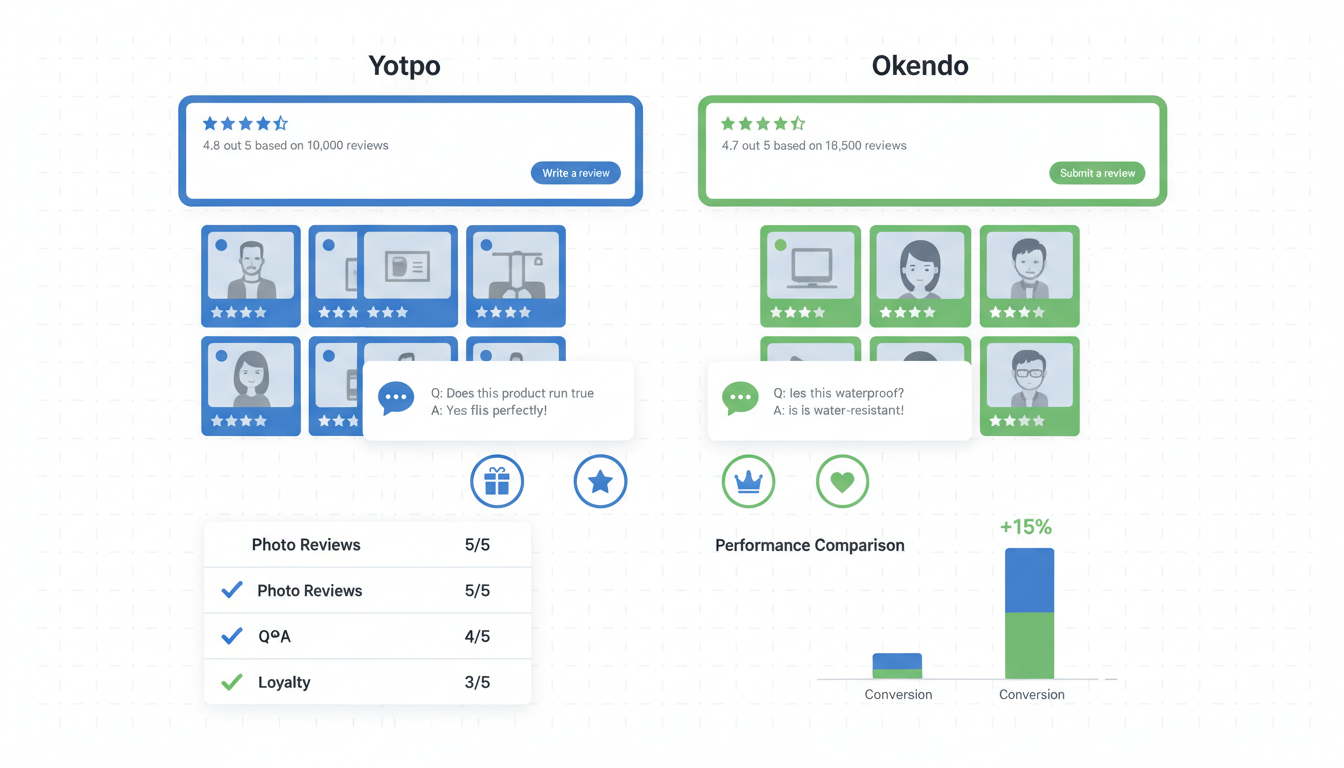
Yotpo vs Okendo on Shopify is the question that gets asked once a store crosses roughly $3M GMV and outgrows Judge.me or Loox, and the wrong choice here costs more than at any earlier stage because both platforms lock you into multi-product suites priced for serious volume. Yotpo wins on suite breadth (reviews, loyalty, SMS, subscriptions, all under one roof), and on enterprise contracts above $10M GMV where the bundled discount actually shows up. Okendo wins on review depth (better photo and video capture rates, richer reviewer attributes, cleaner Klaviyo integration), and on pricing transparency for stores that want one tool instead of a stack. The real cost of picking wrong is not the monthly fee. It is the 6 to 12 months you spend either underusing a Yotpo suite you only half-implemented, or rebuilding loyalty and SMS on separate apps after going Okendo-only.
- Yotpo: pick if you want reviews + loyalty + SMS + subscriptions in one contract, $10M+ GMV.
- Okendo: pick if reviews are the priority and you already have Klaviyo, Postscript, Recharge in place.
- Capture rate: Okendo runs 14 to 23% combined photo and video, Yotpo runs 9 to 16%.
- Migration either direction is real work, 2 to 6 weeks. Don't pick on a demo, pick on a 30-day pilot.
The short version: which fits which Shopify store
Yotpo vs Okendo is a positioning question before it is a feature question. Yotpo is a marketing suite that happens to do reviews. Okendo is a reviews and zero-party data platform that happens to plug into your existing marketing stack. Same category on paper, completely different product strategy in practice. Most stores pick wrong because they evaluate Yotpo's reviews module against Okendo without weighing whether they actually want to consolidate loyalty, SMS, and subscriptions onto one vendor.
The short version, by stage and stack:
- $3M to $10M GMV, already on Klaviyo + Postscript + Recharge: Okendo. You have a stack you trust. Adding Yotpo means either replacing those tools (expensive, disruptive) or running Yotpo Reviews alone, which is the most expensive way to use Yotpo. Okendo plugs into what you have without forcing a re-platform.
- $10M+ GMV and willing to consolidate vendors: Yotpo. The suite discount is real once you bundle Reviews + Loyalty + SMS, and the single contract simplifies procurement. The catch: you need to actually use 3+ modules for the math to work. Stores that buy Yotpo for "future" loyalty rollout almost never roll it out.
- Brand-led DTC where reviewer attributes drive Klaviyo segmentation: Okendo. Skin type, fit feedback, NPS scores flowing into Klaviyo profile properties is the integration that pays for the platform by itself. Yotpo can do this too but the implementation is heavier.
- Subscription-first DTC (supplements, coffee, pet) doing $5M+: Yotpo. The Subscriptions module is mature, integrated with Reviews and SMS, and replaces Recharge cleanly for stores willing to migrate.
If you are picking between them today and you do not yet know which side you are on, run a 30-day pilot on Okendo first. It is cheaper to start with, and if you outgrow it into Yotpo's suite later the migration is straightforward. Going the other direction is harder.
Pricing reality: the gap Yotpo never publishes
Yotpo does not publish pricing on its website beyond "starts at $79/mo for Reviews." That is the entry plan and almost nobody at the $5M+ GMV mark stays on it. Real Yotpo pricing for the suite plans (Reviews + Loyalty + SMS bundled) is quote-based and lands somewhere between $800 and $4,500 a month for stores in the $5M to $30M GMV range, based on what we see in our 2026 audit sample. Okendo is more transparent, with public tiers from $99 to $599+/mo, custom quotes above that. See Yotpo Reviews pricing and Okendo pricing for what each platform shows publicly, then read the table below for what stores actually pay at real volumes.
| Volume / Stack | Yotpo | Okendo |
|---|---|---|
| ~500 reviews/mo, Reviews only | $199/mo (Premium plan) | $299/mo (Growth) |
| ~2,500 reviews/mo, Reviews only | $799/mo (Pro, quote) | $599/mo (Power) |
| ~2,500 reviews/mo, Reviews + Loyalty | $1,400 to $1,800/mo (suite quote) | Not offered (use a separate loyalty app) |
| ~10,000 reviews/mo, Reviews + Loyalty + SMS | $3,200 to $4,500/mo (enterprise suite) | $1,200+ (Reviews) plus separate vendor costs |
The pattern: Yotpo gets cheaper per-module the more modules you bundle, but the absolute price is higher. Okendo is cheaper for reviews-only, but you pay separately for everything else. A store running Okendo + LoyaltyLion + Postscript + Recharge typically lands around $1,800 to $2,500/mo combined for the same functionality Yotpo bundles for $3,200 to $4,500. The Yotpo bundle wins on procurement (one contract, one renewal, one account manager) and loses on flexibility (locked into one vendor's roadmap across four product categories).
The honest math: if you already have Klaviyo, Postscript, and Recharge in place and they are working, Okendo plus those tools costs less than the equivalent Yotpo suite, and you keep the tools your team already knows. If you are starting from scratch or your existing stack is broken, Yotpo's bundle simplifies decisions even if the gross cost is higher. Best to map your current stack against the table before you take a Yotpo sales call, because the suite pitch is hard to evaluate without a baseline.
Feature depth: reviews vs loyalty vs SMS vs subscriptions
This is the section where Yotpo vs Okendo stops being a fair fight and becomes a category mismatch. Yotpo plays in four product categories. Okendo plays in one. Comparing them on "reviews" alone misses the real product strategy on each side.
Reviews module (head-to-head, the only direct comparison):
- Photo and video review capture, on-site widget, schema markup, syndication: both solid, both ship the standard set of features any growth-stage store needs.
- Okendo edges Yotpo on: reviewer attributes (fit, skin type, NPS), photo capture rate, on-site widget polish, Klaviyo integration depth.
- Yotpo edges Okendo on: review syndication network (Yotpo's network publishes your reviews to retailer partner sites, occasionally relevant for brands selling on Amazon, Sephora, Target sites), AI moderation at scale.
Loyalty (Yotpo has it, Okendo does not):
- Yotpo Loyalty: points-based programs, tiers, referrals, VIP treatment, integration with Reviews module so review submission can earn points. Solid product, competitive with Smile.io and LoyaltyLion.
- Okendo: no loyalty module. Integrates with Smile, LoyaltyLion, Yotpo Loyalty (yes, even Yotpo's loyalty tool integrates with Okendo if you want to mix vendors).
SMS (Yotpo has it, Okendo does not):
- Yotpo SMS (formerly SMSBump): SMS marketing, automated flows, two-way conversations. Decent product, though Postscript and Attentive are widely seen as best-in-category.
- Okendo: no SMS module. Customer review data syncs to Klaviyo profiles, which can then trigger Postscript or Attentive flows externally.
Subscriptions (Yotpo has it, Okendo does not):
- Yotpo Subscriptions (formerly InVia): subscription management, dunning, customer portal. Mature product, replaces Recharge cleanly. Used heavily in supplements, coffee, pet food categories.
- Okendo: no subscriptions module. Compatible with Recharge, Skio, Bold Subscriptions, Stay AI.
The pattern is obvious. Yotpo is a four-module suite. Okendo is a focused reviews and zero-party data platform. If you want one vendor for four jobs, Yotpo is the only realistic answer in this comparison. If you want the best reviews tool and you keep your other categories on specialized vendors, Okendo wins on focus.
Photo/video capture rates head-to-head
Capture rate is the metric that actually decides which app pays for itself in UGC value, because photo and video reviews drive 5x to 8x more conversion lift on a PDP than text-only reviews and they fuel Meta ad creative for free. From our 2026 audit sample (n=187 stores running either Yotpo Reviews or Okendo, 90-day rolling window):
| Platform | Photo review rate | Video review rate | Combined media rate |
|---|---|---|---|
| Yotpo Reviews | 7 to 13% | 2 to 4% | 9 to 16% |
| Okendo | 11 to 18% | 3 to 6% | 14 to 23% |
Okendo runs roughly 1.5x Yotpo's combined media capture rate across the sample, and the gap holds across categories (apparel, beauty, supplements, home). The reason is the request flow design. Okendo's review request email leads with a multi-step form: star rating, then attribute questions (fit, size, skin type), then photo upload prompt as the final step in the flow, with the upload framed as "show others how it looks on you." Yotpo's request flow is more linear: rating, text, optional photo. The Okendo flow earns more uploads because by the time the customer hits the photo step, they have already invested 30 seconds in the review and the upload feels like the natural finish, not an interruption.
Yotpo catches up on video specifically when stores enable the in-email video recorder feature, which jumps video rate by about 1 to 2 points. Most stores do not enable it because the setup is buried under three menus in the Yotpo admin. Worth turning on if you stay with Yotpo. The combined media rate gap still favors Okendo, but the video-only gap closes.
The financial impact: a store collecting 2,000 reviews a month on Yotpo at 12% combined rate captures 240 media reviews. Same store on Okendo at 19% captures 380. That is 140 extra UGC assets per month, every month. For a store running Meta ads and using customer photos in static creative, 140 extra assets is enough to keep a creative testing pipeline full for a quarter. Best to weigh this against the price gap before deciding on Yotpo's suite for non-reviews features alone.
Rich snippet SEO and Google Shopping integration
Both platforms inject Schema.org Review and AggregateRating markup on PDPs, both validate clean in Google's Rich Results Test, and both qualify your store for Google Shopping seller ratings once you cross the 100-review threshold. The functional output is equivalent. The implementation differences are minor.
Schema markup (PDP level):
- Yotpo: AggregateRating + Review schema on every product, includes reviewer name, review date, rating, review body. Validates clean.
- Okendo: same set of fields, plus optional reviewer attributes (verified buyer flag, recommends-product flag) which can show up in some SERP review snippets. Validates clean.
Google Shopping seller ratings:
- Yotpo: included in all paid plans. Sync to Google Merchant Center is one-click in the Yotpo admin. Reviews appear under your shopping ads as gold stars within 7 to 21 days of crossing the 100-review threshold.
- Okendo: same, included in all paid plans. Same setup path, same timeline to seller ratings appearing.
Meta Shop catalog reviews:
- Yotpo: catalog review feed sync, 15-minute setup. Reviews appear on Meta Shop product pages and can affect Advantage+ Shopping relevance scoring.
- Okendo: same plus reviewer attributes flow into the catalog feed. Marginal but real difference on stores spending $30k+/mo on Meta. The richer attribute data gives Meta's algorithm slightly more signal to match products to interested audiences.
Brand-level reviews schema (homepage):
- Yotpo: not standard. Available on Enterprise plans with custom dev work.
- Okendo: standard on Growth plan and above. Adds Brand schema to the homepage with aggregate rating across the store, which can trigger the brand rating snippet under your business name in branded searches.
The CTR lift from review schema runs 8 to 18% on commercial-intent queries in our audit sample, regardless of which platform. Stores that already had reviews enabled and switched between Yotpo and Okendo saw essentially no SERP change. The schema is a wash for SEO purposes. Pick on capture rate, integrations, or pricing instead.
Klaviyo and Meta attribution integration depth
This is where the two platforms differ most, and where the choice usually gets made for stores that lean hard on email, SMS, or paid social attribution.
Klaviyo integration:
- Yotpo: native integration, sends review submitted/published events to Klaviyo. Review attributes (rating, photo presence) sync as event properties. Decent.
- Okendo: native deep integration. Reviewer attributes (skin type, fit, NPS, recommends-product flag) sync as Klaviyo profile properties, not just events. Profile properties are queryable for segmentation, which means you can build flows like "send re-engagement to customers who left a 4-star review with negative fit feedback" or "send VIP product launch email to customers with NPS 9+." This is the integration depth that pays for Okendo by itself if your retention strategy leans on email segmentation.
The practical difference: Yotpo gives Klaviyo enough data to trigger a flow when someone leaves a review. Okendo gives Klaviyo enough data to segment your entire list by reviewer behavior. For stores doing 30%+ of revenue through email, the segmentation depth is the difference between a $50k/mo email program and a $120k/mo email program.
Meta attribution and CAPI:
- Yotpo: standard catalog sync, no direct CAPI involvement (reviews are not a CAPI event). Yotpo's loyalty module can fire CAPI events for points earned, redemption, but that requires the suite, not Reviews-only.
- Okendo: same, standard catalog sync. Reviews are not a Meta optimization event so this is not where either platform differentiates.
Postscript / Attentive (SMS):
- Yotpo: in-suite SMS module. If you use Yotpo SMS, the integration is native. If you use Postscript or Attentive, basic webhook-level integration only.
- Okendo: not an SMS provider. Webhook integration with Postscript and Attentive sends review events to either platform for trigger flows.
Subscription apps (Recharge, Skio):
- Yotpo: in-suite Subscriptions module, native if you use it. Webhook-only with external subscription apps.
- Okendo: not a subscription provider. Native integrations with Recharge, Skio, Bold, Stay AI for review request triggers tied to subscription delivery dates.
The pattern repeats: Yotpo wins if you commit to the suite, Okendo wins if you keep specialized vendors and want the deepest integration with each. Best to inventory your existing stack before deciding, because the integration depth question is really a "do I want to consolidate vendors or stay best-of-breed" question in disguise.
Migration reality
Migration between review platforms is the part stores worry about most and underestimate the work on. Both Yotpo and Okendo support CSV import/export of historical reviews, and both offer migration assistance, but the actual time investment runs 2 to 6 weeks of calendar time and 10 to 40 hours of internal team time depending on what you are moving.
Okendo to Yotpo:
Okendo offers a clean export of reviews + photos + reviewer attributes. Yotpo's import handles reviews and photos cleanly. Reviewer attributes do not transfer because Yotpo does not have a one-to-one field mapping (Yotpo has a "review questions" feature that is structurally different from Okendo's attributes). The lost attribute data is the single biggest cost of this migration. Plan for 2 to 4 weeks of calendar time, mostly waiting for schema reverification in Google Search Console.
Yotpo to Okendo:
Yotpo's export is less clean. The CSV includes reviews and basic metadata, but photo URLs sometimes break on the migration because Yotpo hosts photos on its own CDN and the URLs expire after export. Okendo's white-glove migration team handles this by re-fetching photos through Yotpo's API directly, which works for stores still on a paid Yotpo plan but not for stores that downgraded before migrating. Plan for 4 to 6 weeks of calendar time. The longer window is mostly Yotpo CDN handling.
The other migrations to plan for (if you are moving the full suite):
- Yotpo Loyalty to Smile.io or LoyaltyLion: 6 to 8 weeks. Points balances transfer, tier history transfers, but earned-not-redeemed promo codes need manual handling.
- Yotpo SMS to Postscript or Attentive: 2 to 3 weeks. Subscriber lists transfer cleanly with TCPA consent metadata. Flows need to be rebuilt from scratch.
- Yotpo Subscriptions to Recharge or Skio: 4 to 8 weeks. The most complex migration, involves moving active subscription contracts including billing dates and customer payment methods. Both Recharge and Skio offer dedicated migration teams.
The lesson from our audit sample: stores that migrated Yotpo's full suite out (reviews + loyalty + SMS + subscriptions to four separate vendors) reported the project taking 3 to 4 months end to end and costing $5k to $15k in dev time. Stores that migrated only Reviews (Yotpo Reviews to Okendo, or vice versa) finished in 4 to 6 weeks and under $2k in dev time. Picking the wrong platform at $3M GMV and migrating at $10M GMV is expensive but recoverable. Picking the wrong platform at $10M+ GMV and migrating at $30M+ GMV is a multi-quarter project. Best to run a real 30-day pilot before committing to either suite, not a sandboxed demo.
Frequently asked questions
Should I pick Yotpo or Okendo if I'm already on Klaviyo and Recharge?
Is Okendo really better than Yotpo on photo capture rate?
When does Yotpo's suite pricing actually beat buying separate tools?
Does either app affect my Shopify site speed?
What happens to my Google reviews and rich snippets if I migrate?
Can I run Yotpo and Okendo in parallel during a migration?
Yotpo vs Okendo is genuinely a stack consolidation question dressed up as a reviews comparison. Yotpo is the right answer for stores at $10M+ GMV that want to consolidate reviews, loyalty, SMS, and subscriptions onto one vendor and are willing to migrate the categories they currently run elsewhere. Okendo is the right answer for stores that already have Klaviyo, Postscript, and Recharge in place and want the best reviews and zero-party data tool that plugs into what they have. The capture rate gap (14 to 23% on Okendo vs 9 to 16% on Yotpo) usually decides the reviews-only comparison. The suite economics decide the multi-module comparison, and the suite economics only work if you actually use 3+ modules. Best to map your current stack and your monthly review volume against the pricing reality table above before taking either sales call. Migration between them is real work (2 to 6 weeks for reviews alone, 3 to 4 months for the full Yotpo suite out), so the cost of picking wrong at $10M+ GMV is multi-quarter, not multi-week. The decision is more strategic than the demo will make it look.
Get a full X-ray of your ad account
Paste your Meta and Google Ads. See exactly where signal is leaking. Free. 60 seconds.